Gym Friendly Jewelry: What to Wear and What to Leave
The safest jewelry for a workout is none at all. If you want to keep something on, choose a small, smooth, snug piece in a metal that does not corrode, such as stainless steel, titanium, platinum or solid gold. Skip anything long, dangling, loose or set with prominent stones.
This guide covers how to pick jewelry for working out, which materials handle sweat, which styles are safe for each type of training, and when to take it off.
TL;DR
- Take jewelry off for weight training and equipment work. Low-profile pieces are the next best choice if you keep something on.
- Pick stainless steel, titanium, platinum or solid gold over brass, copper or plated pieces.
- Choose small studs, a short necklace tucked under your shirt, or a smooth snug band. Avoid long chains, big hoops and stacks.
- Itching, redness or blisters under a piece may be contact dermatitis, not tarnish. Remove it and see a doctor if symptoms last.
- A watch is the exception to “leave it at home” for many people. Choose one with a smooth case and a secure strap or bracelet.
Table of Contents
- Is it okay to wear jewelry to the gym?
- When to take it off completely
- What counts as gym friendly jewelry
- Which metals handle sweat
- Tarnish or a skin reaction?
- Our view on jewelry and training
- Choosing by workout
- Care after a workout
- A short, sensible set
- Wear it from gym to street
- Gift ideas for people who love the gym
- FAQ
- Sources
Is it okay to wear jewelry to the gym?
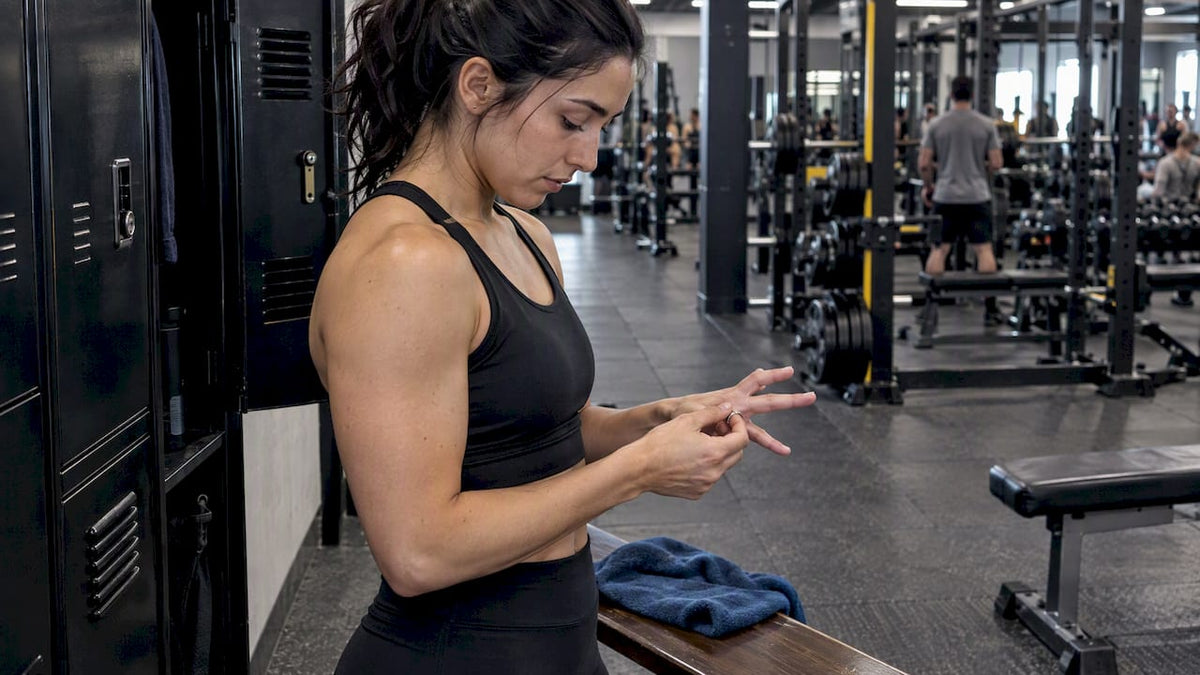
You can, but you carry more risk than someone who does not. Jewelry catches, pulls and scratches. That matters most when you handle barbells, cables, machines, ropes or other people.
The pattern shows up in the rules facilities write for themselves. A Cobb County, Georgia gymnastics center bans necklaces, chokers, bracelets, anklets, rings, dangling earrings and hoops during class. It allows small studs and gives a safety hazard as the reason. Your gym may not be that strict, but the logic applies on any floor.
Expert and editorial advice agrees on the same point. Women’s Health covers sweat-proof pieces, and its guidance is that “gym friendly” is not the same as risk-free. Three things decide how safe a piece is:
- How close it sits to your body.
- Whether it can catch on equipment, clothing or hair.
- Whether the metal and finish tolerate sweat.
A minimalist piece beats a statement piece on all three. Removing it beats both.
When to take it off completely
Some workouts leave no good reason to keep jewelry on. Take it off for:
- Barbell and dumbbell work. Rings pinch against the bar and a loose bracelet slides into your grip.
- Cable machines, pull-ups and rowing. Chains and bracelets can snag on handles, bars and moving parts.
- Partner work, boxing, martial arts and group classes. Another person’s hand or glove can catch a necklace or hoop.
- Yoga floor work and Pilates. A pendant swings into your face in inversions and presses into your sternum on the mat.
- Anything involving your hair. Long hair plus a fine chain is a common tangle.
Leave valuable pieces in a locker only if the locker is secure. A zipped pocket in your own bag is often safer, and a small pouch keeps chains from knotting.
What counts as gym friendly jewelry
If you keep something on, use this checklist.
- Low profile. Nothing should stick out more than a few millimeters from your skin.
- Smooth. No prongs, sharp edges or textured links that grab fabric.
- Secure. Snug fit, locking clasps, screw-back or flat-back earrings.
- Short. A necklace that fits close to the neck can tuck under a shirt. A long chain cannot.
- Few pieces. Stacks rub against each other and trap sweat.
- Metal that holds up. More on this below.
Styles that work
| Piece | Gym friendly choice | Avoid |
|---|---|---|
| Earrings | Small studs, snug huggies | Dangling drops, large hoops |
| Necklace | Short chain, tucked under clothing | Long chains, loose pendants that swing |
| Ring | Smooth, low-profile, snug band | Raised settings, prominent stones |
| Bracelet | Smooth snug band, or skip it | Loose bangles, charm bracelets |
| Watch | Smooth case, secure strap or bracelet | Oversized or sharp-edged cases |
The research behind this list is the same as the facility rule above: small studs are the one earring style most places allow, and everything that dangles is out.
Which metals handle sweat
Sweat is salty and slightly acidic, and it sits against your skin under friction. Metals that corrode or wear through a thin coating show it first.
For workout pieces, put these first: stainless steel, titanium, platinum or solid gold. Put brass, copper and plated jewelry last. Women’s Health’s expert guidance names stainless steel, properly cared-for sterling silver and solid gold as non-corroding options.
GIA’s ring material comparison adds useful trade-offs. It describes titanium as very light, affordable and low on upkeep, and platinum as durable and hypoallergenic but heavier and more expensive. It also tells you to weigh durability, upkeep, comfort, skin sensitivity and budget together, not appearance alone.
| Material | Sweat | Weight | Upkeep | Watch for |
|---|---|---|---|---|
| Stainless steel | Does not corrode | Solid, mid-weight | Low | Check the grade if you have a nickel allergy |
| Titanium | Handles it well | Very light | Low | Fewer styles and colors |
| Platinum | Durable | Heavier | Low | Cost |
| Solid gold | Survives sweat | Varies | Scratches over time | Soft in high karats |
| Plated pieces | Coating can wear | Light | High | Wear-through under friction and cleaning |
| Brass and copper | Can corrode | Varies | High | Skin discoloration |
Stones need extra caution. Repeated sweat, friction and cleaning can affect settings, so prominent stones are a poor fit for training.
Stainless steel or titanium?
Both are sound choices. Titanium wins on weight. Stainless steel wins on range of finishes, color options and the sturdier feel many people like. If you want to compare them in detail, see our guide to stainless steel vs titanium jewelry. If you wonder how steel looks after months of wear, read does stainless steel tarnish.

What about silver?
Sterling silver can work if you care for it, but it needs more attention than steel. We compare the two in stainless steel vs silver jewelry.
Tarnish or a skin reaction?
These are different problems. Tarnish is a surface change on the metal. A reaction is something your skin does.
Harvard Health says allergic contact dermatitis can appear around metal jewelry, with redness, blistering and severe itching. Nickel in a necklace or bracelet is one of the listed triggers. Sweat, friction, soap and trapped moisture can add to the irritation during a workout, even when a piece looks clean.
If your skin turns itchy, red, blistered or inflamed under a piece:
- Take it off.
- Do not simply polish it and put it back on.
- See a doctor or dermatologist if symptoms persist or are severe.
“Hypoallergenic” is not a full specification. Look at the actual metal and grade. Our guides on nickel free jewelry, posts and clasps, and hypoallergenic stainless steel jewelry explain what to check on the product page.
Our view on jewelry and training
We design stainless steel watches and jewelry inspired by Miami, and we hear the same question often: can I wear this to the gym?
Our answer is split. Material is only half of it. Stainless steel is a sensible choice for sweat, and our pieces are made with premium materials and water resistance in mind. But shape decides what happens when you grab a bar. A smooth, close-fitting piece is a better gym companion than anything that swings.
That is why we think of gym wear in two groups:
- Pieces that stay on all day. A watch with a smooth case is the most natural. You can check time and intervals without carrying a phone. Check the water resistance details on the product page before you rely on it near water or in a steam room.
- Pieces for before and after. A pendant or charm is better worn on the way in and out. Our charms are designed as statement pieces with painted color, and that is a reason to take them off during a lift, not a reason to wear them under a bar.
We also do not tell anyone to wear jewelry on a heavy lifting day. Taking it off is still the lowest-risk option, and a good piece will be fine waiting in your bag.
— Mathias
Choosing by workout
Running and cardio
Keep it small. Studs, a snug band and a watch are enough. A necklace bounces on a run, so tuck a short chain under your shirt or leave it off. Salt builds up on long, hot runs, so rinse off pieces afterward.

Weight training
Take rings, bracelets and necklaces off. If you must keep one thing on, make it a small stud or a smooth watch worn snugly above the wrist bone. Rings can crush a finger against a plate or bar, and sweat makes them slide.
Yoga, Pilates and stretching
No pendants, no bracelets that dig into the mat. Small studs are fine. A pendant swings into your face during inversions.
Swimming and ocean workouts
Water adds chlorine and salt to the sweat. If you swim in the sea, see stainless steel jewelry for the ocean for what steel can and cannot take.
Training on the road
If you pack for a trip and want one set to work at the gym and at dinner, keep it to a few smooth pieces. Our guide to travel-safe jewelry explains what to look for.
Care after a workout
A few habits keep any piece looking right.
- Wipe it with a soft cloth after training. Trapped sweat is the main irritant.
- Rinse it in plain water if you worked hard, then dry it fully.
- Do not store it damp in a gym bag. Use a dry pouch.
- Take it off before showers with strong soaps if you can, because soap residue adds to irritation.
- Check clasps and earring backs now and then. A loose piece is the one that gets lost.
If you want a view on which finishes resist wear longest, our list of waterproof anti-tarnish jewelry alternatives is a good start.
A short, sensible set
If you want one small set that works in and out of the gym, build it from these:
- A stainless steel watch with a smooth case.
- Small studs or snug huggies.
- One short pendant to wear after the workout, not during.
For men starting from scratch, our guide to minimalist jewelry for men in stainless steel lays out a three-piece starting point. If your skin is sensitive, read our guide to hypoallergenic jewelry brands for sensitive skin before you buy.
Wear it from gym to street
We make stainless steel watches and jewelry that look at home outside the gym too. Browse our Miami inspired watches for a piece you can wear all day, or see the palm tree charms for a pendant to put on after training. The silver classic palm tree charm is our minimal option.
If you run a gym, studio, hotel or brand and want a custom watch for your team or members, see our corporate custom watches. We offer logo engraving, dial customization, packaging customization and bulk ordering.

Gift ideas for people who love the gym
Buying for someone who trains? Pick something they can wear without thinking about it.
- A stainless steel watch. It is practical and it works outside the gym.
- A pendant for after training. It gives them something to wear when the workout is done.
- A branded watch for a team or club. A custom piece works as a corporate gift or member reward.
Avoid long chains, big hoops and anything with prominent stones, because they are the pieces that get left in a drawer.
FAQ
What is the best jewelry to wear while working out?
Choose small, smooth, snug pieces in stainless steel, titanium, platinum or solid gold. Small studs, a short necklace tucked under your shirt and a smooth band are the safest choices. Avoid long chains, dangling or large hoops, loose bracelets, stacking and prominent stones.
Can I wear a ring to lift weights?
The safest answer is to take it off. If you keep one on, pick a smooth, low-profile band that fits securely, as GIA’s guidance on ring choice stresses comfort and durability. Sweat can loosen the fit, and a ring can pinch or catch on a bar or handle.
Is stainless steel jewelry safe to sweat in?
Stainless steel is one of the metals experts name as non-corroding, so sweat does not damage it the way it can damage plated pieces. If you have sensitive skin, check the grade and the nickel content. If your skin gets itchy, red or blistered, stop wearing it and see a doctor.
What should I do if jewelry makes my skin itch after a workout?
Take it off first. Itching, redness or blisters can point to contact dermatitis, which is different from tarnish, according to Harvard Health. If symptoms continue or get severe, see a doctor or dermatologist.
Sources
- Cobb County Gymnastics Center, Cobb County Georgia
- The best sweatproof jewellery, Women’s Health UK
- Best Ring Material for Everyday Wear, GIA 4Cs
- Contact Dermatitis, Harvard Health