Article: PVD vs. DLC: Which Watch Coating Lasts Longer?
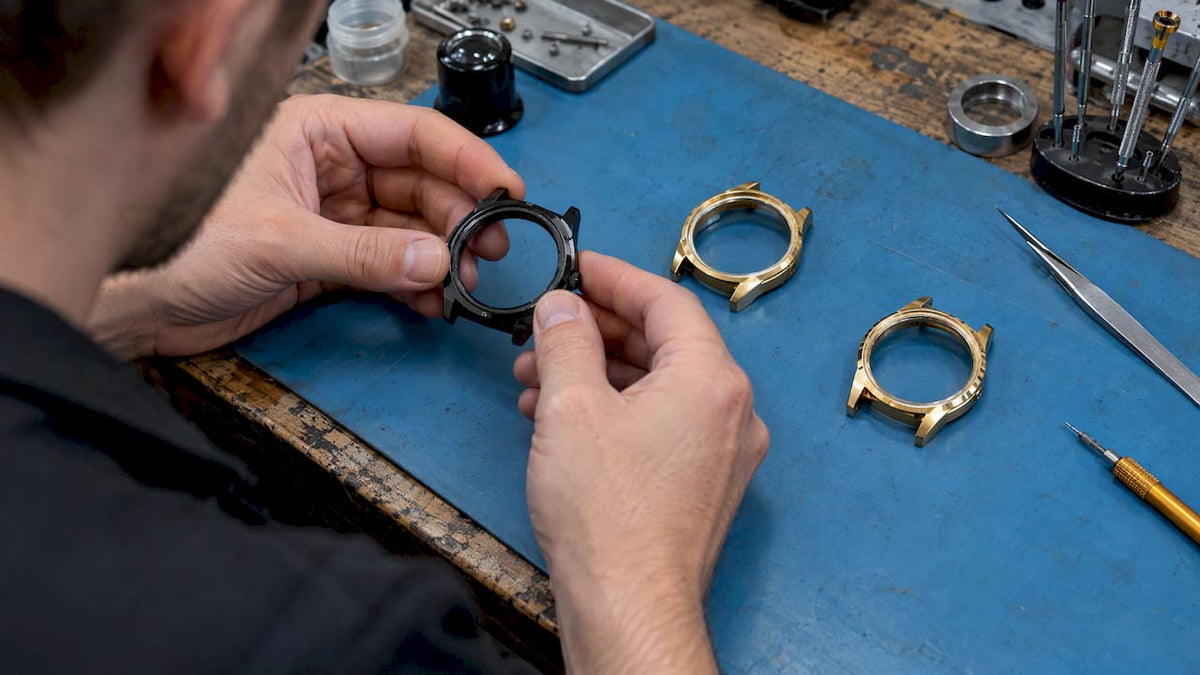
PVD vs. DLC: Which Watch Coating Lasts Longer?
DLC is usually harder and more scratch resistant than standard PVD. PVD gives you more colors and costs less. They are also not strict opposites. DLC is a type of thin film, and it is often applied with PVD methods. So the real choice is between a metallic nitride PVD coating, which suits color, and a carbon-based DLC coating, which suits hardness and a deep black finish.
This guide explains the difference in plain terms. You will see the numbers, the trade-offs and what each coating means for a stainless steel watch you wear every day.
TL;DR
- PVD is a coating process. DLC (diamond-like carbon) is one kind of coating, and it is often applied by PVD.
- DLC is typically harder (2,000 to 8,000 HV) than nitride PVD (1,500 to 3,500 HV) and has lower friction.
- Nitride PVD offers more colors, such as gold, bronze, black and silver, and is usually the more budget-friendly choice.
- Neither coating is scratch-proof. Hard impacts and a poorly polished base metal cause most failures.
- Pick DLC for a dark, hard-wearing case. Pick PVD when color matters most.
Table of Contents
- What PVD means
- What DLC means
- Process versus result
- PVD vs. DLC: side-by-side
- Which one is harder to scratch?
- Why the base metal matters as much as the coating
- How long does a PVD or DLC finish last?
- Why a watchmaker might still choose PVD
- Disadvantages to know about
- Coatings in other gear
- Our view
- How to choose
- Shop stainless steel watches inspired by Miami
- FAQ
- Sources
What PVD means
PVD stands for Physical Vapor Deposition. It is a vacuum process. A solid material is turned into vapor and condenses on the part as a very thin, even layer. Thermilyon Group describes PVD as a vacuum deposition that applies a metallic or ceramic layer to a part.
In watchmaking, the layers are often nitrides, such as titanium nitride (TiN) or chromium nitride (CrN). Different materials give different colors. Oerlikon Balzers notes that PVD technology can produce many decorative color coatings, from gold and bronze to black and silver.
PVD is also used to apply real gold. A WatchProSite technical article explains that PVD condenses the metal from vapor in a vacuum. Traditional galvanic plating works differently. Gold PVD is a different thing from a thin dip of gold.

What DLC means
DLC stands for diamond-like carbon. It is an amorphous carbon film. It is not a crystal diamond, but it has some of the same traits: high hardness and a slick surface.
VaporTech explains that DLC is applied through either a physical or a plasma-enhanced chemical vapor deposition process. These are called PVD and PE-CVD. That is why you see DLC listed as a subset of PVD in some places and as its own category in others. Both statements hold, depending on how the film is made.
The finish is a deep black or dark grey. Ionbond describes its Diamondblack ADLC as a carbon-based coating developed for luxury and fashion goods, with notable hardness, scratch resistance and a black metallic look.
Process versus result
This is where most confusion starts. People ask “PVD or DLC?” as if they were two products on a shelf. In practice:
- PVD names how a coating is applied.
- DLC names what the coating is made of.
- A DLC coating may be applied by PVD. A TiN gold coating is also applied by PVD.
So when a brand says “PVD black” and another says “DLC black,” ask what is actually in the layer. A black nitride and a black carbon film can look close and wear differently.
PVD vs. DLC: side-by-side
The figures below are typical ranges from Oerlikon Balzers. Exact values depend on the specific coating, the supplier and the process.
| Property | Nitride PVD (TiN, CrN and similar) | DLC |
|---|---|---|
| Typical hardness | 1,500 to 3,500 HV | 2,000 to 8,000 HV (ta-C variants at the top) |
| Friction coefficient | 0.3 to 0.6 | 0.08 to 0.2 |
| Color range | Wide: gold, bronze, black, silver | Deep black or dark grey |
| Cost | Generally lower | Generally higher |
| Best fit | Decorative cases where color matters | Hard-wearing, sliding-contact or dark finishes |
Two takeaways. First, the ranges overlap. A strong nitride can be harder than a soft DLC. Second, DLC is clearly ahead on friction. That matters more for moving parts than for a case.
Which one is harder to scratch?
DLC, in most cases. It is the safer pick if you want a dark case that keeps its look. Forum threads and reviews agree, and so do the numbers above.
Hardness is not the full story, though. Watchmakers stress that coatings are scratch resistant, not scratch-proof. An impact against a harder material, such as a ceramic door frame or a diamond-tipped tool, can mark or chip the coating whatever its type.
Our own guide on scratch-resistant watch materials compares sapphire, DLC and steel in more detail, if you want to see where coatings sit among the other options.
Why the base metal matters as much as the coating
A coating is only a few microns of film on top of a metal. It copies whatever is underneath.
Practitioners at Blaken point out that the case must be perfectly polished before coating. If the stainless steel has flaws, the coating highlights them, and it can look as if the coating is failing when the surface was never right.
This changes how you should judge a watch:
- Look at the finish quality of the bare areas, such as the case back and the clasp.
- Ask what steel is under the coating. We cover this in our guide to 316L stainless steel watches.
- Treat a very low price on a “DLC” watch with caution. A thin or poorly prepared layer is hard to see in photos.
How long does a PVD or DLC finish last?
There is no honest single number. Wear depends on layer thickness, prep, color and how you live.
A few patterns hold across sources:
- Active wear, such as desk edges, bag zippers and door frames, wears coatings first at the edges of the case and the bracelet links.
- Bracelets wear faster than cases, because links rub against each other and against the case.
- Gold-colored PVD can show wear sooner on high-contact edges, because the steel underneath is a different color.
- Black DLC hides wear better at first, but a deep scratch on a dark finish shows bright steel.
The forum posts that rank for this query say DLC wears much longer than PVD. That is reasonable on hardness alone, but treat any claim like “lasts forever” as marketing. A coating is thin and can be damaged.
Why a watchmaker might still choose PVD
A common question on watch forums is why a brand would pick PVD when DLC is harder. The answer is application.
Oerlikon Balzers says the biggest misconception is that one technology is always superior. Their advice is to choose DLC when friction reduction and extreme hardness are the priority. Choose metallic or ceramic PVD when color range and cost efficiency drive the design.

Blaken makes a similar point: DLC fits precision and sliding-contact parts, such as escape wheels, because it is self-lubricating and very hard. Nitride PVD fits decorative cases that need color and useful scratch resistance at a sensible price.
For a colorful case, DLC is not an option at all. If you want a gold, rose or bronze tone, a nitride PVD is the route.
Disadvantages to know about
PVD
- Lower hardness on average than DLC.
- Colored finishes can show wear at edges over time.
- Coating quality varies by supplier.
DLC
- Mostly limited to black and dark grey.
- Usually costs more.
- Post-treatment and adhesion steps matter. A poor process means a weaker bond.
- Chips and deep scratches show bright metal against the dark finish.
Coatings in other gear
Coatings are not only for watches. Sunglasses and goggles use their own layered treatments for glare and scratches, and the trade-offs there are a useful parallel. If you are curious how eyewear coatings differ, this guide to polarized lenses versus anti-reflective coatings explains it for lenses.
Our view
We design stainless steel watches and jewelry inspired by places such as Wynwood, Miami Beach, Key West and the Everglades. Color is a big part of that. So we think about coatings as a design question first, not a contest.
Here is how we see it:
- Hardness is useful, but it is not the only reason a watch ages well.
- The steel underneath and the polish before coating decide a lot.
- A finish should match how you live. A beach and travel watch meets salt, sand and bags. Rinse it and care for it.
- No coating is scratch-proof, and we would rather say so than promise otherwise.
For the care side, see our notes on saltwater watch care and stainless steel watch care. For a related finish question, our article on ion plating versus PVD covers what buyers should know.
— Mathias
How to choose
Use this short checklist.
- Decide on color. Want gold, bronze or a bright tone? Choose PVD. Want black? Both work, and DLC is harder.
- Think about daily wear. Desk work, bags and gym use favor harder coatings and a well-prepped case.
- Check the base. Ask for the steel grade. 316L is a common choice for watches. See our comparison of 316L and 304 steel.
- Ask for specifics. The coating type, the process and the supplier tell you more than “PVD” or “DLC” alone.
- Plan care. Rinse after salt water, wipe with a soft cloth and keep the watch away from hard edges.
Do not forget the crystal. The glass often shows damage before the coating does. Our guide to watch crystal types explains the options.
Shop stainless steel watches inspired by Miami
If you want a stainless steel automatic watch with a Miami color story, browse our Miami inspired watches. You can also look at the Everglades Green automatic watch or the Sunset Orange automatic watch. Check each product page for its specifications.
Buying for a team, hotel or brand? We make custom branded watches with logo engraving, dial customization and packaging customization.
FAQ
What is better, DLC or PVD?
DLC is typically harder and has lower friction, so it suits a hard-wearing black finish. PVD offers more colors and usually costs less. Neither is better in every case. The right pick depends on the color you want and how you wear the watch.
Is PVD the same as DLC?
No. PVD is a vacuum coating process. DLC is a carbon-based coating that is often applied with PVD or a related process called PE-CVD. So a DLC coating can come from a PVD process, but a PVD coating is not always DLC.
What are the disadvantages of PVD coating?
Nitride PVD is usually less hard than DLC, and colored finishes can wear at edges and bracelet links. Quality also depends on the supplier and on how well the case was polished first. A poor base shows through any coating.
How long will gold PVD last?
No source gives one fixed lifespan. It depends on layer thickness, prep and daily wear, and high-contact edges tend to show wear first. Careful use, rinsing after salt water and avoiding hard knocks help the finish last longer.
Sources
- Decorative coatings for watches, Oerlikon Balzers
- DLC Coating for Luxury Watches, Blaken
- Diamondblack ADLC, Ionbond
- DLC Coating for Watches, VaporTech
- PVD and DLC coatings: what are the differences and what uses?, Thermilyon Group
- Gold PVD, a Scam? Part II, WatchProSite