Sapphire 9 Mohs, DLC 1,200 HV: Scratch Resistant Watch Materials
Sapphire crystal, at roughly 9 on the Mohs scale, remains the toughest crystal you can put on a watch face. For the case itself, technical ceramic and DLC-hardened steel lead the field, with quality coatings pushing surface hardness past 1,200 HV. The catch: the harder the material, the more it tends to chip rather than scratch under a hard knock, so the “best” choice depends on how you actually wear your watch.
TL;DR:
- Sapphire crystal offers the best scratch resistance but cannot be polished if scratched and requires diamond-tipped tools for repair.
- Ceramic cases provide very high scratch resistance but are more brittle and prone to chipping upon hard impacts.
- Steel cases around 150 to 220 HV are easy to polish and repair, making them suitable for daily wear, unlike high-hardness materials that tend to chip.
- DLC and PVD coatings improve scratch resistance but vary widely in actual durability, with quality depending on proper application and HV rating.
- For active lifestyles, prioritize crystal hardness and choose case materials that balance impact resistance with repairability, such as stainless steel or titanium.
Table of Contents
- Scratch resistant watch materials: what the crystal numbers actually mean
- Case materials compared: steel, titanium, ceramic, and precious metals
- Do coatings like DLC and PVD actually protect your watch?
- The trade-off nobody tells you: hardness versus brittleness
- How to choose the right material, crystal, and finish combo
- Notes from Wynwoodblvd on caring for your watch
- The real lesson buried in the hardness numbers
- Built for daily wear: three Wynwoodblvd picks worth a look
- Where these numbers come from
- Sources
Scratch resistant watch materials: what the crystal numbers actually mean
The crystal is the part of your watch that takes the most abuse, and its hardness rating tells you almost everything you need to know before you buy.
Sapphire crystal sits at about 9 on the Mohs hardness scale, a system that ranks materials by how easily one substance scratches another. That places sapphire just below diamond and well above nearly everything you encounter day to day, including sand, keys, and most countertop surfaces. Mineral glass measures around 5 to 6 Mohs, and acrylic (sometimes called Hesalite) sits near 3. That gap explains why a $50 watch with a mineral crystal picks up hairline scratches within a year, while a sapphire crystal on a $500 watch can go a decade without one.
Hardness by the numbers: Sapphire ≈ 9 Mohs. Mineral glass ≈ 5 to 6 Mohs. Acrylic ≈ 3 Mohs. Each step up means the material resists scratches from progressively harder substances.
There’s a trade-off, though. Sapphire’s hardness makes it nearly impossible to polish out a scratch. Cutting or repairing it requires diamond-tipped tools, which is why a scratched sapphire crystal is almost always replaced rather than restored. Acrylic, by contrast, scratches easily but polishes back to clarity with basic buffing compound, which is why some collectors still prefer it on vintage-style pieces. Modern chemically strengthened glass, the same family as Gorilla Glass used in smartwatches, splits the difference: harder than standard mineral glass, more shatter-resistant than sapphire, and far cheaper to produce.
- Sapphire: Nearly scratch-proof, expensive, must be replaced (not polished) if damaged.
- Mineral glass: Moderate resistance, affordable, can be polished for light marks.
- Acrylic: Scratches easily, polishes back to new, best impact absorption.
- Chemically strengthened glass: Good middle ground for active use, common on smartwatches.
For a deeper comparison of what fits your wrist, sapphire vs. mineral glass breaks down which crystal suits which lifestyle.
Case materials compared: steel, titanium, ceramic, and precious metals
The crystal protects the dial, but the case takes the daily wear from desks, doorframes, and car keys in your pocket.
316L stainless steel, the standard in most quality watches, measures around 150 to 220 HV on the Vickers scale, a hardness test that measures how much force a diamond-tipped indented needs to leave a mark. That’s soft enough to scratch with regular use but hard enough to hold its shape for decades, and critically, it polishes out well. A jeweler or even careful home buffing can erase years of light surface marks, which is part of why steel remains the default choice for daily wearers.
Grade 5 titanium can be harder depending on the alloy used and is lighter and more corrosion resistant than steel, though it may show fine scratches more easily due to its finish. Technical ceramic usually offers very high scratch resistance with hardness values often exceeding 1,000 HV, but it is more brittle than metals and can chip upon hard impacts rather than denting.
- 316L stainless steel: ~150 to 220 HV, polishable, corrosion-resistant, the most repairable option.
- Grade 5 titanium: Lightweight, hypoallergenic, corrosion-resistant, but shows fine marks easily.
- Technical ceramic: Very high scratch resistance, but brittle and prone to chip damage on impact.
- Gold and bronze: Soft, easily marked, valued for patina rather than resistance.
Finish matters as much as material. A brushed or matte case hides the same scratch that would stand out sharply on a mirror-polished one, since the light scatters differently across a textured surface. For more on how steel specifically holds up over years of wear, WYNWOOD BLVD’s guide to 316L stainless steel covers the corrosion and polishing details in full.
Do coatings like DLC and PVD actually protect your watch?
Not all coatings are equal, and the marketing language on a spec sheet often blurs decorative treatments with genuinely structural ones.
PVD (physical vapor deposition) and IP (ion plating) are umbrella terms for thin-film coatings applied in a vacuum chamber. Standard decorative PVD typically lands in the 400 to 900 HV range, which adds some scratch resistance and color stability but won’t survive heavy daily abuse. DLC (diamond-like carbon), specifically the a-C:H and ta-C variants, is a different category entirely. A properly applied DLC coating commonly starts around 1,200 HV, and higher grades reach several thousand HV, which is why watchmakers marketing DLC cases often call the finish nearly permanent under normal office wear.
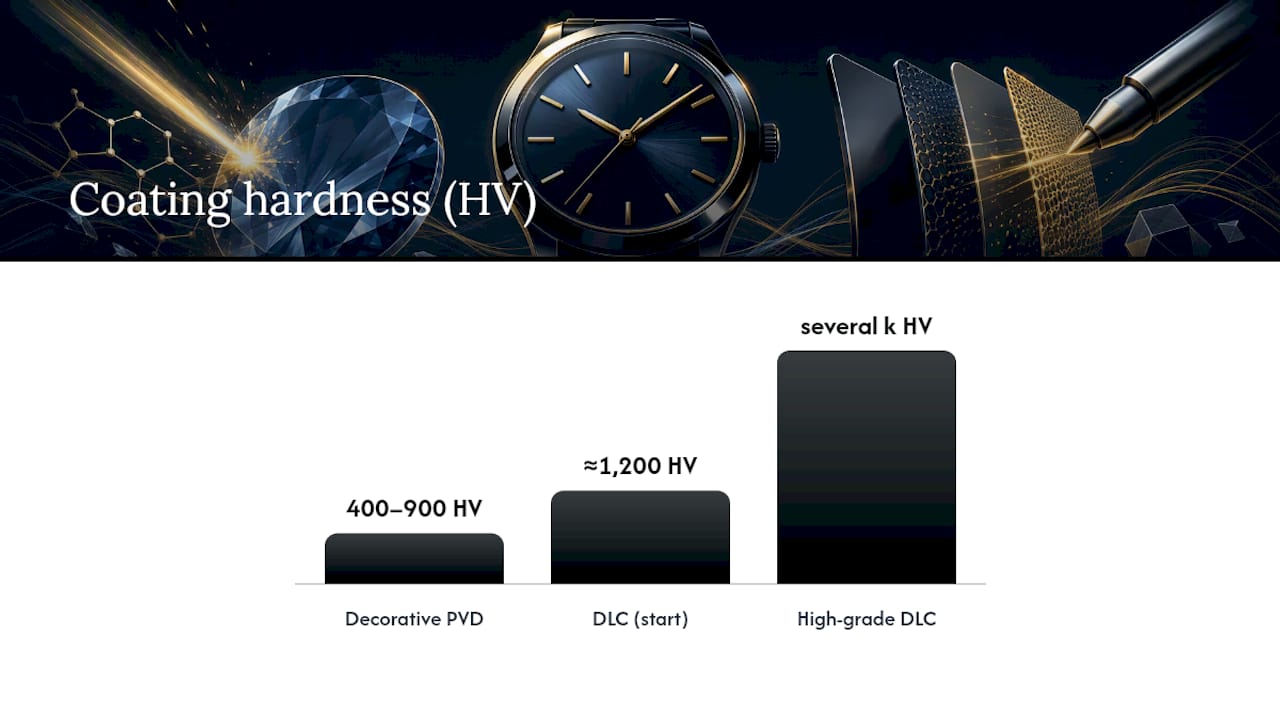
Seiko’s Diashield treatment has a hardness rating higher than untreated 316L steel but is lower than typical DLC coatings.
Tegiment and other diffusion hardening treatments work differently. Instead of adding a layer on top, they alter the metal’s surface structure directly, which avoids the biggest weakness of thin coatings: delamination, where the coating separates or flakes at the edges after repeated impact. A hardened or diffusion-treated case can’t peel because there’s nothing sitting on top to peel.
When comparing spec sheets, look for:
- Coating type — DLC and diffusion treatments outperform standard decorative PVD.
- HV number — anything below 1,000 HV is closer to cosmetic than structural.
- Warranty on finish — brands confident in their coating typically back it in writing.
Ion plating vs. PVD walks through how these processes differ in practice, including why thickness and adhesion quality matter more than the coating name alone.
The trade-off nobody tells you: hardness versus brittleness
Every material on this list gets harder to scratch as you move up the hardness scale, and every material also gets more likely to chip. That’s not a coincidence. Hardness resists surface abrasion; toughness resists cracking under sudden force, and the two properties often work against each other in the same material.
Ceramic and sapphire illustrate this clearly. Both resist scratches from keys, sand, and countertops almost completely, but drop either one hard on a tile floor or a rock ledge and you risk a chip at the edge that no amount of polishing fixes. Acrylic and steel sit at the other end: they scratch more easily, but they flex slightly under impact instead of cracking, and both can be restored to like-new condition with polishing.
- Repairable: acrylic scratches, most steel surface marks.
- Usually replaced, not repaired: sapphire chips or deep scratches, ceramic chips.
- Hidden by finish: fine scratches on brushed or blasted surfaces.
- Highlighted by finish: any mark on a polished, mirror surface.
Pro Tip: Case edges and crown guards take the hardest hits, not the flat case back or crystal face. If you’re rough on watches, prioritize a case design with a recessed crown or reinforced lugs over chasing a slightly higher hardness number.
How to choose the right material, crystal, and finish combo
Before you compare spec sheets, answer a few questions about how you actually live with a watch.
- What’s your environment? Job sites and gyms call for higher impact resistance over pure hardness.
- Do you mind visible wear? If not, a brushed steel case with sapphire crystal ages gracefully.
- Would patina bother you? Bronze and gold develop character over time; steel and titanium don’t.
- Do you have metal allergies? Titanium and 316L steel are both hypoallergenic choices.
- What’s your repair budget? Steel is cheap to polish; sapphire and ceramic are not.
| Wearer profile | Recommended combo | Why it fits |
|---|---|---|
| Office commuter | 316L steel case, sapphire crystal, brushed finish | Polishable case pairs with a crystal that never needs replacing |
| Active or outdoor | Titanium case, sapphire crystal, matte finish | Lightweight and corrosion-resistant with hidden fine scratches |
| Style or patina seeker | Bronze or gold-tone case, mineral crystal, polished finish | Embraces visible aging as part of the watch’s character |
When you’re shopping, ask the seller directly for the HV number on any coating, the crystal type by name (not just “scratch resistant glass”), and whether finish damage is covered under warranty. Vague answers on any of those three usually mean the spec sheet is marketing copy, not engineering data. For more on how steel case options stack up against each other, three stainless steel automatic alternatives is worth a read before you commit.
Notes from Wynwoodblvd on caring for your watch
Mathias, who oversees product development at Wynwoodblvd, points to a simple rule: most scratch damage comes from careless storage, not daily wear. Toss a watch loose in a bag with keys and coins, and even a sapphire crystal case will pick up marks on the bracelet links faster than the wristband suggests it should.
A basic care routine covers most of it: wipe the case with a soft cloth after sweat or saltwater exposure, avoid stacking watches in a drawer without separation, and take a piece to a service center if you notice gasket wear rather than waiting for a water resistance failure. For related guidance on protecting your watch in humid or coastal environments, see what each water resistance rating actually lets you do.
The real lesson buried in the hardness numbers
Most buying guides treat scratch resistance like a single score you can rank materials on, and that’s where the conventional advice goes wrong. Mohs and Vickers numbers tell you how a material resists abrasion, not how it survives your actual life. A courier who drops a watch on concrete weekly needs toughness more than raw hardness. A desk worker who never takes their watch off needs the opposite.
The industry also oversells coatings. A “DLC-coated” watch sounds identical to a “DLC-coated” watch from a different brand, but a thin, poorly adhered layer at 800 HV behaves nothing like a properly applied 1,200+ HV treatment. Ask for the number. If a brand doesn’t give you one, treat that silence as the answer.
My honest recommendation: prioritize crystal hardness first, since that’s where scratches happen most visibly and most often, then choose case material based on how you actually treat your gear, not how the spec sheet reads in a showroom.
— Mathias
Built for daily wear: three Wynwoodblvd picks worth a look
Wynwoodblvd builds every case around 316L stainless steel specifically because it holds up to daily wear and still polishes back to new when it doesn’t. That’s a different bet than chasing maximum hardness numbers, and for most people wearing a watch every day, it’s the more practical one.
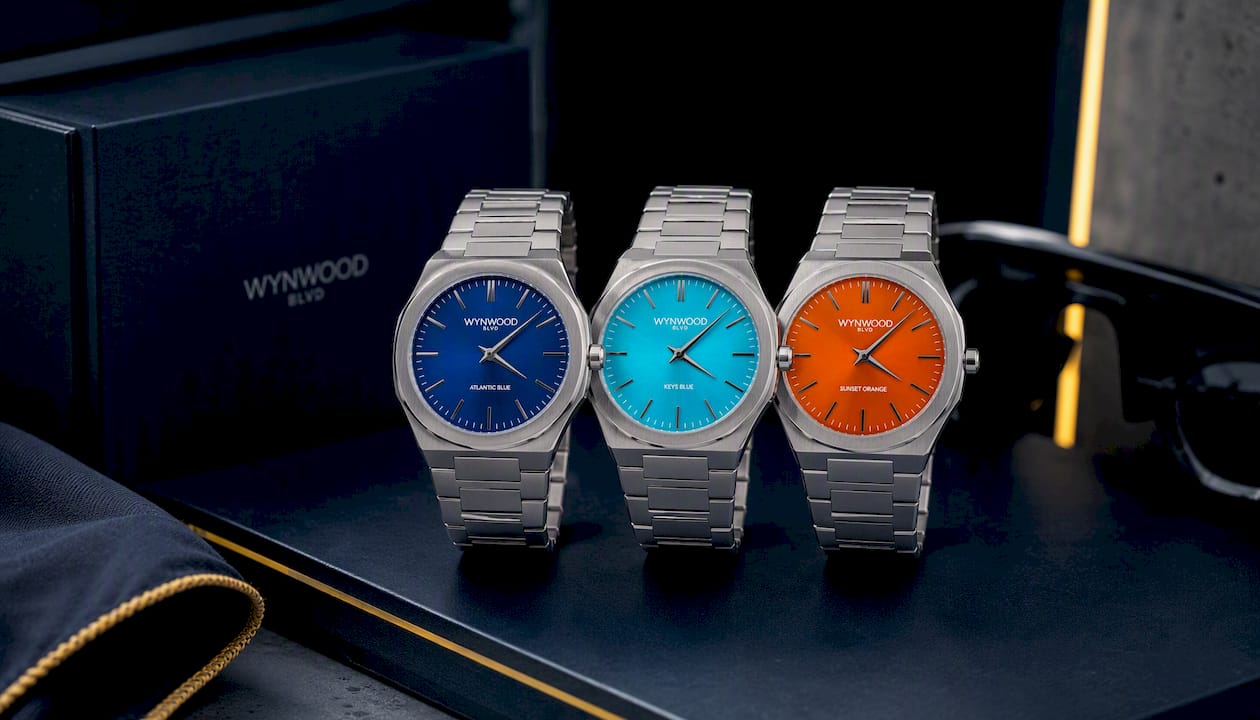
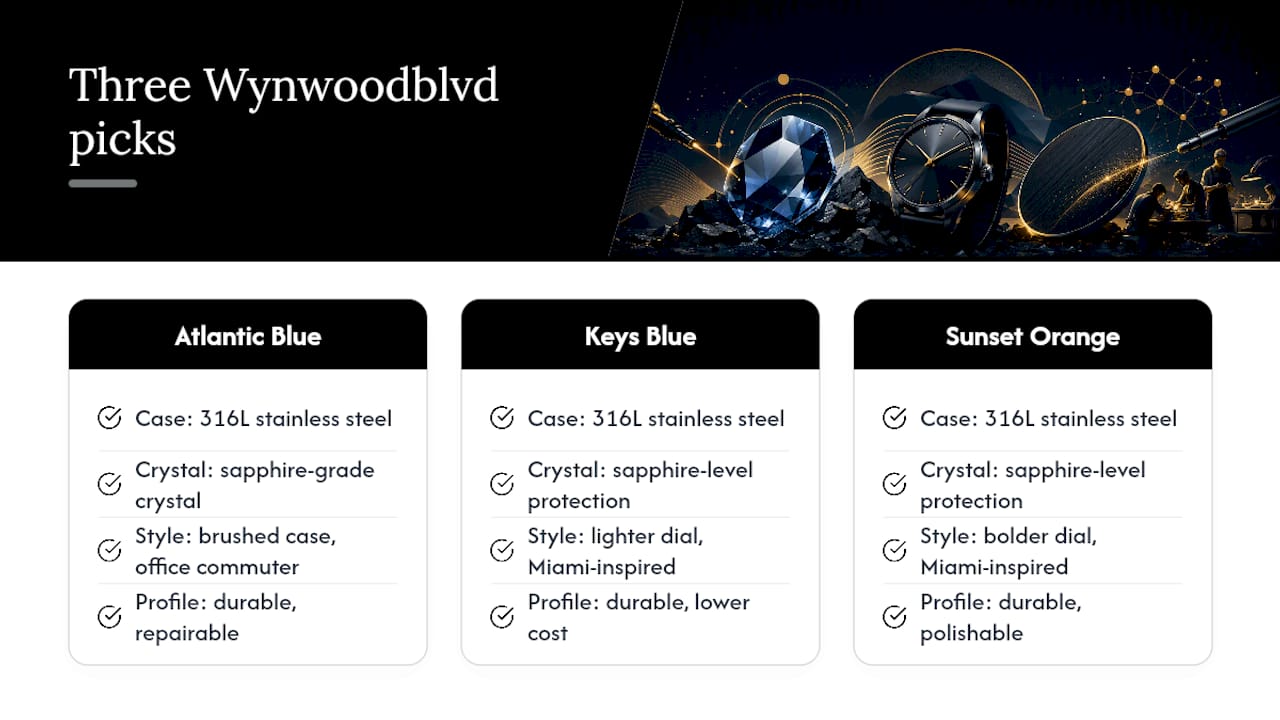
The Atlantic Blue Stainless Steel Automatic Watch pairs a brushed steel case with a sapphire-grade crystal, matching the office commuter profile from the checklist above: durable, repairable, and forgiving of daily bumps. The Keys Blue Miami Inspired Watch uses the same steel construction in a lighter dial treatment, well suited to anyone who wants sapphire-level scratch protection without the higher cost of titanium or ceramic. The Sunset Orange Miami Inspired Watch rounds out the lineup for buyers who want a bolder dial without giving up the polishability that steel offers over harder, more brittle cases.
All three are automatic, water resistant, and built on stainless steel for a reason: it’s the material most owners can actually maintain themselves for the life of the watch. Browse the current collection at Wynwoodblvd to compare dial colors and find your fit.
Where these numbers come from
The hardness figures and material comparisons in this article draw from a handful of technical sources worth bookmarking if you want to go deeper:
- Hodinkee’s breakdown of watch crystal types, including sapphire’s Mohs rating and why it’s the industry benchmark.
- Time+Tide’s guide to hardness across case materials, covering Vickers hardness for steel and coated surfaces.
- WatchPolice’s coating spec guide, detailing DLC and PVD hardness ranges.
- The National Park Service’s explanation of the Mohs scale, the foundational reference for mineral hardness.
- What makes a watch luxury, a useful companion read on buying criteria beyond scratch resistance alone.
Sources
- Here’s Why Watches Use Sapphire Crystals
- How hard is your watch? Demystifying hardness across case materials and crystals
- Watch Coating Guide 2026: DLC, PVD & Vickers Hardness | WatchPolice
- Mohs hardness scale — NPS