Minimalist Watch Style: Why Under 10mm Thinness Matters for Enthusiasts
A minimalist watch is a timepiece built to make time instantly legible using the least visual noise possible. When you’re comparing pieces, judge them by one rule above all else: legibility and proportional thinness, not the absence of a logo or the number of markers on the dial. This guide walks through the design families, the specs worth checking, how to style each piece, and how Wynwood Blvd applies these exact principles to its own automatics.
TL;DR:
- Minimalist watches prioritize legibility and proportional thinness over dial complexity, with case diameter ideally matching wrist size between 36mm and 42mm.
- Quartz movements are more common in ultra-thin models, but well-engineered automatic minimalist watches are more durable and suitable for daily wear, especially at higher price points.
- Water resistance should be at least 50 meters for everyday use, with 30 meters sufficient for splashes, while case material and finish—polished or brushed steel—affect the watch’s formality.
- Straps in leather or mesh retain minimalism by avoiding texture and pattern, and lume should be minimal but functional on hands and key markers for night visibility.
- For formal wear, a case under 10mm thick in black or deep brown leather straps is ideal, while casual outfits are best paired with brushed steel, colorful dials, and simple straps like leather or NATO.
Table of Contents
- What Is Minimalist Watch Style, and What Makes It Different?
- What to Check Before You Buy: Case, Dial, Movement, and Water Resistance
- How to Wear a Minimalist Watch Across Casual, Smart Casual, and Formal Outfits
- A Practical Checklist for Matching Wrist Size and Budget to the Right Watch
- Materials and Finishes That Keep a Watch Looking Minimal
- Wynwood Blvd’s Approach: Minimalist Automatics Built Around Miami Color
- History and Evolution of Minimalist Watch Style
- Notable Brands and Iconic Minimalist Watch Models
- How to Care for a Minimalist Watch and Keep It Looking Clean
- Common Myths and Misconceptions About Minimalist Watches
- Author’s Note: Why Minimalism Belongs in Every Collection
- Ready to Add a Minimalist Automatic to Your Collection?
- Sources
What Is Minimalist Watch Style, and What Makes It Different?
Minimalism in watch design is not the absence of design. It’s the opposite. Stripping a dial down to three hands, a slim bezel, and a handful of markers takes more restraint and precision than adding complications, because every remaining element has to earn its place. A Blog to Watch notes that true minimalist design requires meticulous attention to negative space and legibility rather than a shortcut around effort. A cluttered dial hides mistakes. A minimal one exposes them.
Three principles separate genuine minimalism from a watch that just happens to look plain.
Legibility first. The hands, markers, and dial color need enough contrast that you can read the time at a glance in dim light, not just under a store spotlight. Negative space as a design tool. The empty area of the dial isn’t wasted space; it’s what makes the remaining elements (the logo, the hands, maybe a date window) feel deliberate instead of crowded. Restrained branding and proportion. A minimalist watch keeps its logo small, its date window (if present) unobtrusive, and its case proportions balanced against the dial rather than oversized for the sake of presence.
Within that framework, four design families dominate the category, and guides like Teddy Baldassarre’s roundup treat them as the staples of minimalist style:
- Bauhaus-inspired: thin indices, sans-serif or restrained typography, and a dial built around function over decoration, often with a single accent hand for seconds.
- Dress-minimal: slim cases, leather or mesh straps, and a formal dial layout with no more than hour markers, minute markers, and hands.
- Field-minimal: utilitarian roots, high-contrast numerals or markers for outdoor legibility, sometimes a small seconds sub-dial, but still stripped of unnecessary text.
- Ultra-thin: the case profile itself becomes the design statement, with the dial secondary to how flat the watch sits on the wrist.
The Bauhaus family traces its visual language to thin indices and pared-back fonts, a look The Watch Company’s guide to Bauhaus watches ties directly to the German design school’s “form follows function” mandate. Dress-minimal pieces borrow from that same discipline but soften it with rounder cases and warmer strap materials. Field-minimal keeps the legibility priority but trades elegance for ruggedness. Ultra-thin pieces, meanwhile, treat the case height itself as the entire point, which is why a slim automatic movement matters so much to that family specifically.
What to Check Before You Buy: Case, Dial, Movement, and Water Resistance
Once you know which family appeals to you, the real test is whether the specifications back up the look. A watch can look minimal in a product photo and still wear poorly, run thick under a cuff, or skip water resistance you’ll actually need.
Work through these six checkpoints in order:
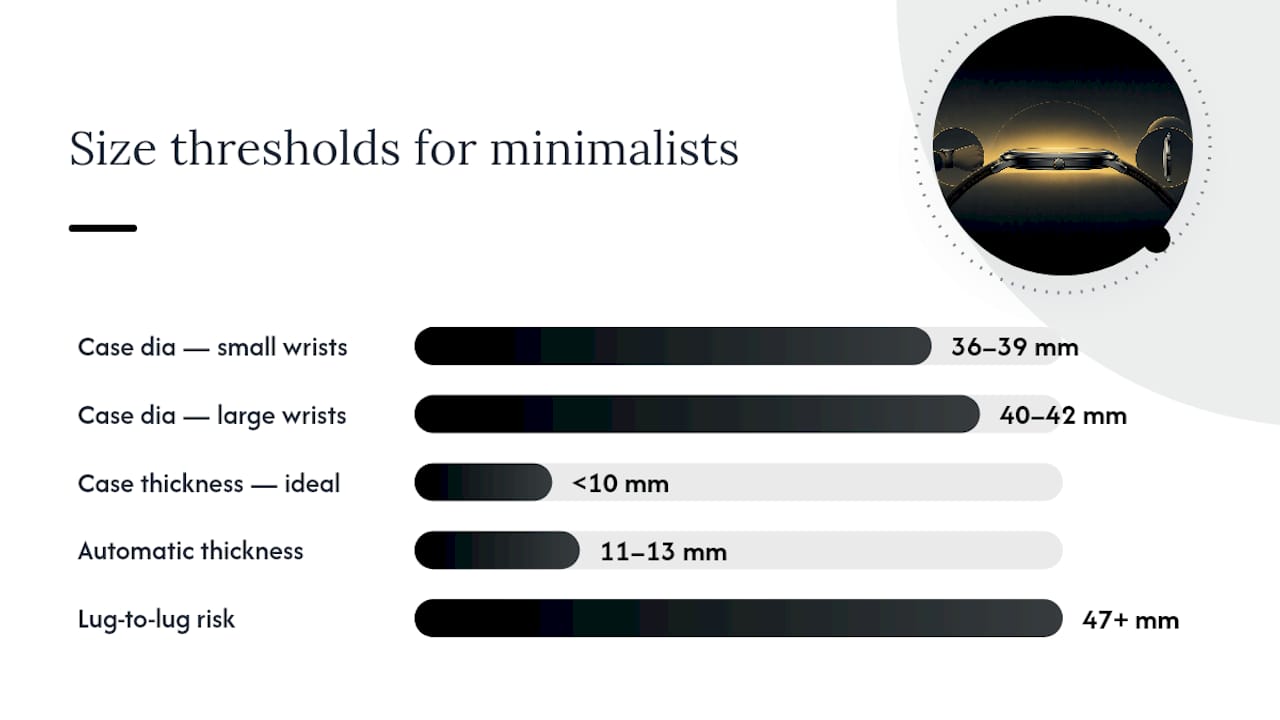
- Case diameter. Many minimalist watches typically range in case diameter, often between sizes that accommodate both smaller and larger wrists. Smaller wrists (under 6.5 inches) generally look better in 36 to 39mm; larger wrists can comfortably carry 40 to 42mm without the case looking oversized.
- Case thickness. This is the detail most buyers skip and most regret skipping. Anything under 10mm slides easily under a dress-shirt cuff. Automatics with thicker calibers can run 11 to 13mm, which still works but changes how the watch sits with a jacket sleeve.
- Lug-to-lug length. A watch can have a “correct” diameter and still overhang a smaller wrist if the lugs extend too far past the case. Check this figure specifically if you have a wrist under 7 inches.
- Dial layout. Confirm the marker style matches the family you want (thin indices for Bauhaus, numerals for field-minimal), and decide whether a date window is a feature or a flaw. A date window breaks dial symmetry, which purists in the Bauhaus and dress-minimal camps tend to avoid.
- Movement type. Quartz movements are thinner and cheaper to produce, which is part of why some of the flattest minimalist watches on the market run on quartz calibers. Automatic movements add mechanical appeal and no battery to replace, but they demand more case engineering to stay slim. Manufacturers like NOMOS Glashütte solve this with dedicated low-height automatic calibers, and their Tangente neomatik line is a useful technical reference for how far that engineering can go.
- Water resistance. 30 meters (3 ATM) covers splashes and hand washing only. 50 meters (5 ATM) is the realistic minimum for daily wear, including light rain and swimming. Anything below that on a watch you plan to wear every day is a compromise, not a feature.
Pro Tip: Try the watch on with your wrist bent, not flat on a table. A case that looks perfectly proportioned lying still can crowd your wrist bone the moment you bend it, especially with lug-to-lug lengths over 47mm.
Strap choice affects perceived minimalism almost as much as the dial does. A wide, heavily textured leather strap or an oversized metal bracelet can undercut an otherwise clean dial, while a slim mesh band or a simple calfskin strap reinforces it. Retail guides covering the category consistently point to mesh bracelets and plain leather as the two strap types that preserve a minimalist read without adding visual weight.
Movement choice also shapes price more than most buyers expect. Tested comparisons of minimalist watches show the style spans from affordable thin quartz pieces to genuinely high-end dress watches, and that range in price and materials is normal for the category rather than a sign that cheaper options are lesser designs. What separates a good $150 minimalist watch from a mediocre one is rarely the dial concept. It’s the crystal (sapphire scratches less than mineral glass), the case finishing, and whether the water resistance rating matches how you’ll actually wear it.
How to Wear a Minimalist Watch Across Casual, Smart Casual, and Formal Outfits
The reason minimalist watches earn a spot in a small, well-edited collection is versatility. A watch with a busy dial, a chunky bezel, or a sport-specific bracelet reads as “off” the moment you pair it with the wrong outfit. A clean three-hand watch on a slim strap rarely does. Because minimal dials avoid competing patterns or heavy branding, they slot into a far wider range of outfits without clashing, a point style guides covering the category raise specifically when discussing daily-wear versatility.
That doesn’t mean every minimalist watch works with every outfit. Strap material, dial color, and case finish still shift a piece up or down the formality scale.
Casual and denim
A field-minimal or Bauhaus watch on a leather NATO strap or a simple two-piece leather band is the easiest pairing in the category. Stick to warmer strap tones (tan, chestnut, olive) with denim, and let the dial color do the work if you want any personality at all. This is where a color-forward dial, like a deep orange or a saturated green, actually earns its keep instead of looking out of place. A brushed steel case reads more casual than a polished one, and it hides scuffs better if you’re wearing the watch daily with jeans and boots.
- Pair brushed steel cases with denim and canvas; polished steel tends to look slightly formal for genuinely casual outfits.
- Use a leather strap in a warm tone for a lived-in, easygoing look rather than a stark contrast strap.
- Save bold dial colors (orange, green, blue) for casual wear, where they read as personality rather than distraction.
Smart casual and blazers
This is the register where dress-minimal watches perform best. A slim stainless steel bracelet or a dark leather strap under a blazer sleeve reads as intentional rather than an afterthought. Keep the dial subdued (black, white, navy, or a muted blue) and let the case finish do the talking. Polished steel edges paired with a brushed top surface strike the right balance between “dressed up” and “trying too hard.” Business-casual style guides recommend keeping accessories understated in this register precisely because a blazer already adds visual weight to an outfit. A busy dial competes with that; a clean one supports it.
- Match a slim metal bracelet or dark leather strap with tailored trousers and a blazer.
- Avoid sport-oriented rubber or nylon straps in this register, even on a minimalist dial.
- Let the watch be the only metal accent if you’re already wearing a belt buckle or cufflinks; two competing metal tones can undercut the clean look you’re going for.
Formal and dress occasions
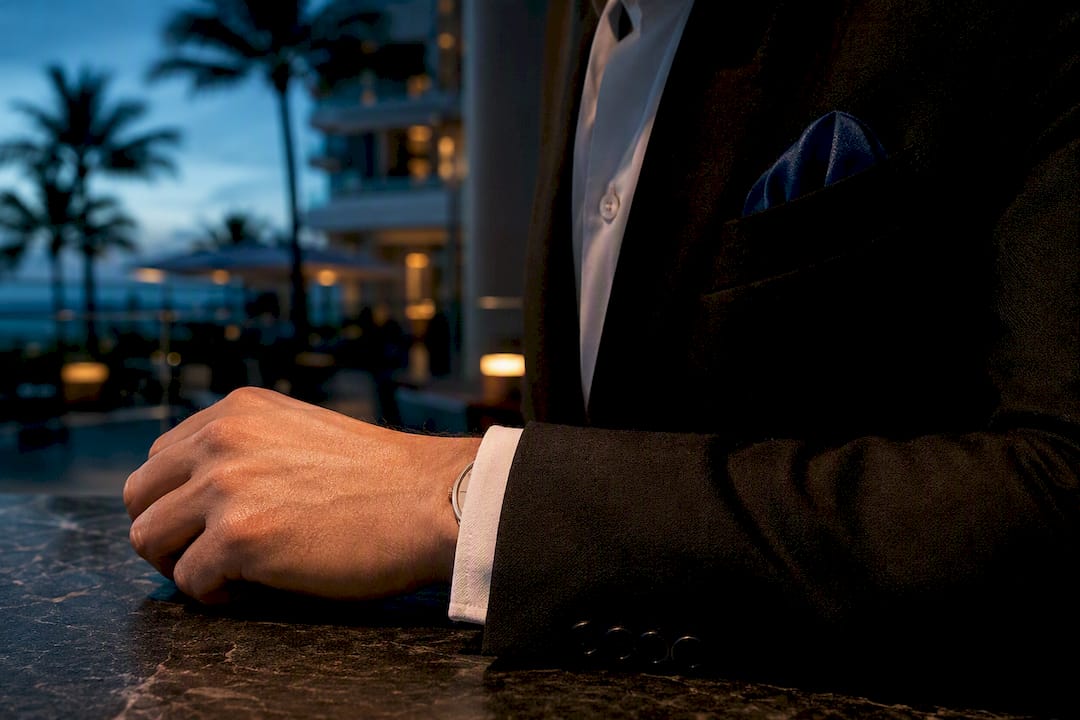
Here, thinness matters more than anywhere else. A case under 10mm slides cleanly under a dress-shirt cuff, and a slim leather strap in black or deep brown pairs with formal leather shoes far better than a bulky steel bracelet. Ultra-thin pieces exist specifically for this register. If you own only one minimalist watch and want it to cover formal wear convincingly, thinness should outrank almost every other spec on your list.
For wrist presence in general, the rule is simple: muted dials (black, white, gray, navy) work in every context, while a pop color is a casual and smart-casual tool, not a formal one. Save the Sunset Orange or Everglades Green dial for weekend and workday wear, and reach for a blue or black dial when the occasion calls for restraint.
Bracelet stacking follows its own logic. A slim minimalist watch pairs cleanly with one or two thin bracelets on the same wrist, but avoid stacking anything with texture that competes with the case finish, like a chunky beaded bracelet against a polished steel case. If you wear a watch and jewelry on the same wrist, match metal tones (silver with silver, gold with gold) so the overall look reads coordinated rather than mismatched. Fit matters just as much here as case size does: a watch bracelet that’s too loose will spin around your wrist and constantly show the clasp, while one that’s too tight will pinch when you bend your wrist. Get it adjusted at purchase rather than living with either extreme.
A Practical Checklist for Matching Wrist Size and Budget to the Right Watch
Buying a minimalist watch without checking your own wrist measurements first is the single most common mistake enthusiasts make, and it’s an easy one to avoid.
- Measure your wrist with a flexible tape or a strip of paper, wrapped snugly where you’d normally wear a watch. Under 6.5 inches means you should lean toward 36 to 39mm cases. 6.5 to 7.5 inches comfortably fits 38 to 41mm. Over 7.5 inches can carry 40 to 42mm without looking undersized.
- Check lug-to-lug before diameter. Two watches with the same 40mm case can wear completely differently if one has a 46mm lug-to-lug and the other has a 50mm lug-to-lug. The shorter figure will sit better on most wrists.
- Set a thickness ceiling based on how you’ll wear it. If the watch needs to fit under dress-shirt cuffs regularly, cap thickness around 10 to 11mm. If it’s a weekend piece you’ll wear over a sleeve or bare wrist, up to 13mm is fine.
- Decide your budget tier honestly. Entry-level minimalist watches (roughly under $200) usually run quartz movements, mineral crystal, and simpler case finishing, but can still nail the design brief. Mid-tier pieces (roughly $200 to $600) start introducing sapphire crystal, automatic movements, and better bracelet construction. Premium pieces (above $600) add finishing details like polished bevels, in-house or heavily modified movements, and premium packaging. Mainstream brands like Casio prove minimalism isn’t gated behind a luxury price tag; it shows up in practical, durable pieces at every tier.
- Ask about strap swap options before buying. A watch on a proprietary lug system limits you to the manufacturer’s straps. Standard lug widths (18mm, 20mm, 22mm) let you switch between leather, mesh, and bracelet options as your outfit needs change, which matters a lot if you want one watch to cover casual and smart-casual wear.
- Confirm the return window and warranty terms before buying online, especially for your first purchase from a brand. Sizing issues are common enough with watches that a flexible return policy should be a real factor in your decision, not an afterthought.
Budget tier and visual polish don’t move in perfect lockstep. A well-finished mid-tier automatic can look more refined than a poorly finished premium piece, which is why checking case finishing and lug-to-lug fit in person (or through detailed photos) matters more than trusting price alone.
Materials and Finishes That Keep a Watch Looking Minimal
The metal finish on a case changes how formal or casual a minimalist watch reads, sometimes more than the dial does. Polished stainless steel throws more light and reads dressier, which is why it shows up so often on dress-minimal pieces. Brushed steel scatters light instead of reflecting it, giving a more understated, everyday look that also hides fine scratches better over years of wear.
Titanium and PVD (physical vapor deposition) coatings complicate the minimalist read in different directions. Titanium’s matte gray tone and light weight suit field-minimal and everyday pieces well, reinforcing understatement. PVD coatings in black or gunmetal can either sharpen a minimalist look (a stealthy, monochrome effect) or work against it if the coating is paired with heavy branding or an oversized case, since the dark tone draws more attention to size and proportion than a bright steel case would.
Strap material carries similar weight. Simple leather in black, brown, or tan preserves minimalism because it avoids texture and pattern. Mesh bracelets do the same in metal, offering a fine, uniform texture that reads clean rather than busy. For a deeper look at bracelet construction and how link style affects the finished look of a watch, this bracelet-type guide breaks down the tradeoffs between mesh, Jubilee, and Oyster-style links.
Lume and coatings introduce the one real tradeoff in minimalist design: legibility versus invisibility. A truly minimal dial wants markers and hands to disappear when not needed, but that same restraint can hurt night legibility if the lume is applied sparingly. The better minimalist pieces solve this by using lume only on the hands and a few key markers (12, 3, 6, 9) rather than skipping it altogether, which keeps the daytime look clean without sacrificing function after dark.
- Choose polished steel for smart-casual and formal wear; brushed steel for daily and casual wear.
- Treat titanium as a lightweight, understated alternative to steel, best suited to field-minimal and everyday pieces.
- Pick simple leather or mesh straps over textured or patterned bands to keep the overall look clean.
- Look for lume on the hands and cardinal markers at minimum, even on the most pared-back dials.
Wynwood Blvd’s Approach: Minimalist Automatics Built Around Miami Color
Wynwood Blvd designs every watch around the same core rule covered throughout this guide: legibility and proportional thinness first, then color and story second. Each piece pulls its identity from a real Miami-area location, but the dial layout stays disciplined, a small logo, restrained markers, and a case built to sit flat under a sleeve rather than announce itself.
The four current models map cleanly onto the checklist above:
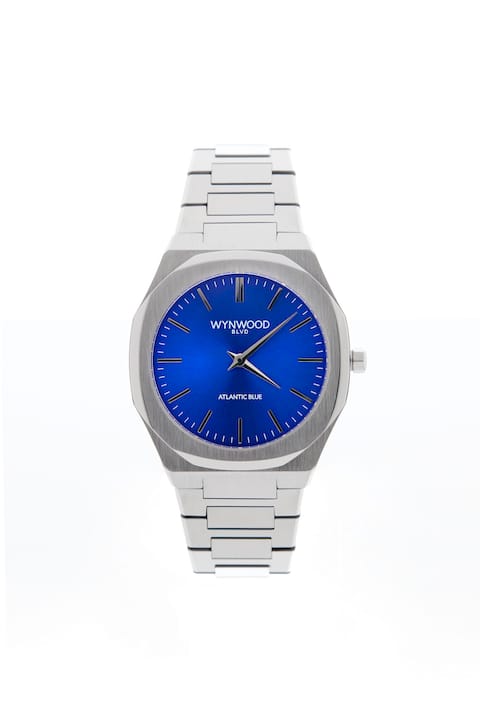
- Atlantic Blue Stainless Steel Automatic Watch: a deep navy dial that works across smart-casual and formal wear, best for readers who want one automatic minimalist watch that covers most of a wardrobe.
- Keys Blue Miami Inspired Watch: a lighter, more saturated blue dial suited to warm-weather casual and smart-casual pairings, best for everyday wear in a climate where navy feels too heavy.
- Sunset Orange Miami Inspired Watch: the color-pop option in the lineup, best worn with denim or other genuinely casual outfits where a bold dial adds personality instead of clashing.
- Everglades Green Miami Inspired Watch: an understated green dial that splits the difference between muted and colorful, a strong pick for readers who want something distinctive without going as bold as orange.
All four run on automatic movements housed in stainless steel cases, which means no battery changes and a mechanical rotor doing the work every time you wear the watch. That case engineering matters here specifically because automatic movements typically demand more internal height than quartz, and keeping the profile wearable under a cuff took the same design discipline the NOMOS Tangente neomatik line demonstrates at a different price point. Anyone deciding between an automatic and a quartz piece for their own minimalist wristwatch collection can read more in Wynwood’s automatic watch guide.
History and Evolution of Minimalist Watch Style
Minimalist watch design has roots in the Bauhaus movement of 1920s Germany, where the school’s “form follows function” philosophy shaped everything from furniture to typography, and eventually watch dials. Bauhaus-trained designers rejected decorative excess in favor of clear, functional layouts, a philosophy that carried directly into watchmaking through the mid-20th century as designers began stripping dials down to hour markers, minute markers, and hands, nothing more.
The style found a second wave through Scandinavian and German design houses in the 1980s and 1990s, which leaned even further into negative space and monochrome dials. Around the same period, field and military watches contributed their own strand of minimalism: legibility-driven, rugged, and built for function over decoration, which is why field-minimal remains a distinct family rather than a subset of Bauhaus.
The 2010s brought a broader mainstream shift toward minimalism across product design generally, from smartphone interfaces to furniture, and watch brands followed. Slimmer cases, quieter dials, and simpler branding became a selling point rather than a niche preference, expanding minimalist watches from a design-enthusiast interest into a mainstream category available at nearly every price point. That expansion is why the style now spans from sub-$100 quartz pieces to five-figure dress watches, all working from the same core design language established a century earlier.
Notable Brands and Iconic Minimalist Watch Models
Bauhaus-inspired minimalism owes much of its modern visibility to German watchmakers who built entire collections around the philosophy, using thin indices and restrained typography as the defining visual signature of the family. Dress-minimal design found its clearest technical expression in ultra-thin automatic movements, where manufacturers engineer calibers specifically to keep case height low without sacrificing the mechanical appeal of an automatic movement, exemplified by NOMOS Glashütte’s neomatik line.
Field-minimal design draws its lineage from military-issued watches, where legibility under stress mattered more than aesthetics, a discipline that later carried into civilian designs valued for their honest, no-frills dials. Mainstream and accessible brands have their own strong presence in the category too. Casio’s minimalist watch line proves that simple dials and practical durability aren’t reserved for higher price points, an important reference point for anyone assuming minimalism only exists in expensive dress watches.
Within the coastal and lifestyle-watch space specifically, Wynwood Blvd’s four Miami-inspired automatics apply the same design family principles, restrained branding, proportional cases, legible dials while introducing color as the differentiator rather than dial complexity, a combination that’s less common among the mostly monochrome options that dominate the broader minimalist category.
How to Care for a Minimalist Watch and Keep It Looking Clean
Minimalist watches show wear differently than busier designs, because there’s nowhere for scratches or grime to hide on a clean dial or a polished case edge.
Clean the case and bracelet with a soft, slightly damp cloth after wear, especially if you’ve been sweating or near saltwater, since residue dulls polished steel faster than brushed finishes. Avoid harsh chemical cleaners on leather straps; a dry cloth and occasional leather conditioner keep the color even and prevent cracking, which matters more on a minimalist dress-minimal watch than a rugged field piece, since visible cracking undercuts the entire clean aesthetic.
Store the watch on a soft surface or in a case rather than tossed in a drawer with other jewelry, since metal-on-metal contact is what causes most surface scratches on stainless steel cases. If your watch has a polished bezel or case edge, handle it by the strap or bracelet rather than gripping the case directly, since fingerprints and oils show up more visibly on polished surfaces than brushed ones.
For automatic movements specifically, wear the watch regularly or store it on a watch winder if you rotate between multiple pieces. Automatics that sit unworn for weeks will stop and need resetting, which isn’t damaging but is an avoidable inconvenience. Get water resistance seals checked every few years if you swim or shower with the watch regularly, since gaskets degrade over time even on watches rated for higher water resistance.
Common Myths and Misconceptions About Minimalist Watches
The biggest misconception is that minimalist means cheap or lazy design. As covered earlier, minimalism actually demands more design discipline than a busier dial, since every remaining element has to justify its presence with no ornamentation to distract from a poorly balanced layout.
A second myth: minimalist watches are only for formal or professional settings. Field-minimal and casual color-forward pieces prove otherwise. The style spans the full range from beach-casual to black-tie, and the outfit pairing rules covered earlier show how the same design family can shift registers with the right strap and dial color choice.
A third misconception treats “no date window” as a requirement for minimalism. Plenty of well-regarded minimalist watches include a small, well-placed date window without breaking the design’s integrity. What actually breaks minimalism is a date window that disrupts marker spacing or uses a mismatched font, not the feature itself.
Finally, some buyers assume minimalist watches are all quartz because “simple” gets conflated with “basic mechanically.” Automatic minimalist watches are common and often prized specifically because achieving a slim profile with a mechanical movement takes more engineering than doing it with quartz, not less.
Author’s Note: Why Minimalism Belongs in Every Collection
A minimalist watch earns its place in a collection by doing the job other pieces can’t: going anywhere without a second thought. I’d argue the real skill in building a small watch collection isn’t chasing complications or rare dial variants.
Where collectors get this wrong is treating minimalism as a starting point to graduate from, rather than a standing part of a well-built rotation. A chronograph or a dive watch earns its slot for specific occasions. A minimalist automatic earns its slot every single day, which is exactly why it deserves the same scrutiny on case thickness and lug-to-lug fit that enthusiasts apply to more “exciting” pieces. If you’re building out a broader minimalist wristwatch collection, our guides on ultra-thin men’s watches and minimalist watches for women go deeper into sizing and family-specific picks than this overview could.
— Mathias
Ready to Add a Minimalist Automatic to Your Collection?
Everything in this guide, legible dials, proportional case sizing, slim automatic engineering, is the exact brief Wynwood Blvd designs against, so you’re not guessing whether a piece fits the criteria you just read. Each model pairs a genuine automatic movement with a stainless steel case built to wear thin under a cuff, then adds a single, story-driven color instead of a busy dial.

If you want one watch that covers smart-casual and formal wear without a second thought, start with the Atlantic Blue Stainless Steel Automatic Watch. If you’re after the casual color-pop pairing covered in the styling section, look at the Sunset Orange or Everglades Green dials. The Keys Blue model splits the difference for warm-weather everyday wear. Browse the full Miami-inspired watch collection to compare all four side by side, and if you’re sourcing branded timepieces for a hotel, agency, or event, our B2B custom watch program covers logo engraving and bulk ordering for exactly that kind of order.
Sources
- A Blog to Watch — Minimalist watches: plain and simple
- Teddy Baldassarre — 40 Best Minimalist Watches - A Complete Guide for 2024
- NOMOS Glashütte — Tangente neomatik platinum gray (US store)