Watchmaker Backed 316L Stainless Steel Watch Care for Owners
For most stainless steel watches, a daily microfiber wipe plus a monthly gentle soapy wash keeps the finish bright and the movement protected. Confirm water resistance before any soaking. This guide, from Mathias at WYNWOOD BLVD, draws on AWCI guidance and 316L passive film research. Skip the soak if gaskets are old or the crown isn’t screwed down.
TL;DR:
- Regular wiping with a microfiber cloth after daily wear prevents buildup of oils and dust without damaging the surface.
- Weekly cleaning with diluted dish soap and gentle brushing keeps grime out of crevices, while monthly deep cleaning involves removing the bracelet for better access.
- Only soak the watch if water resistance is confirmed, avoiding ultrasonic cleaning unless performed by a professional who can check gasket condition.
- Use proper polishing techniques for finishes and avoid abrasive tools that can thin the case or damage coatings, especially on PVD or DLC surfaces.
- Rinsing promptly after saltwater exposure and drying thoroughly helps maintain the protective oxide layer of 316L stainless steel.
Table of Contents
- Essential gear and tools for cleaning your watch
- Step by step: cleaning your watch case, bracelet, and crystal
- Dealing with scratches and when to polish
- How often to clean and check water resistance
- Clasp and bracelet care that prevents wear
- Material notes from WYNWOOD BLVD on caring for 316L steel
- Why we build watches with easy care in mind
- Find a watch built for the way you actually wear it
- Sources
- FAQ
Essential gear and tools for cleaning your watch
The right tools protect your watch’s finish while the wrong ones strip it. Keep your kit simple and gentle.
- Microfiber cloth: lifts oils and dust without scratching the metal.
- Soft-bristle brush: an old toothbrush works well for grooves and clasps.
- Mild dish soap: a few drops of Dawn diluted in warm water cuts through grime.
- Distilled water: rinses without leaving mineral spots.
- Low-pressure air blower: clears moisture from tight spaces.
- Watch-grade lubricant: for clasp pins and friction points, applied sparingly.
Avoid bleach, ammonia, abrasive pads, toothpaste, and WD-40 as a polish. These strip or damage the protective chromium oxide layer that keeps stainless steel from pitting. Steam cleaners and dishwashers are off the table entirely; both push moisture past seals that were never designed for that kind of pressure or heat.
Before you soak anything, check the water resistance rating stamped on the case back or listed in your manual. A rating under 30 meters means splash resistant only, not swim or soak safe.
Step by step: cleaning your watch case, bracelet, and crystal
A little consistency does more for a watch than any single deep clean. Build the routine around three tiers: daily, weekly, and occasional deep cleaning.
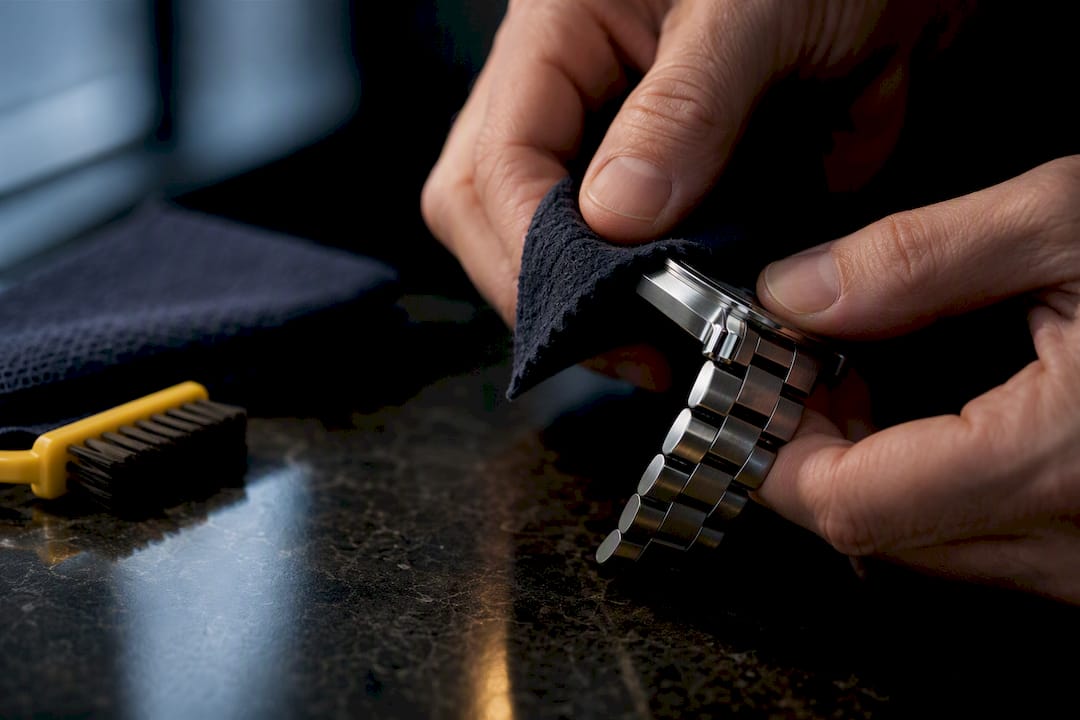
- Wipe daily. After wearing your watch, especially through sweat, sunscreen, or a swim, run a microfiber cloth over the case, crystal, and bracelet.
- Spot-clean weekly. Dampen a soft brush with diluted dish soap and work it into the bracelet links and case crevices, then rinse under lukewarm water.
- Dry thoroughly. Pat with a towel, then let the watch air-dry for a few minutes before wearing it again.
- Deep clean monthly or as needed. If you’re comfortable, remove the bracelet to reach the lug gaps that trap the most grime.
- Soak only when water resistance is confirmed. A brief soak in warm soapy water loosens buildup that a cloth can’t reach.
- Leave ultrasonic cleaning to a professional shop. Watchmaker guidance reserves ultrasonic baths for pros who can check gasket condition first.
- Check for trapped moisture. Look at the crystal for condensation after cleaning; fogging that doesn’t clear points to a seal problem.
Pro Tip: If you see condensation under the crystal that lingers after an hour indoors, stop wearing the watch and get a pressure test before it goes back in water.
Removing the bracelet before a deep clean isn’t required, but it makes a real difference. Grime hides in lug gaps and link joints where a cloth simply can’t reach, and that’s exactly where corrosion tends to start.
Dealing with scratches and when to polish
Brushed and polished finishes need different handling. A brushed case has fine parallel lines cut into the metal, so wipe and brush in the same direction as those lines, never across them. A polished case is mirror smooth, and a soft jeweler’s cloth used in gentle circular motions keeps it that way.
- For acrylic crystals, a product like PolyWatch buffs out light surface scratches at home.
- For sapphire or mineral crystals, skip home polishing entirely; these materials need professional-grade tools to correct.
- Avoid sandpaper, metal polish, or rotary tools. These remove far more metal than intended.
Professional polishing has its place for deeper scratches, but it works by removing a thin layer of metal to level the surface. Done too often, it thins the case and can soften sharp edges that define the design, which affects resale value over time.
Pro Tip: Never polish a PVD or DLC-coated watch at home. Those coatings sit on top of the steel, and abrasive polish removes the coating rather than the scratch.
How often to clean and check water resistance
A realistic schedule beats an aggressive one. Wipe daily, deep clean every one to three months depending on how often you sweat, swim, or work with your hands, and send the watch for full service every three to five years, sooner if it sees regular water exposure.
- Daily: microfiber wipe after wear.
- Monthly to quarterly: soapy wash and bracelet detail clean.
- Every 3 to 5 years: professional service including gasket replacement.
Water resistance isn’t permanent. Gaskets compress and age, and a watch rated 100 meters new can lose that margin over years of wear. If your watch is vintage, secondhand, or hasn’t been serviced in a while, treat any stated rating as a starting point rather than a guarantee, and ask a watchmaker for a pressure test before swimming with it.
AWCI guidance notes that neglected gaskets and clasps are a leading cause of watch failures, which is why routine checks matter as much as routine cleaning.

Clasp and bracelet care that prevents wear
Clasps and bracelets take more mechanical stress than the case itself, and grime accelerates that wear by acting like sandpaper between links.
- Open the clasp fully and brush out trapped dust and skin oils with a soft toothbrush.
- Check friction pins and spring bars for looseness; a wobbly link is often a pin working its way out.
- Apply a small amount of watch-grade lubricant to clasp joints, following the light touch AWCI recommends for friction points.
- Leave spring bar removal to a watchmaker if you don’t have the right tool. A slipped tool can scratch the case or launch the spring bar across the room.
- Tighten loose clasp screws with the correct driver size, and ask a watchmaker about thread-locking compound if a screw keeps backing out.
Material notes from WYNWOOD BLVD on caring for 316L steel
Most premium watch cases, including ours, use 316L stainless steel. Under a microscope, that steel holds a chromium-rich passive oxide film just a few nanometers thick, and that thin layer is what keeps it from rusting.
Saltwater changes the equation. Research on chloride exposure shows chloride ions can work into that passive film and trigger pitting at a microscopic level, which is why a prompt freshwater rinse after ocean swimming matters more than people expect.
- Rinse within an hour of saltwater or chlorine exposure when possible.
- Dry the case and bracelet fully before storing.
- Read more on 316L performance and ocean-safe care for deeper detail.
Some models use 316L stainless steel cases, so the rinse-and-dry habit is broadly applicable.
Why we build watches with easy care in mind
These watches are designed to suit Miami and coastal settings, aiming to hold up to sun, sweat, and salt air, not just look good in photographs. That’s why finishes and materials get chosen with maintenance in mind from the start. If you have questions about caring for a specific piece or want to talk custom branded orders, we’re glad to help.
— Mathias
Find a watch built for the way you actually wear it
These watches are designed to handle daily wear without demanding constant upkeep, so the care routine above stays simple.

- Atlantic Blue Stainless Steel Automatic Watch: a brushed case that shrugs off daily scuffs and hides fine marks between cleanings.
- Keys Blue Miami Inspired Watch: pairs well with the weekly soapy wash routine thanks to its 316L case.
- Everglades Green Miami Inspired Watch: a good pick if you want one watch that handles both office and outdoor days.
If you wear a watch daily and want low fuss, lean toward brushed finishes. If you save yours for occasional wear, a polished case stays easy to maintain with light, infrequent buffing. Browse the full Miami Inspired Watches collection, or if you’re outfitting a team or event, look into Corporate Custom Watches for branded gifts built the same way.
Sources
- AWCI watchmaking guidance (August 2012)
- Study on passive oxide film and electrochemical passivation of 316L stainless steel
- Study on chloride-induced passivity breakdown of stainless steel (Nature Communications)
- How to clean a watch — professional and DIY guidance (GQ)
FAQ
Is Dawn dish soap good for stainless steel watches?
Yes, a few drops of Dawn diluted in warm water is a common and gentle choice for cleaning stainless steel watches. It cuts through oils and grime without harming the passive oxide layer that protects the metal.
What cleans stainless steel really well?
A soft brush and mild dish soap diluted in lukewarm water remove most everyday grime from stainless steel watches. For tougher mineral deposits, a brief soak in distilled water works well, but always confirm water resistance first.
Does WD-40 polish stainless steel?
WD-40 is not a recommended polish for stainless steel watches. It can leave residue and isn’t formulated for the fine surface finishes on watch cases, so a jeweler’s cloth or PolyWatch for acrylic crystals is a safer choice.
Will a stainless steel watch tarnish?
Stainless steel resists tarnish better than most metals because of its chromium-rich passive film, but chloride exposure from saltwater or sweat can still cause pitting over time. Rinsing and drying promptly after exposure keeps that risk low; more detail is available on tarnish prevention.