How to Use a Watch Size Guide to Find Your Perfect Fit
Measure your wrist, then pick a case diameter and a lug-to-lug cap. Lug-to-lug determines fit more than the number stamped on the dial. A 7-inch wrist usually wears a 38 to 42mm case with a 46 to 49mm lug-to-lug comfortably, without the case overhanging the wrist edges.
Here’s the quick math before you shop:
- 5.5" to 6.0" wrist: 36 to 40mm diameter, 42 to 45mm lug-to-lug
- 6.5" wrist: 38 to 41mm diameter, up to ~47mm lug-to-lug
- 7.0" wrist: 40 to 42mm diameter, up to ~49 to 50mm lug-to-lug
- 7.5"+ wrist: 42 to 44mm diameter, up to ~52mm+ lug-to-lug
A 42mm case fits comfortably on most wrists between roughly 6.7" and 7.5", but only when the lug-to-lug measurement stays proportional. Below 6.5", a 42mm watch often looks like it’s borrowed from someone else’s arm.
Key Takeaways
Lug-to-lug, not diameter, decides whether a watch fits your wrist, and a 40mm case with a proportioned lug-to-lug suits most wrists between 6.3 and 7.3 inches.
| Point | Details |
|---|---|
| Measure before you shop | Wrap a soft tape below your wrist bone, or use a paper strip and ruler if you don’t own one. |
| Lug-to-lug is the real fit test | Keep lug-to-lug under your wrist width (circumference divided by 3.14) to avoid overhang. |
| Use ceilings, not targets | A 7.0" wrist tops out around 49 to 50mm lug-to-lug; a 6.5" wrist tops out near 47mm. |
| Match dimensions to occasion | Dress watches stay under 12mm thick; sport watches can run 14 to 16mm without feeling wrong. |
| Wynwoodblvd’s 40mm case fits most adults | Models like the Atlantic Blue suit wrists from roughly 6.3" to 7.3". |
Table of Contents
- How Do You Measure Your Wrist for a Watch?
- Why Does Lug-to-Lug Matter More Than Diameter?
- Wrist-to-Watch Sizing Chart
- How Do Case Shape and Dial Design Change Perceived Size?
- Does the Strap or Bracelet Change How a Watch Fits?
- Which Watch Size Fits Your Occasion?
- Do Men’s and Women’s Watch Sizes Really Differ?
- How Should Occasion Change Your Watch Size?
- How Does Watch Weight Affect All-Day Comfort?
- What Do People Get Wrong About Watch Size?
- What Sizing Notes Should Guide Your Next Watch Purchase?
- Which WYNWOOD BLVD Watch Matches Your Wrist?
- Sources
How Do You Measure Your Wrist for a Watch?
You need two numbers before you buy anything: your wrist circumference and the watch’s lug-to-lug length. Here’s how to get both right.
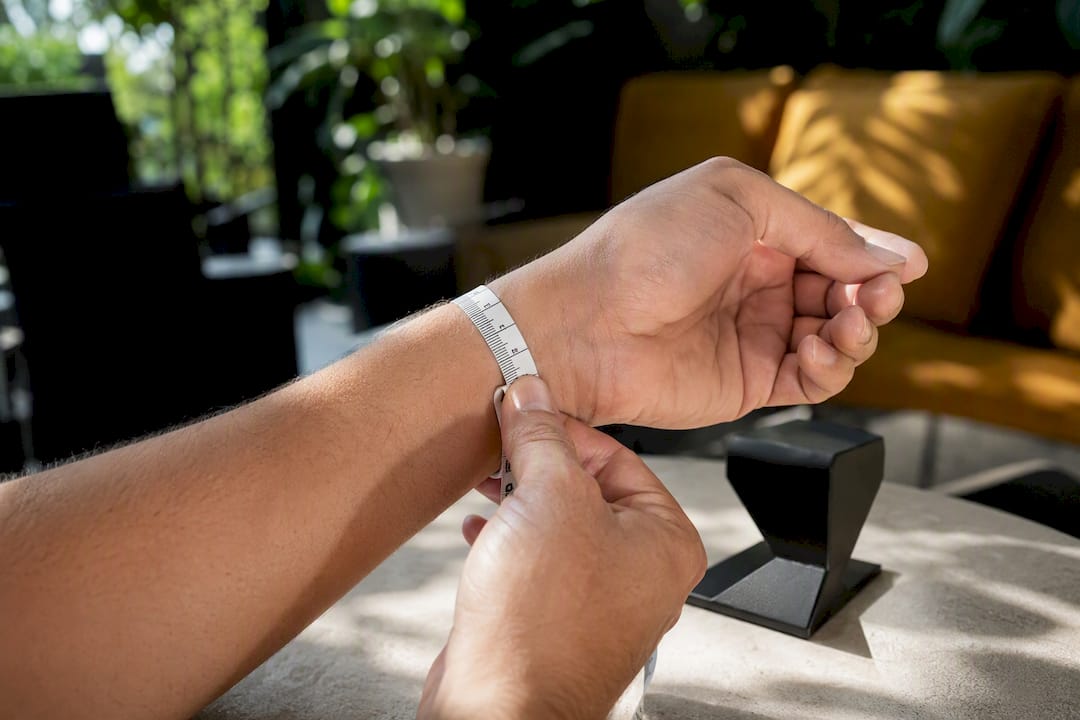
- Wrap a soft tape measure around your wrist, just below the wrist bone, where you’d normally wear a watch. Keep it snug but not tight, then note the number in inches or millimeters.
- No tape measure? Use a strip of paper. Wrap it around your wrist, mark where it overlaps, then lay it flat against a ruler.
- Convert circumference to width. Divide your circumference by 3.14 (pi) to get your flat wrist width. A 7.0" wrist works out to roughly 2.2 inches, or about 56mm, across.
- Measure an existing watch you already own and like. Check diameter (edge to edge, excluding the crown), lug-to-lug (tip to tip, top lug to bottom lug), thickness (case back to crystal), and lug width (where the strap attaches).
Pro Tip: Screenshot a ruler app on your phone or print a sizing template at “actual size” in your print settings, then hold it against your wrist for a gut check before checkout.
Why Does Lug-to-Lug Matter More Than Diameter?
Lug-to-lug is the distance from the tip of the top lug to the tip of the bottom lug. It’s the real footprint of the watch on your arm, and it’s the measurement that determines whether a case overhangs your wrist regardless of what the diameter says.
Two watches can share a 40mm diameter and wear completely differently. A round dive watch with short, tucked lugs might have a 44mm lug-to-lug. A tonneau-shaped dress watch at the same 40mm diameter can stretch to 50mm lug-to-lug because the case flares outward toward the strap.
Use these ceilings as a starting filter, not a hard target:
- 5.5" wrist: cap lug-to-lug around 44 to 46mm
- 6.5" wrist: cap around 47mm
- 7.0" wrist: cap around 49 to 50mm
- 7.5"+ wrist: cap around 52mm or slightly more
Curved lugs that hug the wrist can push slightly past these numbers and still sit fine. Flat, straight lugs need to stay well under the cap, since they don’t follow the wrist’s curve. A 42mm watch with a 44mm lug-to-lug works on a 6.5" wrist; the same 42mm case with a 50mm lug-to-lug will not.
Wrist-to-Watch Sizing Chart
This chart gives you a starting range by style, plus the lug-to-lug ceiling and thickness limit that keep a watch comfortable under a shirt cuff. Treat diameter as a style choice and lug-to-lug as the hard constraint.
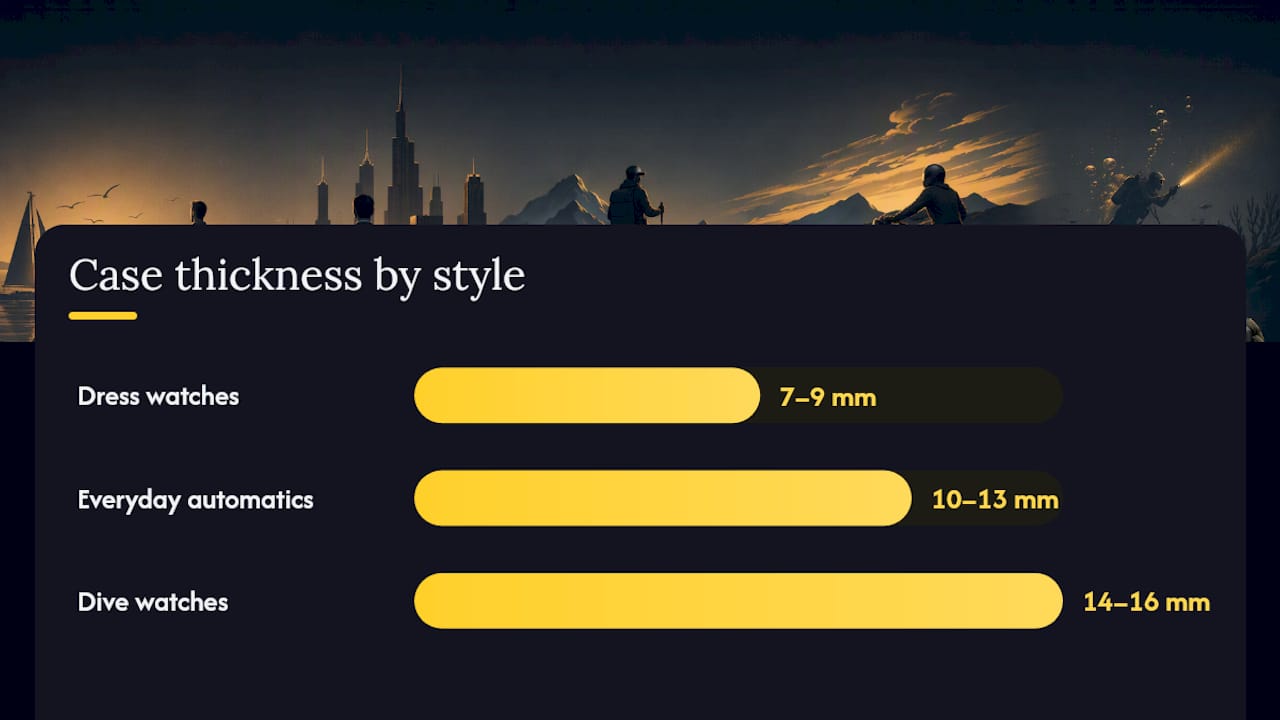
Pick a diameter column that matches your style, then confirm the specific watch’s lug-to-lug stays under your cap. Case thickness matters separately: dress watches typically run 7 to 9mm thick, everyday automatics 10 to 13mm, and dive watches 14 to 16mm, which is why a chunky diver rarely slides under a dress shirt cuff even at a modest diameter.
How Do Case Shape and Dial Design Change Perceived Size?
Diameter tells you almost nothing about how a watch actually reads on the wrist. A round case with a narrow bezel and an edge-to-edge dial looks noticeably larger than a same-diameter watch with a thick bezel and a small dial opening, because your eye follows the visible dial, not the case edge.
Cushion and tonneau cases distort the numbers further. Their corners push the lug-to-lug wider than a round case of identical diameter, which is why some 44mm cushion watches wear bigger than a 46mm round dive watch.
Before buying, check these details in product photos:
- Look for a wrist shot in the listing, not just a flat product photo on a white background.
- Compare bezel width against dial size. A thinner bezel reads larger.
- Note whether the case is round, cushion, tonneau, or square. Cushion and tonneau add visual width.
- Check the thickness spec separately. A thick case often feels more obtrusive than a wider but slimmer one.
Does the Strap or Bracelet Change How a Watch Fits?
Your strap choice affects both comfort and how big the watch looks. Metal bracelets with rigid, straight end links extend the effective lug-to-lug, since the first solid link doesn’t bend with your wrist.
Leather, rubber, and NATO straps flex right where they meet the case, which visually shrinks a larger watch and can make a borderline lug-to-lug measurement wearable. Swapping a bracelet for a soft strap is one of the simplest ways to make an oversized case fit better.
Most watches use a 20mm or 22mm lug width, with 20mm being the most versatile for finding replacement straps. If a bracelet feels stiff on a smaller wrist, try removing links or switching to a curved-end leather band before writing off the size entirely.
Pro Tip: If a watch’s lug-to-lug sits right at your ceiling, choose the leather or rubber strap version over the bracelet. It shaves the perceived overhang without changing the case.
Which Watch Size Fits Your Occasion?
Different use cases prioritize different measurements. Match your priority to the watch’s job.
- Dress watches: Keep diameter modest (36 to 40mm), lug-to-lug short, and thickness under 12mm so the case clears a shirt cuff without a bulge.
- Everyday and elegant-sport watches: You have more room here, roughly 38 to 42mm diameter with moderate thickness, but still check lug-to-lug against your wrist cap before buying.
- Sport and dive watches: Function comes first. Accept a thicker case (14 to 16mm is normal) and a larger diameter, but verify the lug-to-lug doesn’t exceed your ceiling even on a rugged design.
- Final checklist before checkout: Measure your wrist, check the lug-to-lug against your cap, confirm thickness fits your cuff needs, then pick a strap that supports the fit.
Do Men’s and Women’s Watch Sizes Really Differ?
The gap between “men’s” and “women’s” watches is shrinking, but it hasn’t disappeared. Traditional men’s cases run 38 to 46mm, while watches marketed to women often sit between 26 and 36mm. Those labels describe market convention more than biology, though. Wrist size varies enormously within each group, and plenty of women wear 38 to 40mm watches comfortably while some men prefer smaller, minimalist cases.
The real driver is wrist circumference and personal style, not gender. A 6.0" wrist, whether on a man or a woman, generally wants the same 36 to 40mm range and the same 45mm lug-to-lug ceiling. Brands that still segregate by gender are really segregating by average wrist size and aesthetic preference, bundling smaller diameters with thinner cases, delicate bracelets, and quartz movements aimed at lower profiles.
If you’re shopping outside the “expected” category for your gender, ignore the label entirely and measure your wrist the same way anyone else would. A woman with a 7-inch wrist and an interest in dive watches should shop the sport chart, not the women’s chart. A man with a 6-inch wrist looking for a dress watch should size down to 36 to 38mm rather than default to a 42mm because it’s marketed to men.
Unisex sizing, generally in the 34 to 40mm range, has grown for exactly this reason: it lets the wrist measurement decide, not the marketing category.
How Should Occasion Change Your Watch Size?
Formal settings reward restraint. A dress watch worn with a suit works best thin and modest in diameter, generally 36 to 40mm, because it needs to disappear under a cuff and avoid competing with the rest of the outfit. Anything bulky at a formal event reads as trying too hard.
Casual and sport contexts flip that logic. A dive watch or field watch earns extra visual weight because size signals durability and function. A 42 to 44mm sport watch with a thick case looks intentional on a weekend, where the same proportions would feel out of place in a boardroom.
The mistake most buyers make is owning only one watch and expecting it to handle both jobs. A single 44mm dive watch worn to a wedding looks mismatched, just as a delicate 36mm dress watch feels undersized on a hiking trail. If your budget allows for two watches, size one for formal wear (thin, modest diameter, short lug-to-lug) and one for everyday or sport use (larger diameter, thicker case, more lug-to-lug room).
If you only want one watch that flexes across contexts, aim for the middle of your range: a 40mm case with a moderate 12mm thickness splits the difference well for most wrist sizes between 6.5" and 7.5". Swapping straps, a leather band for the office and a rubber one for the weekend, does more to shift a single watch’s occasion than changing the case itself.
How Does Watch Weight Affect All-Day Comfort?
Diameter and lug-to-lug determine whether a watch looks right on your wrist. Weight determines whether you want to keep wearing it by hour six. A dense stainless steel case with a full metal bracelet can weigh two to three times what a similarly sized watch on a leather or rubber strap weighs, and that difference shows up as wrist fatigue, especially on smaller wrists carrying a proportionally large case.
Weight interacts with size in a specific way: a heavy watch with a lug-to-lug that already sits at your ceiling will shift and rotate on your wrist throughout the day, since there’s more mass pulling against a tight margin of clearance. A lighter watch at the same dimensions stays put better because there’s less momentum working against the strap.
Titanium cases solve part of this by cutting weight substantially versus stainless steel at the same dimensions, which is why some larger watches (44mm and up) feel more wearable in titanium than a 40mm equivalent in solid steel. If you have a smaller wrist and want a bigger case for style reasons, a lighter case material or a bracelet swapped for rubber closes much of that comfort gap.
Bracelet clasps matter too. A watch that feels fine sized correctly can still feel heavy if the clasp sits stiffly rather than following the wrist’s curve. Before buying, check whether the model offers a micro-adjustment clasp, since fine-tuning the fit reduces both slack and the sensation of dead weight dragging on one side of your wrist.
What Do People Get Wrong About Watch Size?
The biggest misconception is treating diameter as the whole story. Plenty of buyers reject a 42mm watch as “too big” without checking lug-to-lug, then miss out on a piece that would have fit fine because its lugs tuck in tight. The reverse happens too: someone buys a “safe” 38mm watch that ends up overhanging their wrist because its lug-to-lug runs unusually long for its diameter.
A second myth: bigger always looks more expensive or more serious. Oversized cases on small wrists usually look the opposite, like the watch is wearing the person rather than the other way around. Fit reads as intentional; overhang reads as a mistake.
Third, people assume men’s and women’s sizing rules are fixed biological facts rather than market conventions, which leads them to buy the “wrong” size out of habit rather than measurement. And fourth, buyers often assume a watch that fit them five years ago still fits the same way, ignoring that body composition and even wrist circumference can shift slightly over time.
The fix for all four is the same: measure your actual wrist, check the actual lug-to-lug spec (or measure it yourself if it’s missing from the listing), and let those two numbers override assumptions about size, gender marketing, or what “should” look expensive.
What Sizing Notes Should Guide Your Next Watch Purchase?
Wynwoodblvd builds its Miami-inspired automatic watches around a 40mm case, a size chosen deliberately to sit in the sweet spot for wrists between roughly 6.3" and 7.3". That range covers most buyers without forcing a choice between “too small” and “too big.”
For wrists under 6.3", a slimmer profile or a strap swap to leather generally improves fit more than hunting for a smaller case altogether. For wrists over 7.3", the 40mm diameter still reads well thanks to a lug-to-lug design proportioned to avoid overhang, though a metal bracelet will wear differently than a rubber or leather band on a larger wrist.
Questions about fit for a specific wrist size, or interest in bulk corporate orders with custom dials and engraving, go directly to Wynwoodblvd’s support team through the site.
Which WYNWOOD BLVD Watch Matches Your Wrist?
If your measurements land you in the 40mm range from the chart above, three Wynwoodblvd pieces are built for exactly that fit, and each carries its own Miami-inspired story rather than a generic dial.
The Atlantic Blue Stainless Steel Automatic Watch suits wrists in the 6.3" to 7.3" range looking for a versatile everyday case that moves between casual and slightly dressed-up settings. The Keys Blue automatic works well for readers who measured toward the smaller end of that same range and want a cleaner, more minimalist dial layout. The Everglades Green colorway gives the same 40mm proportions with a bolder dial for anyone who wants their watch to stand out rather than disappear under a cuff.
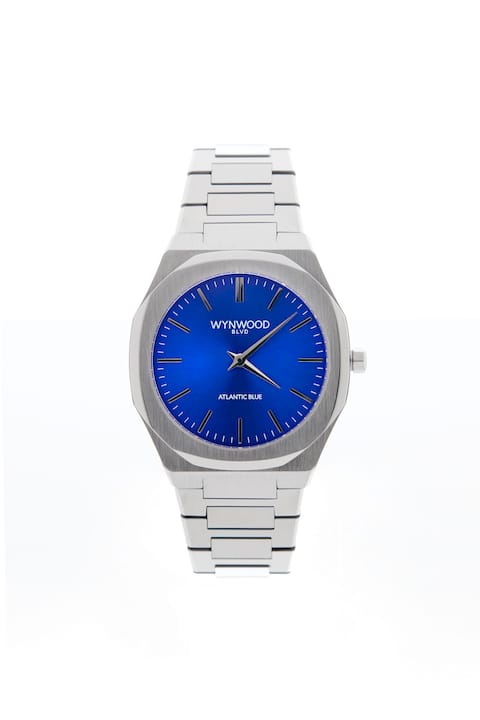
All three ship as automatic movements in stainless steel, sized to the same 40mm case that this guide’s chart flags as the safest bet for most adult wrists. If your measurements put you between sizes, or you’re weighing a bulk order for a corporate gift or hotel merchandise program, reach out to Wynwoodblvd’s support team before you buy. Sizing questions get answered fast, and custom dial or engraving requests for business orders start with the same conversation.
Sources
- Watch Sizes Guide: Diameter, Lug-to-Lug and Thickness | lug²lug
- How to Choose the Right Watch Size - Jewels in Time
- Watch Case Size Guide, wrist to watch in minutes