Automatic vs Quartz: Which Watch Movement Fits You?
Choose quartz if you want a precise, low-maintenance watch you never think about. Choose automatic if you want craftsmanship, mechanical detail, and a piece that could mean something in twenty years. That is the real automatic vs quartz split, and almost every other question in this guide flows from it.
- Quartz’s biggest advantage: accuracy without upkeep. A quartz movement maintains accuracy to within a few seconds per month and needs nothing from you but an occasional battery.
- Automatic’s biggest advantage: mechanical craft and staying power. No battery, no waste, and a movement that can be serviced and passed down for decades.
If you land on the automatic side, Wynwoodblvd builds stainless steel automatics designed around Miami and coastal themes, worth a look before you commit to a movement type.
Key Takeaways
Quartz delivers the highest accuracy and lowest upkeep, while automatic delivers mechanical craftsmanship and long-term collectibility at the cost of periodic servicing.
| Point | Details |
|---|---|
| Accuracy gap is real | Standard quartz holds ±15 seconds a month versus seconds per day for standard automatics. |
| Maintenance costs differ in shape | Quartz needs a cheap battery every 1 to 3 years; automatics need a $200 to $400 service every 5 to 7 years. |
| Power reserve matters for rotation | Automatics typically stop after 38 to 72 hours unworn, so daily wearers benefit most. |
| Collectibility favors automatic | Mechanical craftsmanship tends to drive resale and heirloom value more than accuracy does. |
| Wynwoodblvd covers the automatic side | Atlantic Blue, Keys Blue, and Sunset Orange give buyers three coastal-themed automatic options at different style points. |
Table of Contents
- How Do Automatic and Quartz Movements Actually Work?
- How Much More Accurate Is Quartz Than Automatic?
- Which Movement Fits Your Lifestyle and Budget?
- What Makes Wynwoodblvd’s Automatics Worth Considering?
- Which Wins: Automatic or Quartz?
- Find Your Next Automatic With Wynwoodblvd
- Sources
How Do Automatic and Quartz Movements Actually Work?
A quartz watch runs on a battery that sends current through a small circuit, which vibrates a quartz crystal at exactly 32,768 times per second. A stepping motor counts those vibrations and moves the second hand once per second, which is why quartz watches “tick” instead of glide.
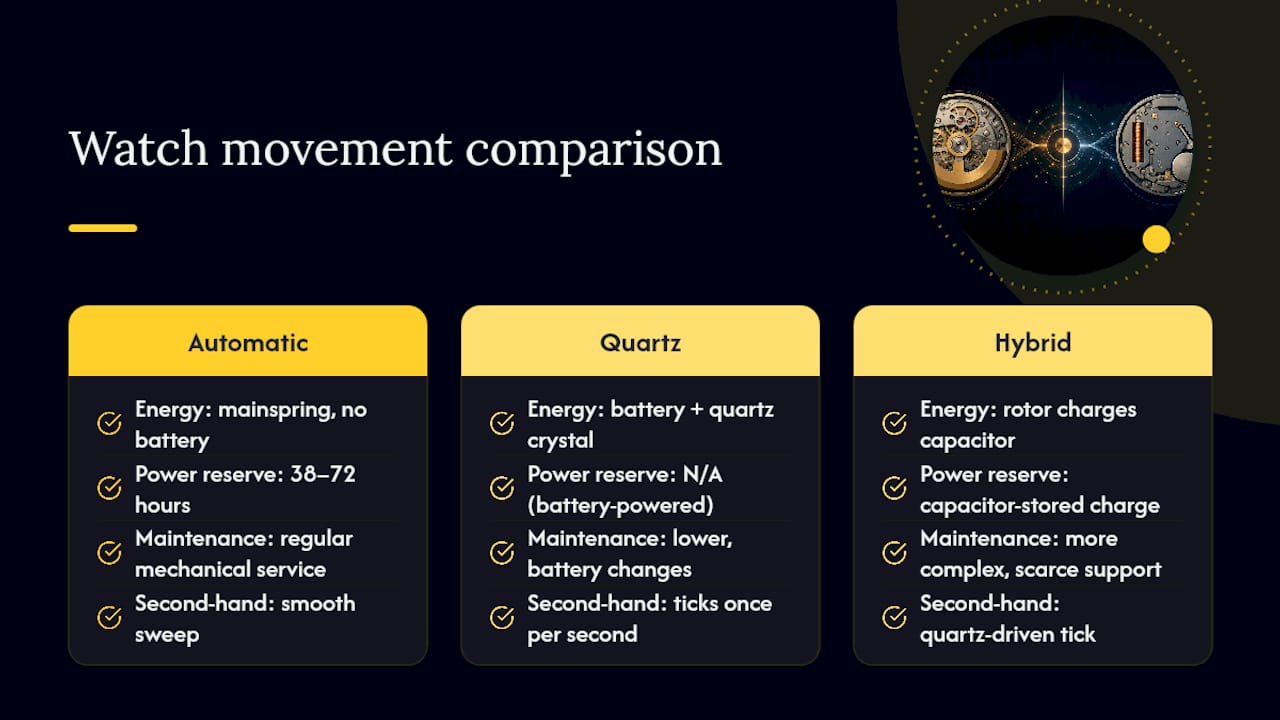
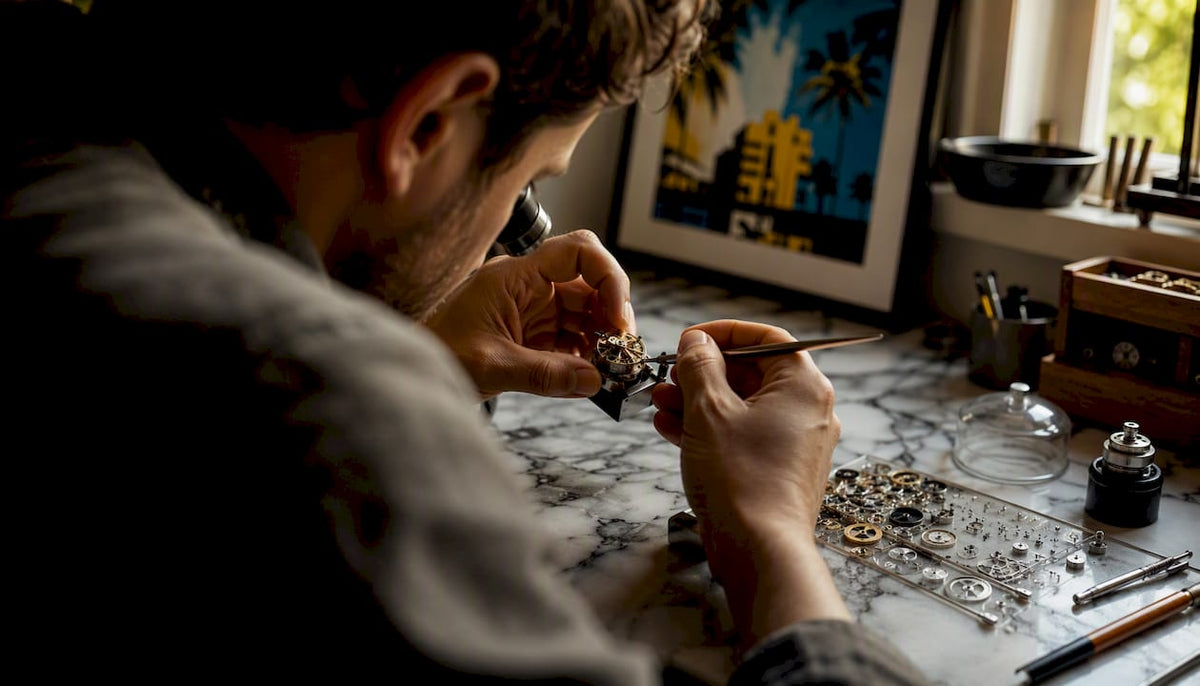
An automatic watch has no battery at all. A coiled mainspring stores energy, released through a chain of gears and regulated by an escapement, the same basic system Swiss watchmakers have refined for centuries. A rotor swings with your wrist motion and winds the mainspring automatically, building what’s called a power reserve, typically 38 to 72 hours depending on the caliber. Because the escapement releases energy in tiny continuous bursts rather than discrete ticks, the second hand appears to sweep rather than jump.
A third category worth knowing: automatic-quartz hybrids, sometimes called Autoquartz or Kinetic movements. These use a rotor to generate electricity instead of winding a spring, storing that charge in a capacitor to run a quartz circuit. Seiko and ETA both built versions of this hybrid technology historically, aiming for quartz-level accuracy without battery waste. They never caught on widely, mostly because they added cost and complexity without a clear enough benefit over either pure system.
Pro Tip: If you’re drawn to the idea of “never touching a battery,” an automatic-quartz hybrid sounds ideal on paper, but they’re now largely discontinued in current production. A standard automatic or a solar quartz will serve you better in 2026.
How Much More Accurate Is Quartz Than Automatic?
The accuracy gap is bigger than most first-time buyers expect. A standard quartz watch runs accurate to about ±15 seconds per month. A standard automatic movement, even a well-made one, typically drifts by seconds per day, which adds up to several minutes a month.
±4 seconds a day. That’s the accuracy standard for COSC-certified automatics, the official Swiss chronometer rating, have tighter standards than most automatics but are still less precise than basic quartz.
Premium quartz variants close the gap from the other direction. Movements like Seiko’s 9F, Citizen’s Caliber 0100, and various V.H.P. calibers reach ±5 seconds per year or better, a level no mechanical movement touches, including Spring Drive hybrids that use a quartz-regulated glide wheel instead of a traditional escapement.
Ownership costs follow a similar pattern of small recurring versus larger occasional. Quartz batteries need replacing every few years, often for a modest cost. Automatics need a full service roughly every 5 to 7 years, typically running $200 to $400 for mainstream brands.
A few durability notes matter here too:
- Automatics are more sensitive to magnetism and hard shocks, which can throw off timing until adjusted.
- Quartz movements shrug off both far better, thanks to their simpler electronic design.
- Leave an automatic unworn for more than a day or two and it stops cold, since the mainspring has nothing to keep it running.
Which Movement Fits Your Lifestyle and Budget?
Your daily habits matter more than spec sheets here. A commuter who wants to glance at a wrist and trust the time without thought is a quartz buyer, full stop. A frequent traveler crossing time zones benefits from quartz’s stability, though a solar or Eco-Drive style model removes battery anxiety entirely. A gift buyer often leans automatic, since the sweeping hand and visible movement read as a more considered present. A budding collector or anyone thinking about resale value should lean automatic too, since mechanical craftsmanship and finishing tend to drive collector interest and long-term value more than raw precision.
Run through this checklist before you buy:
- Rank your top priority. Decide if precision, low maintenance, or mechanical character matters most to you.
- Be honest about wear habits. If you rotate watches often, an automatic will stop between wears.
- Factor in your tolerance for service visits. Quartz means occasional battery swaps; automatic means a service appointment every several years.
- Consider resale and sentiment. Automatics hold collector and heirloom appeal that quartz typically doesn’t match.
- Match the aesthetic to your taste. A ticking second hand versus a smooth sweep is a real visual difference once you start looking for it.
Two common red flags and quick fixes: if you love automatics but don’t wear one daily, a watch winder solves the “stopped watch” problem cheaply. If you want zero maintenance but still want a premium feel, a high-accuracy or solar quartz model splits the difference nicely.
Pro Tip: Before buying an automatic as a second or third watch, check its power reserve. A 40-hour reserve means it dies by Monday if you last wore it Friday night.
What Makes Wynwoodblvd’s Automatics Worth Considering?
Wynwoodblvd designs stainless steel automatic watches around real coastal locations, giving each piece a specific identity rather than a generic dial. If you’ve decided automatic is your movement, three models cover distinct buyer profiles.
- The Atlantic Blue automatic suits buyers who want a versatile daily piece with a deep blue dial that works from office to evening.
- The Keys Blue automatic fits a more minimalist, dress-leaning taste at 40mm, ideal for someone who wants understated mechanical detail.
- The Sunset Orange automatic fits buyers who want their movement choice to show. Its warm dial color makes the appeal visible at a glance, not just felt on the wrist.
For more style context, see our roundup of minimalist automatic watches or browse stainless steel automatic alternatives within the catalog.
Which Wins: Automatic or Quartz?
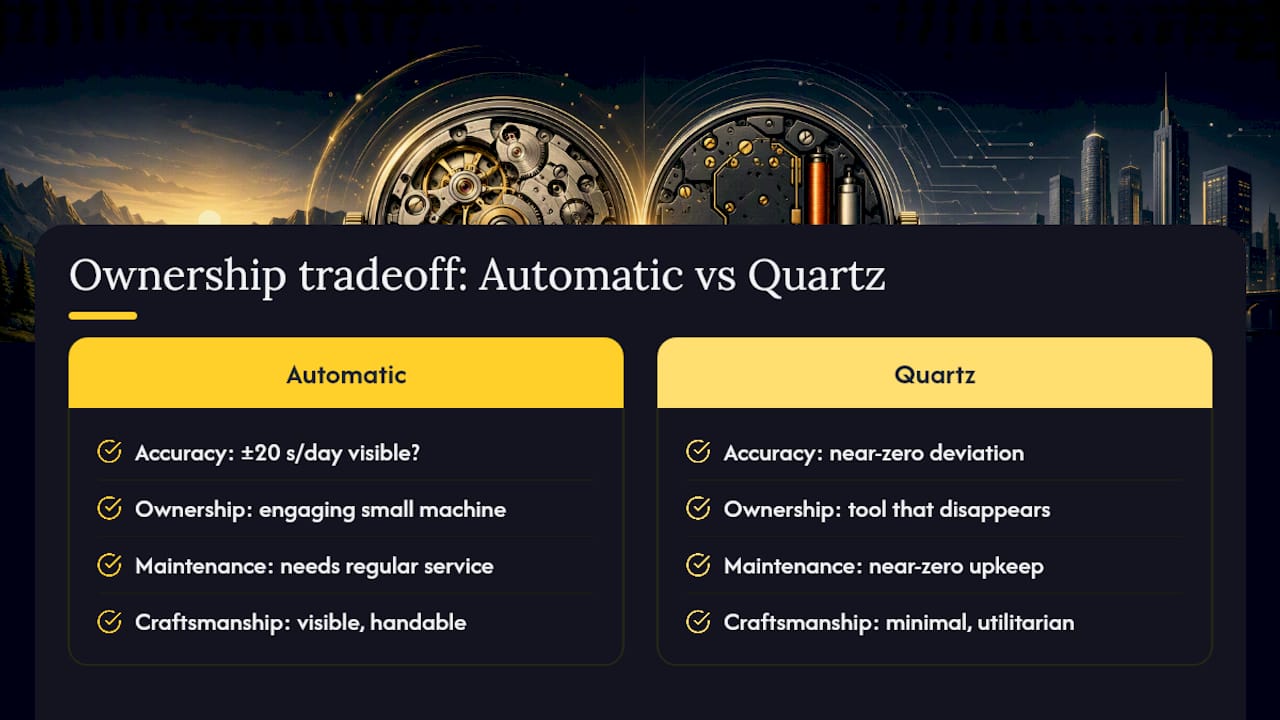
Conventional advice treats this as a simple tradeoff between accuracy and romance, and that framing undersells both sides. Quartz isn’t just “more accurate,” it’s a fundamentally different ownership experience: near-zero mental overhead, at the cost of a small piece of craftsmanship most owners never miss. Automatic isn’t just “less accurate,” it’s a mechanical object with moving parts you can watch, service, and hand down, at the cost of real, recurring attention.
Where I think most buying guides get it wrong is treating accuracy as the deciding factor at all. Unless you’re setting your watch against an atomic clock daily, ±20 seconds a day is invisible in practice. The real question is whether you want to own a small machine that requires your engagement, or whether you want a tool that disappears into the background of your day.
Prioritize that question first. Everything else, price, brand, dial color, is secondary to it.
Find Your Next Automatic With Wynwoodblvd
If the case for automatic movements made sense to you, Wynwoodblvd gives you a direct way to act on it, without hunting through dozens of brands to find a design with actual identity behind it. Every Wynwoodblvd automatic ties back to a real coastal place, Miami, the Florida Keys, a Wynwood sunset, so you’re not just buying a movement type, you’re buying a specific story on your wrist.
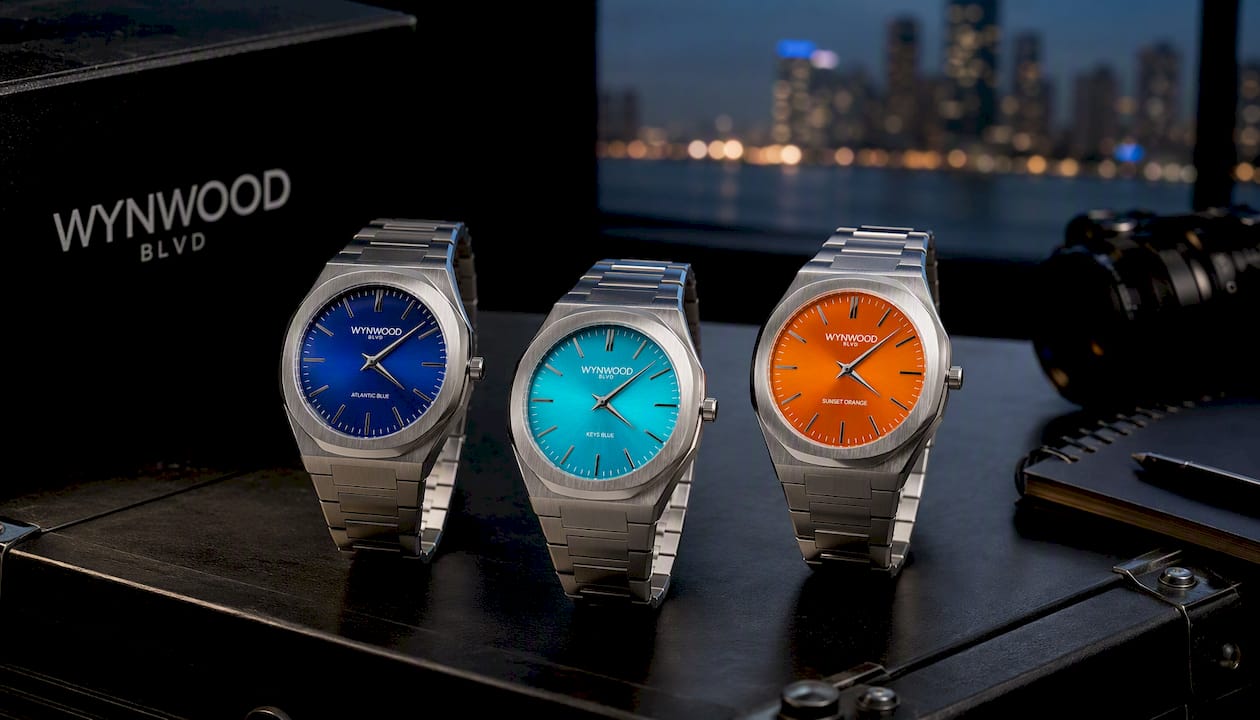
Compare the Atlantic Blue, Keys Blue, and Sunset Orange automatics side by side and check specs like water resistance and case size before you decide. If you’re buying for a team or client gifts, Wynwoodblvd also handles custom branded automatics with logo engraving and dial customization for bulk orders. Pick the model that matches your style and add it to your cart today.
Sources
- Automatic Vs. Quartz Watch: The Honest Comparison 2026
- Automatic vs Quartz vs Manual: Watch Movements Explained for Beginners - We Know Watches
- Automatic quartz - Wikipedia