Keep Lug to Lug Under 48mm: Designer Fit for Watches on Small Wrists
If your wrist is small, aim for a case diameter under 38mm and a lug-to-lug span of 48mm or less, then let strap and thickness fine-tune the fit. Diameter alone won’t tell you if a watch will overhang your wrist. Lug-to-lug will. Two numbers, one measuring tape, and a few minutes with a dollar bill is really all this takes.
TL;DR:
- Watches for small wrists should have a case diameter of 34 to 38mm, with a lug-to-lug span of 48mm or less to avoid overhang.
- Measuring wrist flat width and circumference provides a more accurate estimate of suitable watch size than diameter alone.
- Lug-to-lug measurement and case shape, especially for rectangular and square designs, are more critical than diameter in ensuring a proper fit.
- Thinner bezels and simple dial layouts make small watches appear larger and more comfortable for daily wear.
- Strap and bracelet designs, including tapering and adjustability, significantly impact comfort and perceived size on small wrists.
Table of Contents
- How Do You Measure Your Wrist for a Watch?
- What Case Diameter Works Best for Small Wrists?
- Why Lug-to-Lug Matters More Than Diameter
- Do Thickness and Dial Design Affect Perceived Size?
- How Should Straps and Bracelets Fit a Small Wrist?
- Which Watch Shapes and Styles Suit Small Wrists?
- How Do You Apply These Numbers When Shopping?
- What Do Wrist Shape and Strap Geometry Change About Fit?
- How Wynwood Blvd Designs for Smaller Wrists
- Wynwood Blvd Watches Built With Small-Wrist Proportions in Mind
- Sources
- FAQ
How Do You Measure Your Wrist for a Watch?
Wrap a soft tape measure around your wrist, right where you’d wear a watch, just past the wrist bone. Note the number in inches or centimeters, and don’t pull it tight. You want the same snugness a watch band would have.
No tape measure handy? A US dollar bill measures 6 inches long (one full bill wrapped once around a wrist that’s exactly six inches around gives you a rough baseline). Wrap it around your wrist and see how much overlaps or how much room is left.
You also need wrist width, not just circumference. Lay your wrist flat on a table and measure straight across the top, bone to bone. This number matters more than circumference when you’re comparing lug-to-lug specs, since it reflects the actual flat surface a case has to sit on.
A few things worth writing down while you measure:
- Where your wrist bone sits relative to where you want the watch face to land
- Whether your wrist feels flatter or rounder than average (it changes how a case sits)
- Both circumference and flat width, since sellers rarely ask for both, but you’ll need both
What Case Diameter Works Best for Small Wrists?
Wrist circumference maps fairly predictably to comfortable case diameter, and the pattern holds across most brands:
- 5.5 to 6.0 inches: 34 to 36mm
- 6.0 to 6.5 inches: 36 to 38mm
- 6.5 to 6.75 inches: up to 38 to 39mm, with lug-to-lug becoming the deciding factor
Industry sizing guidance generally caps wrists under 6.5 inches at around 38mm, with 38 to 42mm reserved for the 6.5 to 7.5 inch range. That’s a useful default, not a hard ceiling.
You can break the rule when the case shape compensates. Square and rectangular cases wear smaller than their diameter suggests, since there’s no rotating bezel eating into the visual footprint. Vintage-proportioned pieces with slim bezels and small lugs also cheat the numbers.
So, is 40mm too big for a small wrist? Usually, yes, unless the lug-to-lug is unusually short for that diameter. Is 37mm small? Not really. It’s a classic, well-proportioned size that a growing number of wearers are choosing on purpose rather than settling for.
Why Lug-to-Lug Matters More Than Diameter
Diameter tells you how wide the dial looks. Lug-to-lug tells you whether the watch physically fits on your arm without hanging off the edges. A 38mm watch with long, flat lugs can overhang a small wrist worse than a 40mm watch with short, curved ones.
For wrists under about 6.5 inches, keep lug-to-lug at 48mm or under. A 6-inch wrist (about 152mm) points to a lug-to-lug ceiling closer to 46 to 48mm.
Three things to check before buying:
- Look up the lug-to-lug spec directly, not just diameter, since many listings bury or omit it.
- Compare that number against your flat wrist width, not your circumference.
- Study product photos shot straight down the wrist. If the lugs visibly extend past the wrist’s edge, that’s your answer.
Do Thickness and Dial Design Affect Perceived Size?
Thickness changes how a watch feels more than how it looks, but bezel width and dial layout change how big it appears at a glance. A thin bezel widens the visible dial opening, so a 36mm watch with a slim bezel can read larger than a 38mm watch with a chunky one.
For daily wear, thinner cases are generally more comfortable, especially on small wrists, with thicker cases potentially catching on cuffs and sleeves more often.
- Favor low-dome or flat crystals if you wear the watch under sleeves often
- Choose simple, uncluttered dials over busy chronograph layouts at small diameters
- Check whether the listed thickness includes the crystal, since many spec sheets don’t
Pro Tip: Brands frequently exclude crystal height from the stated case thickness. A domed crystal can add 0.5 to 1.5mm to how the watch actually sits on your wrist, so add that buffer mentally before you buy.
How Should Straps and Bracelets Fit a Small Wrist?
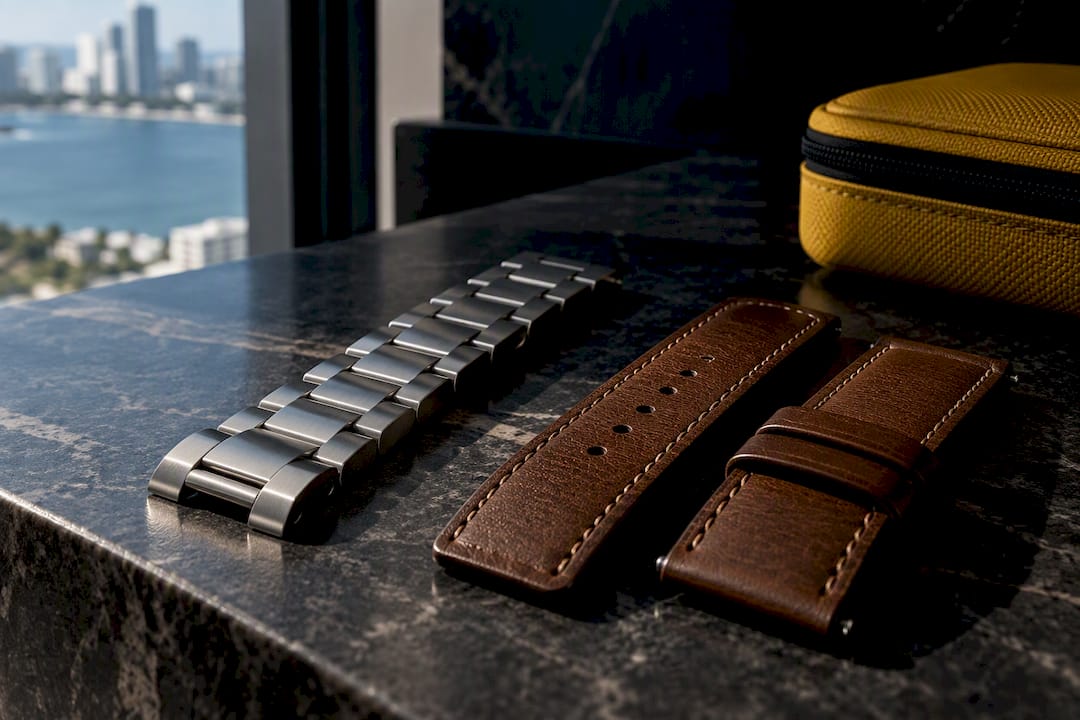
Lug width sets the tone before the strap even touches your skin. Most small-wrist watches start at 18 to 20mm lug width, and a strap that tapers down toward the buckle, say from 20mm at the lugs to 16mm at the clasp, visually narrows the whole piece.
Bracelets need more attention to adjustability than straps do. Look for micro-adjust clasps or half-link options, since a bracelet that’s one link too big will shift constantly and make a well-sized case feel larger than it is.
A few fit notes worth remembering:
- Softer, more flexible strap materials hug the wrist and reduce visual bulk compared to stiff, thick leather
- A strap that curves close to the wrist right at the lugs reads narrower than one that sits flat and stiff
- Rubber and fabric straps typically taper more naturally than metal bracelets
Which Watch Shapes and Styles Suit Small Wrists?
Round watches aren’t the only option, and for smaller wrists, they’re often not the best one. Rectangular and square cases distribute their footprint differently. A 34mm square case can carry more visual presence than a 36mm round one, without adding lug-to-lug length.
Compact field watches and divers still work, but the deciding factor is lug-to-lug and thickness, not the category itself. A 38mm diver with a long lug-to-lug span will overhang a small wrist regardless of how much you like the dive-watch look.
- Rectangular and tank-style cases often wear smaller than their listed dimensions suggest
- Simple dials with modest index sizing let a smaller case look deliberate rather than undersized
- Thin bezels, as noted earlier, expand the visible dial without changing the physical footprint
Reviewers covering brands returning to smaller proportions, including Ralph Lauren’s 867 collection, have noted how well 28 to 32mm cases wear on smaller wrists precisely because the shape and dial layout carry the design, not sheer size.
How Do You Apply These Numbers When Shopping?
Here’s the cheat sheet in one place: 34 to 38mm diameter for most wrists under 6.5 inches, lug-to-lug under 48mm, case thickness under 10mm where comfort matters, and lug width around 18 to 20mm for a strap that tapers well.
Reading a real spec sheet means checking four fields in order: diameter, lug-to-lug, thickness (and whether crystal height is included), then lug width. If a listing skips lug-to-lug entirely, that’s a red flag worth a quick email to the seller before buying.
- Start with lug-to-lug, since it’s the number most listings bury or omit
- Cross-check thickness against your cuff or sleeve fit, not just the spec number
- Confirm strap taper in product photos, since taper rarely shows up in the written specs
A buying checklist that puts fit ahead of style saves more returns than any other single habit shoppers can build.
What Do Wrist Shape and Strap Geometry Change About Fit?
Flat wrists tolerate longer lug-to-lug spans than round wrists of the same circumference, since a flat surface gives the case more room to sit without curving off the edge. A tapered strap or curved lug design can rescue a borderline case that would otherwise overhang a round wrist.
Two home tests settle most doubts: the flip-watch test (turn the watch face down and see how the lugs sit against your wrist) and the tilt test (look straight down at your wrist and check if any edge extends past the skin).

How Wynwood Blvd Designs for Smaller Wrists
We build toward slimmer lug-to-lug proportions and tapered strap geometry rather than chasing oversized dials, because that’s what actually solves fit problems on smaller wrists. Our approach draws on the same measurement principles covered above. If you want to see how it plays out in an actual collection, the Wynwood Blvd watches lineup is a good place to start.
— Mathias
Wynwood Blvd Watches Built With Small-Wrist Proportions in Mind
Most fashion watch brands still design around a one-size-fits-all case, which leaves smaller wrists stuck choosing between “too big” and “no style at all.” Watches can be designed with lug-to-lug and strap taper considered from the start, rather than added as an afterthought, drawing from Miami-inspired minimalism.

The Atlantic Blue Stainless Steel Automatic Watch pairs a clean dial with a slim bezel, the kind of design detail that helps a compact case read larger without adding bulk. The Keys Blue Miami Inspired Watch and the Everglades Green Miami Inspired Watch both carry the same minimalist dial layout and stainless steel construction, letting the case shape and strap taper do the work instead of oversized dimensions.
Try the tape measure and dollar-bill test from earlier before you order, then browse the full Miami Inspired Watches collection to compare specs against your own numbers. If you’re shopping for a team, hotel, or brand gift program instead, the Corporate Custom Watches option lets you apply the same fit logic across a bulk order.

Sources
For deeper technical detail on the numbers used throughout this guide, these three resources cover the specifics:
- What Size Watch Should I Get? | lug²lug
- How tight should a watch be? The complete watch fitting guide | TrueFacet
- Watch sizes (insight on small-watch aesthetics) | Teddy Baldassarre
FAQ
Is 40mm too big for a small wrist?
Usually, yes, unless the lug-to-lug measurement is unusually short for that diameter. A 40mm case with a lug-to-lug under 46mm can still work on a 6-inch wrist, but most 40mm watches will overhang wrists under 6.5 inches.
Is a 37mm watch small?
It’s on the smaller side by modern standards, but not undersized. It sits squarely in the recommended range for wrists between 6 and 6.5 inches and reads as a classic, intentional proportion rather than a compromise.
Is a 7 inch wrist considered small?
No, 7 inches falls into the average-to-larger range for most sizing charts, which typically treat wrists under 6.5 inches as small. A 7-inch wrist usually handles diameters up to 40 to 42mm comfortably.
What watches are best for small wrists?
Look for cases between 34 and 38mm with a lug-to-lug under 48mm, a thickness under 10mm, and a tapered strap. Wynwoodblvd’s Miami Inspired Watches collection follows these proportions across its stainless steel automatic models.
How do I convert wrist circumference to a watch size?
Measure your wrist in inches or centimeters, then match it against diameter bands: 5.5 to 6.0 inches suits 34 to 36mm, and 6.0 to 6.5 inches suits 36 to 38mm. Always confirm lug-to-lug separately, since it changes the fit more than diameter alone.