Annealing vs Removal: Engraving vs Etching Jewelry on Stainless Steel
Engraving removes measurable metal to cut tactile, long-lasting marks. Etching, whether chemical or laser, alters only the surface for shallow, high-contrast marks made fast. Choose engraving for heirlooms and anything that needs to survive decades of handling. Choose etching or laser marking for decorative work, branding, or batch orders. On plated pieces or stainless steel, ask about depth first. Cutting too deep can breach a finish or a protective layer you didn’t know was there.
TL;DR:
- Deep engraving removes metal to create lasting, tactile marks, making it ideal for heirlooms and pieces exposed to heavy wear, especially on stainless steel.
- Etching alters only a surface layer, producing shallow, high-contrast marks suitable for decorative purposes, branding, or batch orders, but less durable over time.
- The depth of the mark and whether it breaches the protective oxide layer on stainless steel determines its long-term resistance to corrosion and fading.
- Laser engraving offers precise depth control without a hand tool, while chemical etching uses acid and lacks abrasion resistance, impacting durability.
- For water-exposed or highly abrasive environments, prioritize engraving or annealing over etching to ensure the mark survives decades of wear.
Table of Contents
- Engraving vs Etching Jewelry: A Quick Side-by-Side Look
- How Does Engraving Actually Cut Into Metal?
- How Does Etching Create a Surface Design?
- Which Metals and Finishes Work Best With Each Method?
- Which Mark Holds Up Better Over Years of Wear?
- What Are the Corrosion and Care Risks After Marking?
- How Do You Choose Between Engraving and Etching?
- How Wynwoodblvd Approaches Personalization on Watches and Charms
- Our Take: Depth Matters More Than People Assume
- Personalizing a Wynwoodblvd Watch or Charm
- Sources
- FAQ
Engraving vs Etching Jewelry: A Quick Side-by-Side Look
The core difference comes down to physics: engraving physically removes metal, while etching alters or vaporizes only a thin surface layer. That distinction drives everything else, from how deep the mark runs to how it reads under a light.
Engraving typically cuts a visible channel you can feel with a fingernail. Etching stays close to the surface, sometimes measured in microns rather than fractions of a millimeter, and reads as more of a stain or texture than a groove.
- Depth: engraving removes material; etching alters or vaporizes a top layer only
- Look: engraving produces tapered, faceted lines; etching tends toward flat, uniform-width marks
- Variants: hand engraving, mechanical/rotary engraving, laser engraving, chemical or photo-etching, laser etching
- Cost and turnaround: hand engraving runs slower and pricier; etching and laser marking scale faster for multiples
The difference in metal removed between the two methods is exactly why one gets chosen for a wedding band meant to last a lifetime and the other gets chosen for a run of 500 branded charms.
How Does Engraving Actually Cut Into Metal?
Hand engraving uses a burin, a small hand-pushed or hammer-driven blade that carves a groove directly into the metal. Because the tool tapers as it enters and exits a cut, the resulting line swells in the middle and narrows at each end, giving the mark a three-dimensional quality no flat process can fake.
Mechanical or rotary engraving swaps the hand tool for a spinning bit guided by a machine, which is why it dominates consistent text and logo work where every letter needs to match. Laser engraving takes a different route entirely: it uses repeated passes to remove measurable depth rather than a single stroke, building a recessed, tactile mark pass by pass.
- Hand engraving: best for one-of-a-kind pieces with visible tool character
- Rotary engraving: best for repeatable logos and text at scale
- Laser engraving: best for depth control without a hand tool
Pro Tip: Ask whether “engraving” on a quote means a single laser pass or several. One pass often looks closer to etching than true engraving once you run a fingernail across it.
How Does Etching Create a Surface Design?
Chemical, or photo-etching, borrows its workflow from printmaking: a protective ground covers the metal, a design gets exposed through a mask, and acid “bites” into the unprotected areas. This method has roots in traditional printmaking on copper and other soft sheet metals, and it remains popular anywhere fine surface texture matters more than depth.
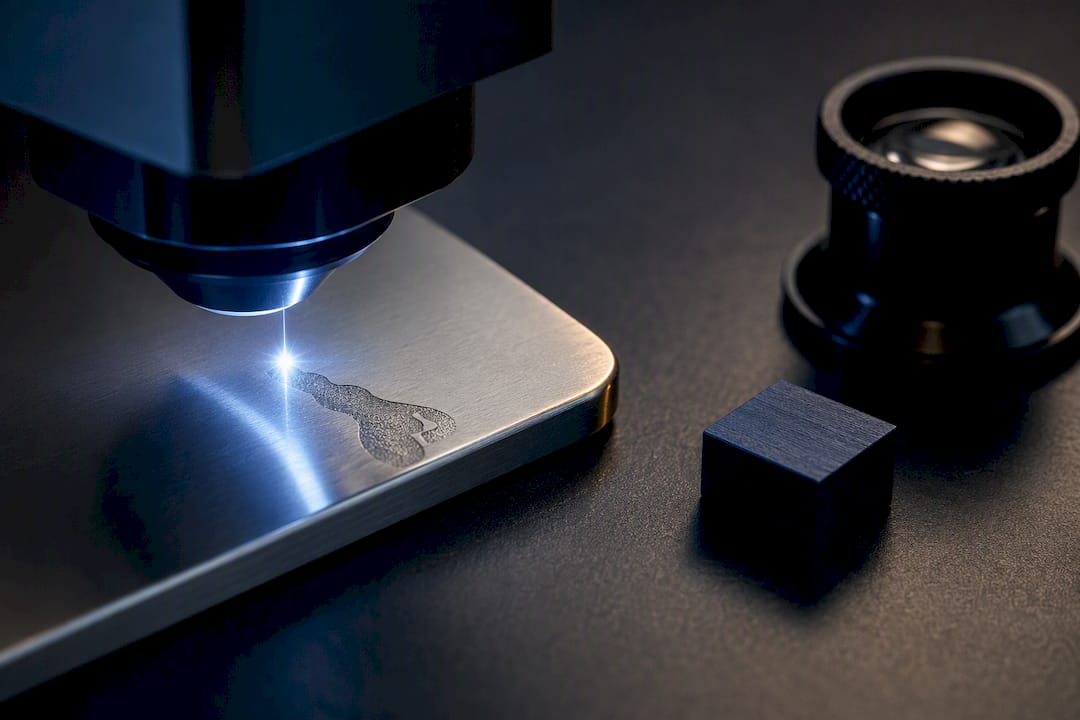
Laser etching works on a different principle. Instead of an acid bath, a laser vaporizes a thin surface layer almost instantly, which is why it’s the go-to for fast, high-contrast marking on production runs. On stainless steel specifically, laser etching and laser engraving are distinct processes: etching vaporizes a shallow layer, engraving removes real depth through repeated passes.
- Chemical/photo-etching: acid-based, detailed, historically used on copper and silver
- Laser etching: fast, shallow, ideal for logos and serial numbers
- Neither method is built for abrasion resistance the way deep engraving is
Which Metals and Finishes Work Best With Each Method?
Gold and silver both accept engraving and etching well, since their softness makes hand tools and acid baths equally effective. Stainless steel is trickier. Fiber lasers running at 1064nm are the standard tool here, and the choice between annealing, etching, or deep engraving changes how the piece holds up long term.
Annealing darkens the surface through oxidation without removing any metal, which preserves the passive chromium-oxide film that gives stainless steel its corrosion resistance. Etching and deep engraving both cut into that film, and breaching it can create localized corrosion sites, particularly on pieces exposed to saltwater or humid air.
- Gold/silver: both methods work, engraving lasts longer
- Stainless steel: prefer annealing when corrosion resistance matters
- Plated pieces: confirm base metal before any deep marking, since exposing it can trigger fast discoloration
- Titanium: hard alloys favor laser marking over hand tools, which struggle to bite the surface
Which Mark Holds Up Better Over Years of Wear?
You can usually tell the two apart just by looking closely. Engraved lines flow smoothly and swell before tapering to a point, while etched lines hold a consistent width with rounded ends, a visual signature that survives even after the metal has aged.
Deep engraving resists abrasion because there’s real material removed. A ring that gets bumped against countertops for twenty years still shows its engraving; a shallow etch on the same ring risks fading into a ghost of itself. Polishing accelerates that fade, since a buffing wheel removes microns of surface with every pass, and etched marks have far fewer microns to spare than engraved ones.
Plating adds another variable: it can sit on top of an etched design and mute its contrast, or it can wear away and reveal a mark that was never meant to be seen at that depth.

What Are the Corrosion and Care Risks After Marking?
Any process that removes material, whether that’s an acid bath or a deep engraving pass, risks breaching the passive layer on stainless steel and opening a localized corrosion site. That risk rises sharply for pieces headed for the beach or the shower every day.
Plating carries its own hazard: puncture through a thin gold or rhodium layer and you expose whatever base metal sits underneath, which often discolors fast. Confirm plating thickness before requesting anything deep.
- Rinse jewelry after saltwater or sweat exposure, ideally within 20 to 30 minutes
- Avoid prolonged chlorine or acidic cleaner contact on engraved or etched areas
- Ask your jeweler about passivation treatments for stainless steel after deep marking
- Request a proof before production on any custom order
Pro Tip: If a piece will see regular moisture, ask specifically whether the vendor can anneal the mark instead of cutting it. It’s the difference between a design that lasts and one that starts pitting within a year.
How Do You Choose Between Engraving and Etching?
- Define the wear pattern. Daily wear near water or friction favors engraving or annealing; occasional-wear decorative pieces tolerate etching fine.
- Decide how permanent you need the mark. Etching and shallow laser marks suit decorative items well, while deep engraving fits pieces meant to carry a tactile, lasting inscription, like a wedding band or a family heirloom.
- Check the base material. Stainless steel, gold, and plated pieces each carry different risk profiles, so confirm what you’re actually marking before committing.
- Ask the vendor pointed questions. Depth of cut, laser type, annealing versus material removal, proof policy, and passivation options all belong on that list.
- Budget for turnaround. Hand engraving takes longer and costs more per piece; laser etching scales faster for multiples, which is why most bulk or corporate orders lean that direction.
How Wynwoodblvd Approaches Personalization on Watches and Charms
Mathias has spent time researching how stainless steel behaves under laser marking, particularly the annealing-versus-removal trade-off that determines whether a piece keeps its corrosion resistance. That research shapes how Wynwoodblvd thinks about personalization on watches and charms.
For pieces likely to see saltwater or daily wear, annealing marks are often the safer route since they preserve the passive layer that protects stainless steel from pitting. Customers requesting bulk or branded orders should expect a proof step before production, and should ask directly whether a design will be annealed, etched, or engraved.
Our Take: Depth Matters More Than People Assume
Most buyers treat “engraving” and “etching” as interchangeable marketing words, and that’s where the trouble starts. The research is fairly consistent on one point: how much metal actually gets removed determines whether a mark survives a decade of wear or fades within a couple of years. That single variable, not the branding on the invoice, is what should drive your decision.

Where conventional advice falls short is in treating stainless steel like gold or silver. Soft precious metals forgive a lot; stainless steel does not, because its corrosion resistance depends on an intact passive layer that any deep cut or acid bite can breach. Annealing gets overlooked constantly, even though it’s often the smarter choice for anything that will touch water regularly.
If you’re commissioning a piece, prioritize this question above all others: how deep is this mark, and does it remove material or just alter the surface? Get a straight answer before you get a quote. Everything else, cost, turnaround, even aesthetics, is secondary to that one structural fact.
— Mathias
Personalizing a Wynwoodblvd Watch or Charm
This brand builds every piece with personalization in mind, and the approach changes depending on the product and material. Watches like the Sunset Orange Miami Inspired Watch, the Keys Blue Miami Inspired Watch, the Atlantic Blue Stainless Steel Automatic Watch, and the Everglades Green Miami Inspired Watch are all built on stainless steel cases suited to careful laser marking.
Charms like the Palm Tree Charm in Silver Signature Painted, the Palm Tree Charm in Gold Classic, and the Palm Tree Charm in Gold Signature Painted work well for lighter surface personalization since their painted finishes call for shallower marking than a raw steel case.
Businesses looking for bulk or logo work should start with the Corporate Custom Watches page, where Wynwoodblvd handles proofing and depth questions before production runs begin. Individual shoppers can browse the Miami Inspired Watches collection or the Palm Tree Charms collection to find a piece worth personalizing. Reaching out through available contact options can help start a proof before committing to a design.
Sources
- Woodcut, engraving, or what? – Folger
- Laser engraving stainless steel: Processes, grades & clean marks — Thunder Laser USA
- Etching vs Engraving: What’s The Difference? — Cookson Gold
FAQ
Which Is Better, Etching or Engraving?
Neither is universally better; each fits a different goal. Engraving suits pieces that need deep, lasting marks that survive decades of wear, while etching suits decorative work, branding, or fast production runs where shallow contrast is enough.
How Much Do Jewelers Charge for Engraving?
Pricing varies by jeweler, complexity, and whether the work is hand done or laser assisted, and Wynwoodblvd does not publish a flat engraving rate. Current pricing for personalization requests through Corporate Custom Watches is available directly on that page.
How Can You Tell an Engraving From an Etching?
Look closely at the line itself. Engraved lines flow smoothly and swell before tapering to a point, while etched lines stay a consistent width with rounded ends, and engraving usually feels raised or recessed under a fingernail in a way etching doesn’t.
What Are the Disadvantages of Etching?
Etching stays shallow, which means it fades faster under polishing or heavy abrasion than a true engraved cut. On stainless steel, etching can also breach the passive oxide layer that resists corrosion, raising the risk of pitting on pieces exposed to saltwater or sweat.