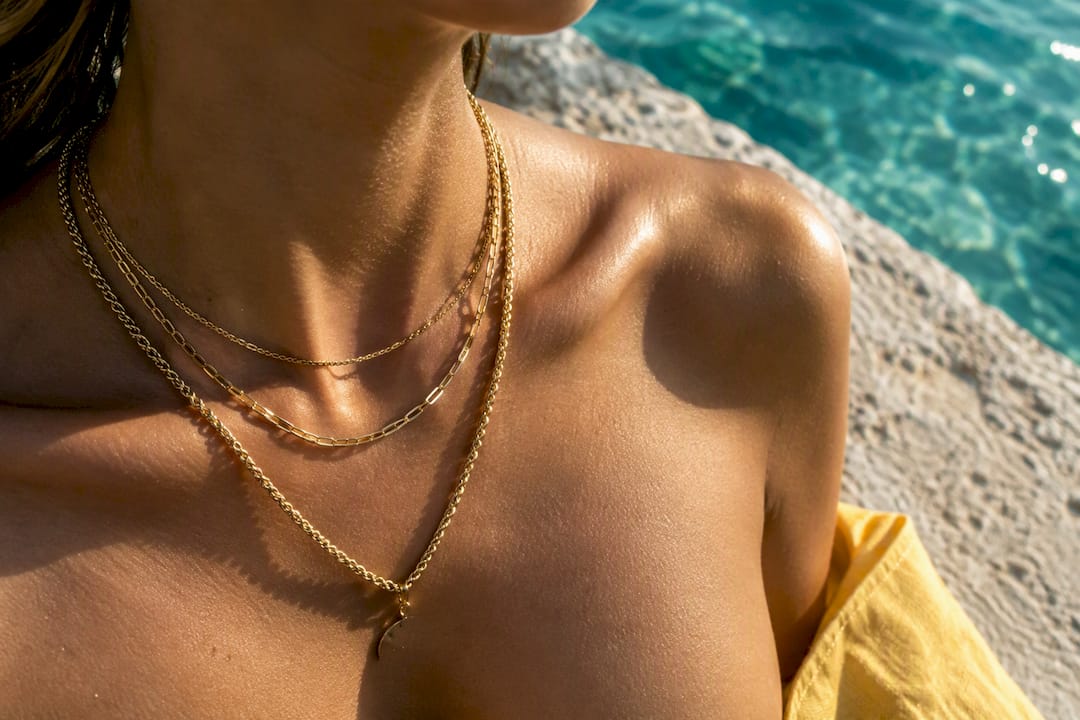
3-Piece Miami Coastal Jewelry Capsule Built for Saltwater
The strongest coastal jewelry style picks one reference point (shell, palm, anchor, or pearl) and lets proportion do the rest. Favor modern finishes like polished shell, 316L stainless steel, or PVD-coated metals over raw novelty pieces, and treated pearls over the flat, matte kind. Do that and a beach find works just as well at your desk on Monday. Certain brands build around exactly this idea.
TL;DR:
- Surfaced finishes like polished shells and PVD-coated stainless steel significantly improve jewelry longevity in saltwater, chlorine, and heat.
- Choosing one dominant coastal motif and keeping other accessories minimal prevents a costume-like appearance in both casual and formal settings.
- A three-piece capsule comprising a daily, layering, and statement piece offers versatile, durable options for office, travel, and evening wear.
- Genuine shell and pearl jewelry will vary slightly in appearance, which reflects material authenticity rather than flaws.
- Brands like Wynwood Blvd and Kiel James Patrick build their coastal jewelry collections around durable materials and specific regional inspiration.
Table of Contents
- What Are the Main Coastal Jewelry Styles?
- How Do You Wear Coastal Jewelry From Beach to City?
- Which Materials Hold Up Best for Coastal Wear?
- How Do You Build a Coastal Jewelry Capsule?
- What Does Wynwood Blvd’s Ocean-Safe Jewelry Prove?
- Why Does Coastal Jewelry Carry Cultural Weight?
- What Coastal Jewelry Designs Are Trending Right Now?
- How Can You Personalize Coastal Jewelry?
- What Occasions Work Best for Coastal Jewelry?
- Which Brands Do Coastal Jewelry Well?
- Styling coastal pieces as lasting wardrobe elements
- Get the Palm Tree Charm That Fits Your Capsule
- Sources
- FAQ
What Are the Main Coastal Jewelry Styles?
Coastal jewelry breaks into five recognizable families, and knowing which one you’re wearing changes how you style everything around it.
Minimalist coastal sticks to thin chains, small polished discs, and single charms in stainless steel or gold vermeil. It reads clean, not beachy, which is exactly the point. Coastal grandmother leans into pearls, seed beads, and soft neutral tones, borrowing from Nancy Meyers-core wardrobes rather than swimwear. Boho beach brings in raw shell, leather cord, and layered anklets, the look most people picture first when they hear “beach jewelry,” but also the easiest to overdo. Nautical style accessories stay structured: rope-twist bangles, anchor motifs, navy and white color stories, often in metal rather than natural material. Modern resort is the newest lane, and it’s where sculptural shell jewelry has been moving from novelty souvenir to genuinely elevated accessory.
Finish separates a $12 souvenir stand necklace from something you’d wear to dinner. A raw, unpolished shell pendant looks like a vacation memento. The same shell shape, cut clean and polished to a slight shine, looks intentional.
- Minimalist coastal pairs with tailored trousers, a plain white tee, or a linen shirt.
- Coastal grandmother works with wide-leg pants, cable knits, and boat shoes.
- Boho beach suits flowy dresses, denim shorts, and sandals, but wears thin on tailored pieces.
- Nautical looks sharp against stripes, navy blazers, and crisp white.
- Modern resort pairs shell and pearl pieces against monochrome or minimalist tailoring for contrast.
How Do You Wear Coastal Jewelry From Beach to City?
Proportion is the single biggest factor in whether coastal jewelry looks polished or costume-like once you leave the sand.
The rule stylists point to again and again: match jewelry scale to outfit complexity. Busy prints and layered textures need quieter, delicate jewelry. Clean, monochrome outfits can carry one sculptural statement piece without looking overdone.
- Printed or patterned outfit: Choose a thin chain or a single small charm. Anything bigger competes with the print.
- Monochrome or minimal outfit: Wear one sculptural pendant, cuff, or shell-shaped piece as the focal point.
- Active or travel day: Stick to low-profile earrings and a secure bracelet with a lobster clasp or magnetic closure that won’t snag on bags or seatbelts.
The most reliable trick for avoiding a costume look is picking one dominant coastal reference (a shell, a palm, a pearl) and keeping every other accessory quiet around it. Stack five ocean motifs at once and you look like a gift shop display. Wear one well-made piece and you look like someone who’s actually been to the coast.
Pro Tip: If you’re not sure whether a piece reads office-appropriate, cover it with your hand and ask if the outfit still makes sense without it. If yes, it’s an accent. If the whole look depends on it, it’s probably too loud for anywhere but vacation.
Which Materials Hold Up Best for Coastal Wear?
Sunscreen, saltwater, chlorine, heat, and sweat are the five things most likely to wreck jewelry over a summer, and material choice determines how much damage you’ll see.
- 316L stainless steel with PVD coating resists corrosion, tarnish, and fading better than plated base metals, making it the strongest choice for everyday coastal wear. WYNWOOD BLVD’s own jewelry uses this combination.
- Gold or rhodium-plated brass looks good out of the box but wears through with repeated sun and saltwater exposure.
- Sterling silver tarnishes faster in humid, salty air and needs more frequent polishing.
- Pearls are largely calcium carbonate, which means they’re vulnerable to acid, heat, and water and need the gentlest handling of any material on this list.
For pearls specifically: wipe them with a soft cloth after every wear, keep them away from perfume and hairspray, and store them flat and separate from harder stones that can scratch the surface.
The ocean-safe habit worth building: rinse stainless steel and PVD-coated pieces in 20 to 30 minutes after saltwater or chlorine exposure, then dry with a soft cloth. Pull pearls off entirely before swimming. Neither takes more than a minute, and both add years to a piece’s life.
How Do You Build a Coastal Jewelry Capsule?
A three-role capsule covers office, travel, and evening wear without needing a jewelry box full of near-duplicates.
The framework: one understated daily piece, one colorful or textured layering piece, and one statement piece that can carry an entire outfit on its own. That’s it. Three pieces, three jobs, done.
Before buying, run through a short checklist:
- Material: confirm 316L stainless, PVD, solid gold, or sterling silver, not an unlabeled “alloy.”
- Finish: polished for daily and statement pieces, raw or textured is fine for the layering piece.
- Clasp security: lobster clasps and magnetic closures outperform simple hook clasps for anything worn daily.
- Scale fit: for pendants and charms, the loop should sit at roughly 1.5 times the chain’s thickness so it hangs correctly instead of tilting.
- Natural variation: genuine shell and pearl pieces will differ slightly in shape, color, and surface. That’s a feature of the material, not a flaw.
For travel, pack the capsule in a soft pouch, not loose in a bag, and rinse ocean-worn pieces the same night rather than waiting until you’re home.
What Does Wynwood Blvd’s Ocean-Safe Jewelry Prove?
WYNWOOD BLVD builds its charms and pendants from 316L stainless steel with PVD coating, the same material combination that held up best in the durability comparison above. The brand’s own maintenance guidance, rinse within 20 to 30 minutes of saltwater or chlorine exposure, is the exact routine this article recommends for any coastal-adjacent piece.
The Palm Tree Charm line translates that Miami-inspired motif into all three capsule roles. The Silver Classic works as a daily piece, the Gold Classic fits the layering role, and the Gold Signature Painted version carries enough color and detail to function as the statement piece.
Why Does Coastal Jewelry Carry Cultural Weight?
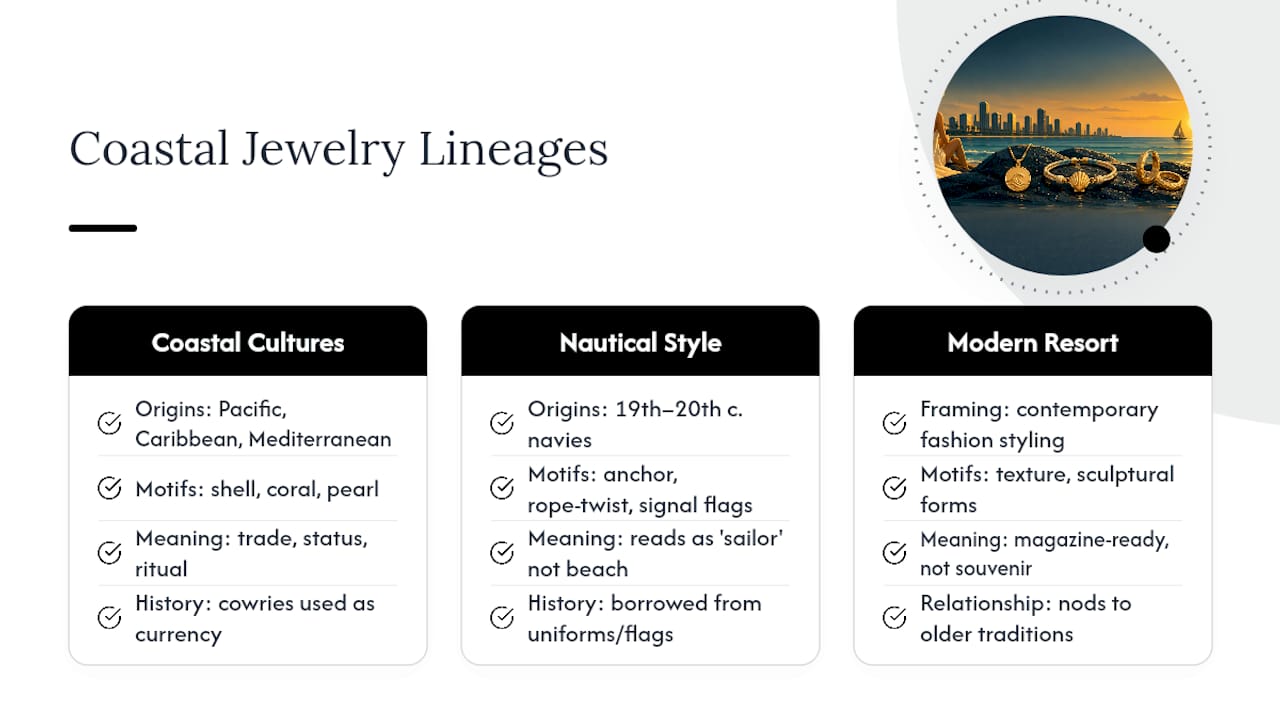
Shell, coral, and pearl jewelry didn’t start as a summer trend. Coastal and island cultures across the Pacific, the Caribbean, and the Mediterranean have used shell and coral ornamentation for centuries, tied to trade, status, and ritual rather than fashion cycles. Cowrie shells circulated as currency across parts of Africa and Asia long before they showed up on a runway. Mediterranean coral jewelry has carried protective symbolism in Italian and Greek folk traditions for generations.
Nautical style borrows from a different, more recent history: naval uniforms and maritime signal flags from the 19th and 20th centuries, which is why anchor motifs and rope-twist details still read as “sailor” rather than “beach vacation.” Pearls carry their own separate arc, prized in royal courts for centuries before Coco Chanel made them a daytime staple in the 1920s, pairing them with tweed instead of formalwear for the first time.
What’s changed recently isn’t the materials. It’s the framing. Modern resort styling takes those same historical references, shell, coral, pearl, rope, and applies fashion’s current obsession with texture and sculptural form. The result is jewelry that nods to centuries of coastal culture while looking like it belongs in a design magazine, not a souvenir shop. That’s a meaningful shift from how these motifs were marketed even a decade ago, when “coastal” mostly meant literal and matte.
What Coastal Jewelry Designs Are Trending Right Now?
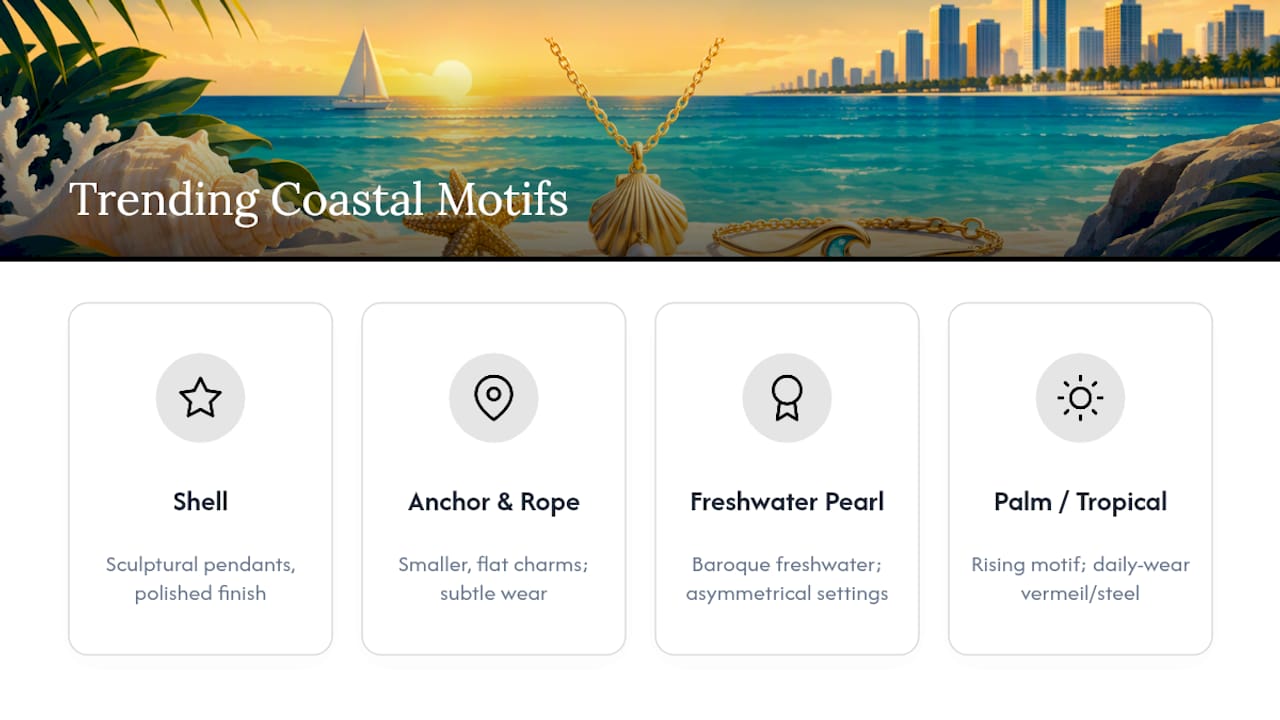
Shell jewelry has moved firmly into sculptural territory. Designers are treating shell shapes as architectural forms rather than literal beach souvenirs, polishing and setting them the way you’d handle a semiprecious stone. That shift is why a shell pendant can now sit comfortably against tailoring instead of only swimwear.
Anchors and rope motifs remain steady in the nautical lane, but the newer versions skew smaller and flatter, worn as subtle charms rather than oversized statement pieces. Coral, meanwhile, is showing up more as color and texture inspiration, warm orange and pink tones in enamel or resin, than as literal coral material, which is increasingly avoided for sustainability reasons.
Freshwater pearls are having a moment outside the traditional strand format: baroque, irregularly shaped pearls set into asymmetrical earrings or mixed with metal chain links. Palm and tropical leaf motifs, closely tied to Miami and South Florida design language, are gaining ground as a fourth major motif alongside shell, anchor, and pearl, especially in stainless steel and gold vermeil pieces meant for daily wear rather than vacation-only rotation.
The throughline across all of it: single, deliberate motifs in polished finishes are outperforming busy, multi-symbol pieces. A single palm charm or one sculptural shell pendant reads as intentional. Five ocean symbols on one chain reads as a tourist shop grab bag.
How Can You Personalize Coastal Jewelry?
Personalization is what turns a trend piece into something you’ll actually wear for years instead of one summer.
Engraving is the simplest entry point: initials, coordinates of a favorite coastline, or a short date on the back of a pendant or charm. Because it’s on the back, it doesn’t compete with the design on the front, so you get sentiment without sacrificing the clean look that makes modern coastal jewelry work.
Mixing motifs is a second route, but it needs restraint. Pair one shell or palm charm with a single small accent, a tiny pearl drop or a thin secondary chain, rather than combining three different coastal symbols at once. Chain layering lets you build a personal look without touching the pieces themselves: a longer chain with a single charm layered over a shorter, bare chain creates depth while keeping the “one dominant reference” rule intact.
For readers who want their coastal piece tied to a specific place rather than a generic beach vibe, look for brands that build collections around named locations. WYNWOOD BLVD’s charms, for instance, draw from specific Miami neighborhoods and coastal spots rather than a generic tropical theme, which gives the piece an actual story if someone asks about it.
What Occasions Work Best for Coastal Jewelry?
Beyond the beach-to-office pivot already covered, coastal jewelry has real range across occasions most people don’t consider.
For weddings and events with a coastal or destination theme, a single pearl drop earring or a polished shell pendant reads elevated without looking like beach costume, especially paired with linen or silk. For date nights, the statement piece from your capsule (that sculptural shell or the Gold Signature Painted palm charm) works alone against a simple black dress or button-down, no other jewelry needed. For work travel, the daily piece from your three-role capsule should be the only thing you pack, since it’s already built to move between meetings and downtime without needing a swap.
Holiday and family gatherings call for something between coastal grandmother and minimalist coastal: pearls or soft metals that feel dressed-up but not beachy. Weekend brunch or errands is where boho beach elements, leather cord, raw shell, layered anklets, actually make the most sense, since the casual setting matches the casual material. The mistake most people make is wearing their most literal “vacation” pieces to their most formal occasions and their most polished pieces to the beach. Flip that instinct and the whole capsule works harder.
Which Brands Do Coastal Jewelry Well?
A handful of names have built real reputations around coastal motifs, each with a different specialty worth knowing.
WYNWOOD BLVD focuses on Miami and South Florida inspired pieces in ocean-safe stainless steel and PVD, positioning itself at the modern resort and minimalist coastal end of the spectrum rather than raw boho. Kiel James Patrick built its Coastal Pearl Shell Necklace around genuine shell and freshwater pearl handcrafting in the USA, a good reference point for shoppers who want the boho beach or coastal grandmother look in natural materials with visible handmade variation.
For nautical specifically, look for smaller independent jewelers who work primarily in rope-twist metal and anchor motifs rather than large fast-fashion retailers, since the detail quality tends to hold up better over years of wear. When comparing any brand, the checklist from the capsule section still applies: confirm the actual metal composition, ask about finish (polished versus raw), and expect natural variation if you’re buying genuine shell or pearl rather than a resin or glass imitation.
Styling coastal pieces as lasting wardrobe elements
The biggest mistake people make with coastal jewelry is treating it as costume rather than wardrobe. A palm charm or a shell pendant doesn’t need five other ocean symbols around it to feel intentional. It needs one clean line, a durable finish, and a chain that fits the piece correctly.
My rule for anyone building out this style: buy modern finishes over raw novelty every time, and choose materials that survive real wear, not just a photo. A piece that tarnishes after one beach trip was never going to earn its place in a daily rotation anyway.
— Mathias
Get the Palm Tree Charm That Fits Your Capsule
Certain Miami-inspired jewelry is built specifically for ocean-safe daily wear, rather than being generic imports stamped with a tropical motif. Palm Tree Charms from this source use 316L stainless steel with PVD coating, a combination recommended for anyone who wants coastal jewelry to survive real seawater, sweat, and sun rather than single wear.
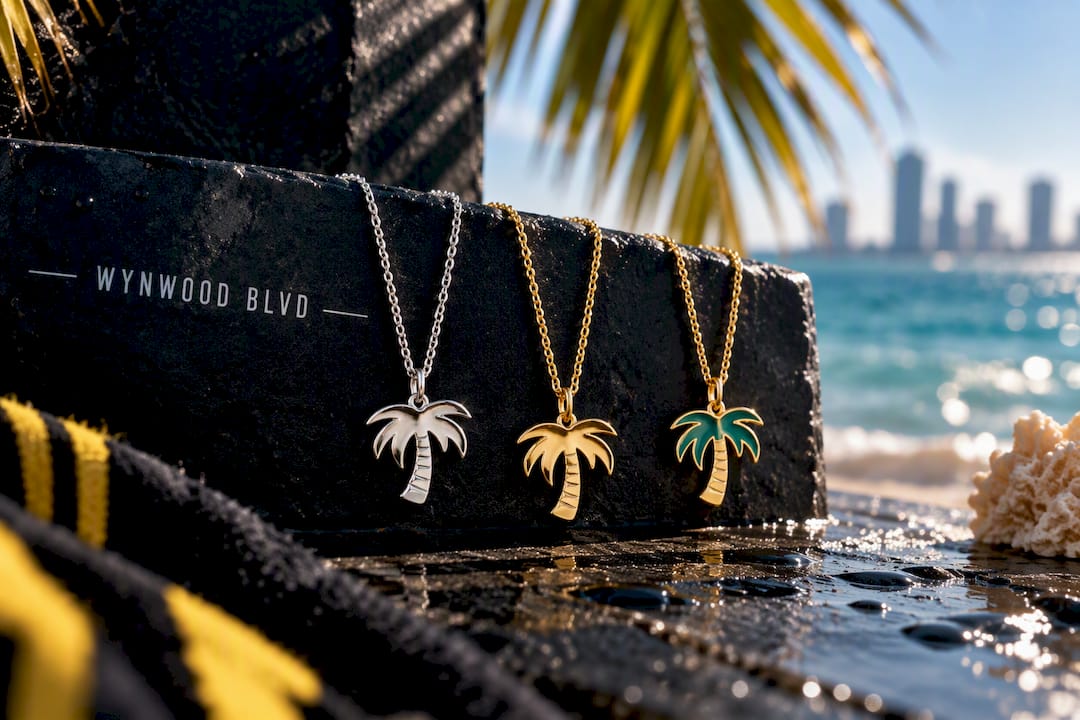
The Silver Classic fits the daily role in a three-piece capsule: clean, understated, easy to wear every day. The Gold Classic works as a layering piece against a longer chain or paired with a second, quieter necklace. The Gold Signature Painted carries enough color and detail to serve as your statement piece on its own. All three follow the rinse-in-20-to-30-minutes routine covered earlier, so ocean days don’t shorten their lifespan.
Browse the full Palm Tree Charms collection to compare finishes side by side, or explore Miami Inspired Charms for additional motifs to round out your capsule.
Sources
- The Summer of the Seaside—The Best Shell Accessories of the Season | Vogue
- The Shell Jewelry Trend Is Taking Over | Coveteur
- How to Take Care of Your Jewelry Amid Heat, Sweat, and Other Summer Nemeses | Reviews by Wirecutter
FAQ
What Is Considered Coastal Jewelry Style?
Coastal jewelry style covers pieces built around ocean-inspired motifs, shells, pearls, anchors, palms, coral, across five main directions: minimalist coastal, coastal grandmother, boho beach, nautical, and modern resort. The strongest versions today favor polished, sculptural finishes over literal souvenir-style pieces.
How Do You Keep Jewelry Safe in Saltwater?
Rinse stainless steel and PVD-coated pieces in 20 to 30 minutes after saltwater or chlorine exposure, then dry them with a soft cloth. Remove pearls entirely before swimming since they’re far more vulnerable to water damage.
What Metal Is Best for Beach Jewelry?
316L stainless steel with PVD coating holds up better against saltwater, sun, and chlorine than plated base metals or sterling silver. WYNWOOD BLVD builds its Palm Tree Charms and other pieces from this combination specifically for that reason.
How Do I Avoid Looking Costume-y in Coastal Jewelry?
Pick one dominant coastal reference, a single shell, palm, or pearl motif, and keep every other accessory quiet around it. Stacking multiple ocean symbols at once is the fastest way to read as costume rather than styled.
How Many Pieces Do I Need for a Coastal Capsule?
Three pieces cover most situations: one understated daily piece, one colorful or textured layering piece, and one statement piece. This three-role framework handles office, travel, and evening wear without extra purchases.
%20and%20lets%20proportion%20do%20the%20rest.%20Favor%20modern%20finishes%20like%20polished%20shell,%20316L%20stainless%20steel,%20or%20...)