Sapphire vs Mineral Glass: Which Crystal Fits Your Watch?
Pick sapphire if you want a watch face that stays scratch-free for decades, especially on dress watches and collector pieces. Pick mineral glass if you want lower replacement costs and better odds of surviving a sharp knock. Sapphire rates about 9 on the Mohs hardness scale, close to a diamond’s 10, while mineral glass typically sits around 5 to 7 depending on tempering.
- Scratch resistance: sapphire wins by a wide margin.
- Impact resistance: mineral glass often wins, because sapphire’s hardness comes with more brittleness.
- Cost: mineral glass is cheaper to buy and far cheaper to replace.
Key Takeaways
Sapphire wins on scratch resistance and long-term clarity, while mineral glass wins on impact tolerance and replacement cost, so the right choice depends entirely on how and where you wear the watch.
| Point | Details |
|---|---|
| Hardness isn’t durability | Sapphire rates ~9 on the Mohs scale versus ~5 to 7 for mineral glass, but higher hardness means more brittleness, not more toughness. |
| Match crystal to use case | Choose sapphire for dress watches and daily luxury pieces; choose tempered mineral for field, dive, or work watches. |
| Replacement cost differs sharply | Sapphire replacements can cost two to ten times more than a basic mineral glass swap. |
| Design mitigates weakness | Recessed crystals and reinforced bezels reduce chip risk on sapphire and edge damage on any crystal type. |
| Wynwoodblvd fits both profiles | Wynwoodblvd offers sapphire-leaning daily pieces like the Atlantic Blue alongside rugged, everyday-durable models like the Everglades Green. |
Table of Contents
- Sapphire vs Mineral Glass at a Glance
- How Do Mohs Hardness Ratings Predict Scratch Resistance?
- Why Does Sapphire Crack While Mineral Glass Just Scratches?
- Does Sapphire Really Look Clearer Than Mineral Glass?
- How Much More Does Sapphire Cost to Replace?
- Which Crystal Should You Buy for Your Use Case?
- How Can You Tell Sapphire From Mineral Glass?
- What Does the Material Science Actually Say?
- Why Wynwoodblvd Chooses Crystals the Way We Do
- Find the Right Crystal for How You Actually Wear a Watch
- Sources
Sapphire vs Mineral Glass at a Glance
| Dimension | Sapphire | Mineral Glass |
|---|---|---|
| Hardness / scratch risk | ~9 Mohs, near scratch-proof | ~5 to 7 Mohs, scratches from grit and metal |
| Impact / shatter risk | More brittle, can chip or crack on sharp hits | Tougher under blunt impact, especially tempered types |
| Optics & AR | Higher clarity, more reflective, benefits from AR | Naturally less reflective, AR less common |
| Replacement cost | Higher, especially double-domed or AR-coated | Lower, often inexpensive to swap |
| Best use-cases | Dress watches, collectors, daily wear | Field watches, tool watches, kids/work watches |
If you hate scratches, sapphire is the obvious pick. If you work with your hands or expect drops, mineral glass usually holds up better and costs less to fix.
How Do Mohs Hardness Ratings Predict Scratch Resistance?
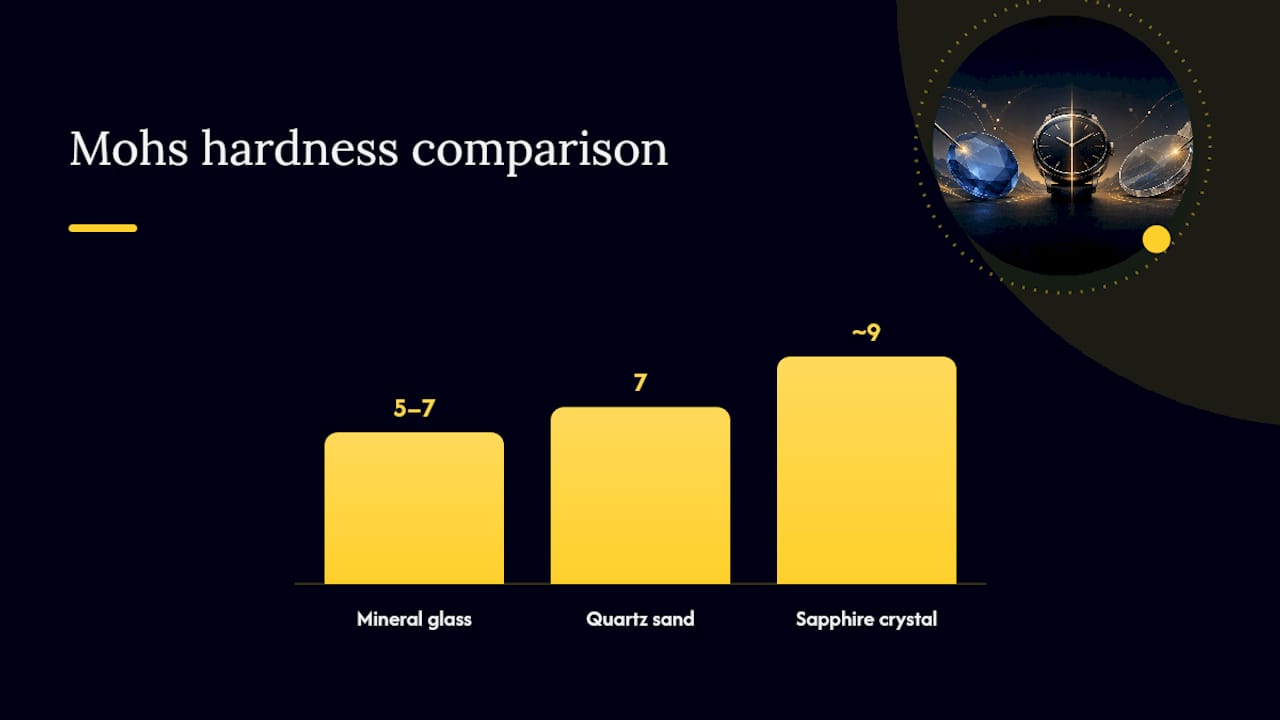
Sapphire crystal sits at roughly 9 on the Mohs scale, one step below diamond and far above quartz sand (7) or common steel alloys. That gap is why sapphire crystal durability holds up against nearly everything you’ll encounter in daily life. Mineral glass typically rates 5 to 7 depending on how it’s treated, which puts it right in the danger zone for quartz-based grit.
Sand at the beach, dust on a workbench, and even some pocket change carry enough hardness to leave fine lines on mineral glass over months of wear. Sapphire shrugs those off entirely.
- Keys and coins in a pocket: scratch mineral glass, rarely touch sapphire.
- Beach sand and construction dust: a slow accumulation of micro-scratches on mineral, none on sapphire.
- Metal watch bracelets rubbing the case: can dull mineral glass edges over a few years.
Why Does Sapphire Crack While Mineral Glass Just Scratches?
Harder doesn’t mean tougher, and this is where a lot of buyers get confused. Sapphire’s crystalline lattice structure is what gives it that scratch-proof surface, but the same rigid atomic bonding makes it more prone to shattering or cracking under a sharp, direct impact. Drop a sapphire-crystal watch face-down on a concrete edge, and it can chip or crack outright rather than absorbing the shock.
Mineral glass behaves differently. Its amorphous, non-crystalline structure flexes slightly on impact, and chemically tempered variants like Hardlex or K1 mineral raise that toughness further, which is exactly why so many dive and tool watches still ship with tempered mineral instead of sapphire.
Hardness and toughness are separate properties. A material can resist every scratch you throw at it and still crack the first time it meets a doorframe at the wrong angle.
Pro Tip: If you want scratch resistance without the brittleness tradeoff, look for watches with a recessed crystal or a raised bezel lip. That design detail absorbs edge impacts before they ever reach the crystal, regardless of which material sits underneath.
Does Sapphire Really Look Clearer Than Mineral Glass?
Sapphire has a higher refractive index than mineral glass, and that’s the real source of the “crisper” look watch enthusiasts talk about. It also means sapphire reflects more ambient light, which is why so many sapphire-equipped watches ship with anti-reflective coatings.
- AR coatings cut glare dramatically but sit as a soft outer layer that can pick up micro-scratches over years of wear.
- Inner-surface AR coatings last longer than outer coatings because they’re shielded from direct contact.
- Double-domed crystals add depth and vintage character but multiply reflection angles, which can hurt legibility in bright sun without a matching AR treatment.
Mineral glass reflects less by nature, so many manufacturers skip AR coating on it entirely and still get acceptable visibility.
How Much More Does Sapphire Cost to Replace?
Mineral glass wins on price at every stage of ownership. Entry-level watches lean on mineral glass specifically because it keeps retail prices down, and many watchmakers don’t move to sapphire until watches reach a mid-range price level. Replacement tells the same story: a standard Hardlex mineral crystal can cost under $20 to swap in some markets, while sapphire replacements run anywhere from two to ten times higher depending on shape and coating.
- Flat mineral crystal replacement: often the cheapest fix a watchmaker offers.
- Double-domed or AR-coated sapphire: the priciest replacement scenario, since factory-shaped sapphire crystals cost significantly more to source and fit than flat mineral.
- Polishing: mineral glass can sometimes be buffed out by a watchmaker, while acrylic polishes out even easier at home. Sapphire needs diamond abrasives and rarely makes economic sense to polish versus just replacing it.
Statistic: Sapphire replacements can run two to ten times higher than mineral glass swaps, a gap wide enough to matter over a decade of ownership.
Which Crystal Should You Buy for Your Use Case?
Match the material to how you actually live, not to which spec sounds more impressive on paper.
- Dress watches and collector pieces: sapphire, no contest. You want a face that looks the same in ten years as it does today, and resale value tends to favor sapphire on higher-end pieces.
- Daily wear where scratch-free matters most: sapphire, paired with a design that offers some bezel protection against edge strikes.
- Field, dive, and tool watches: tempered mineral glass, since it tolerates the kind of blunt shocks that professional users actually encounter.
- Kids’ watches, work environments, or budget beaters: mineral glass, because replacement cost matters more than long-term shine.
Before buying, check three things on the spec sheet: crystal material, whether it’s flat or domed, and whether AR coating is applied to one side or both. Those three details predict most of the ownership experience.
How Can You Tell Sapphire From Mineral Glass?
A few non-destructive checks can help. Run a fingertip lightly across the surface. If it feels unusually smooth and cool, that leans sapphire. A water drop test can also help: water tends to bead more distinctly on sapphire than on mineral glass, though AR or oleophobic coatings can distort this result.
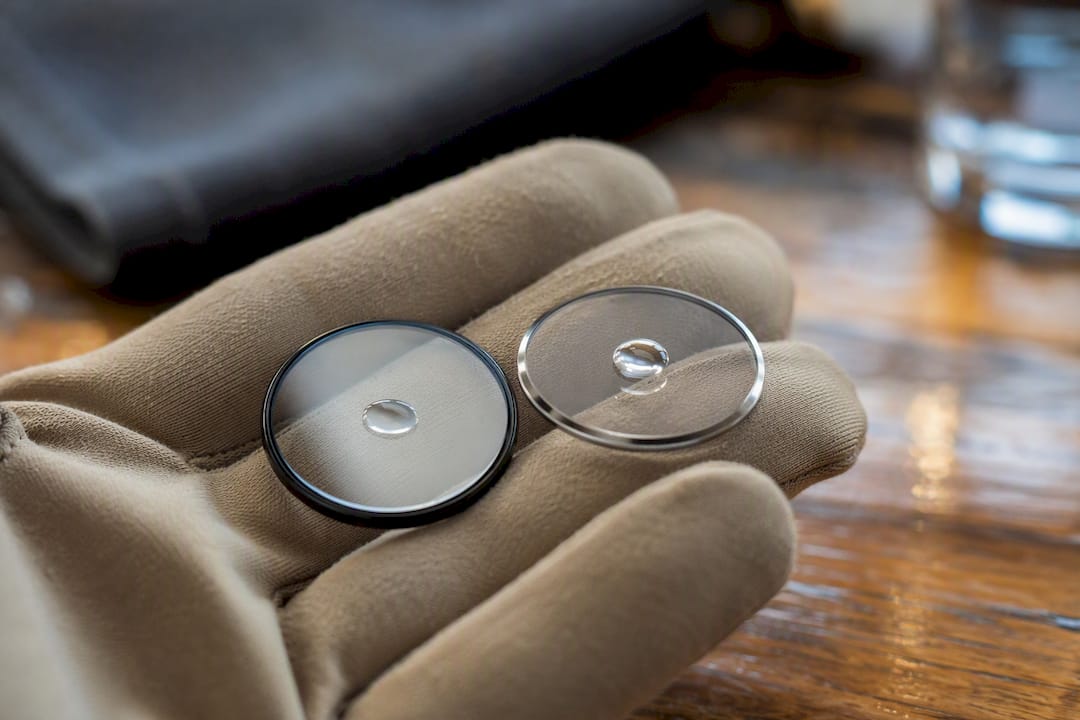
Never attempt a scratch test with a knife or coin to “find out.” You risk permanently marking a mineral crystal for no reliable answer.
Pro Tip: When certainty matters, check the case back or spec sheet for markings like “Hardlex” or “sapphire crystal,” or just ask a watchmaker. It takes thirty seconds and beats guessing.
What Does the Material Science Actually Say?
The tradeoff isn’t marketing spin, it’s basic materials science. Sapphire’s tightly bonded crystalline lattice produces extreme hardness, but that same rigidity leaves little room to flex under a sharp impact, so cracking or shattering is the failure mode instead of scratching. Mineral glass, being amorphous rather than crystalline, has more give.
A crystal’s failure mode under stress depends on its atomic structure as much as its hardness number. Rigid lattices resist scratching; they don’t absorb shock the same way.
That’s also why crystal mounting and bezel design change real-world outcomes as much as the material choice itself. A thick, well-mounted sapphire crystal in a protective case can outlast a thin, poorly mounted mineral crystal in daily abuse.
Why Wynwoodblvd Chooses Crystals the Way We Do
We use sapphire on our premium automatic lines because our customers wear these watches daily and expect them to still look sharp years later. On more rugged, everyday pieces, we weigh mineral glass options for the same reason a dive watch does: durability against unpredictable impact matters more than mirror-flat clarity.
Find the Right Crystal for How You Actually Wear a Watch
If you’re leaning toward a scratch-resistant piece you’ll wear daily without babying it, our Atlantic Blue Automatic Watch is built around that exact priority, premium materials that hold their shine through years of Miami sun, saltwater air, and everyday knocks.
Wynwoodblvd designs every collection around real coastal use, not a showroom shelf. If your priority is a rugged, everyday automatic that can handle sand, pool decks, and travel without babying, browse the Everglades Green instead, a build made for exactly the impact-prone daily use this article walks through. Every Wynwoodblvd watch ships with service support, so a scratched crystal or a loose link isn’t a dead end. Browse the full watch collection and pick the crystal that matches how you actually live, not just how a spec sheet reads. If you’re sourcing branded timepieces for a hotel, agency, or corporate gift program, our custom watch program can spec the right crystal for your use case at volume.
Sources
- The ABCs of Time: All About the Different Crystals Used in Watches Today
- Sapphire Crystal vs Mineral Glass, what’s better for you?
- Watch Crystal Types: Sapphire vs Mineral vs Acrylic — Complete Comparison
- Mohs scale of mineral hardness