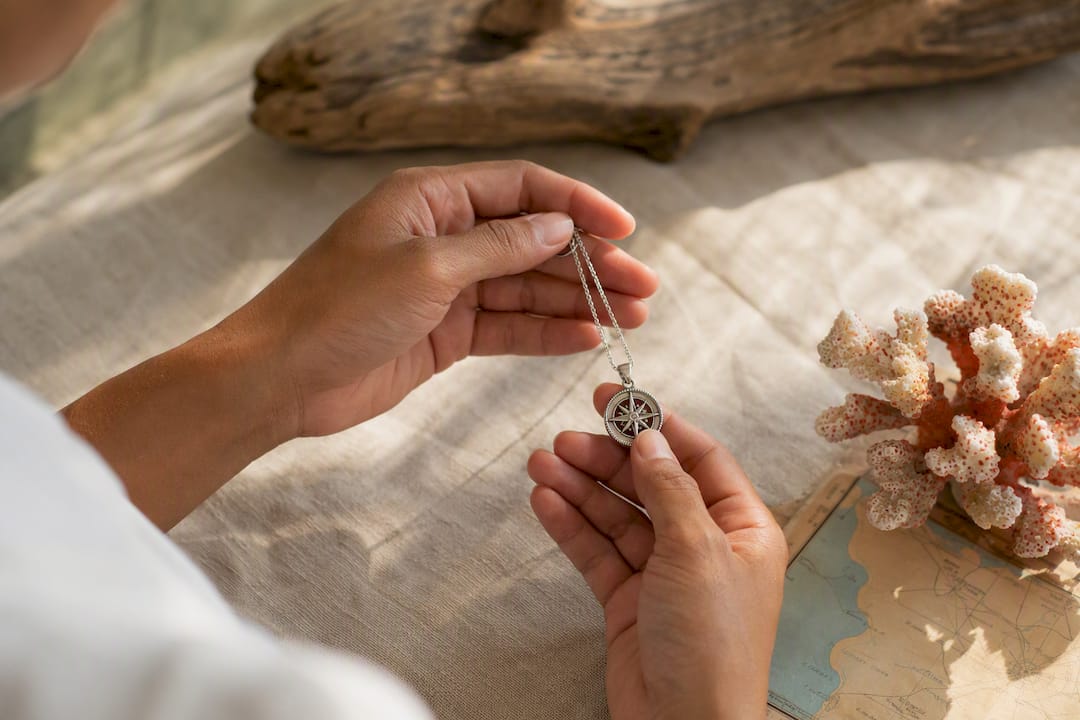
Compass Pendant Meaning: Guidance and Personal Direction
A compass pendant is a wearable symbol of guidance, direction, and finding your own True North. It shows up in someone’s jewelry box for a reason that usually goes deeper than style. The core symbolic themes people connect to a compass pendant include guidance, protection, and adventure, and each one tends to attach itself to a specific moment in life.
Here’s what that means at a glance:
- Guidance: a reminder to trust your own direction when the path isn’t clear
- Protection: a talisman worn for safe travel or safe passage through change
- Adventure: a nod to wanderlust and the pull toward new places
Jewelry writers, including Jeulia’s guide to compass necklace symbolism, consistently frame the piece as a marker of life transitions rather than a purely decorative object. That framing holds up. A compass doesn’t just point north on a map. Worn around the neck, it points toward whatever “north” means to the person wearing it.
Key Takeaways
A compass pendant’s core meaning is guidance toward your own True North, with secondary meanings like protection, adventure, and independence shaped by who wears it and why.
| Point | Details |
|---|---|
| Core meaning | A compass pendant primarily symbolizes guidance and finding your own True North. |
| Design shapes meaning | Open compass designs lean toward exploration; closed, engraved designs lean toward inner resolve. |
| Gifting communicates support | Compass pendants work as gifts for graduations, moves, recoveries, and travel send-offs. |
| Personalization matters most | Engraving a date, initials, or short phrase turns a generic symbol into a specific one. |
| Choose Wynwoodblvd for durability | Wynwoodblvd’s necklaces use stainless steel compass and coastal motifs built for daily wear and personalization. |
Table of Contents
- What Does a Compass Pendant Symbolize?
- Where Did Compass Symbolism Come From?
- What Does Wearing or Gifting One Communicate?
- How Do You Choose the Right Compass Pendant?
- How Can You Make a Compass Pendant Personally Meaningful?
- How Do People Personalize Their Compass Pendant’s Meaning?
- What the Compass Motif Means to Us
- Find a Compass Pendant Built for Everyday Meaning
- Sources
What Does a Compass Pendant Symbolize?
The primary meaning of a compass pendant is guidance toward your True North, your own defined sense of purpose and direction. Everything else the symbol carries branches off from that single idea. A compass doesn’t tell you where to go. It reminds you that you’re capable of finding your own way, which is why the symbolism resonates so strongly during periods of change.
Beyond that core meaning, compass pendants commonly represent:
- Protection during travel, relocation, or uncertain transitions
- Luck for new ventures, whether a business, a relationship, or a move
- Wanderlust and a love of exploring unfamiliar places
- Independence and the confidence to chart your own course
- Inner intuition, sometimes called the “inner compass” that guides decisions when logic runs out
- New beginnings, marking a graduation, a fresh start, or a recovery milestone
A few examples make this concrete. Someone graduating college might choose a compass pendant to mark the shift from structured school life to open-ended adulthood, the meaning here leaning heavily on new beginnings. A person relocating across the country for a job often wears one as a form of quiet protection, a small object that says “I’ll find my footing.” Frequent travelers gravitate toward the wanderlust reading, treating the pendant almost like a passport stamp they never take off. And people in recovery, from illness or from harder chapters of life, sometimes choose it specifically for the inner compass meaning: a way of externalizing the idea that direction can come from within even when the outside world feels unstable.
A compass doesn’t promise an easy path. It promises that you already have what it takes to find one.
That’s the emotional core of the symbol, and it’s why compass jewelry shows up so often as a gift rather than a self-purchase. Someone chooses it for another person specifically because they want to hand over that reminder.
Pro Tip: If you’re picking a compass pendant for yourself, ask which meaning you need most right now, not which one sounds nicest. A pendant chosen for “protection” during a rough year will carry more weight than one picked purely for its look.
Where Did Compass Symbolism Come From?
The compass carries centuries of symbolic weight because the object itself solved a real, life-or-death problem before it ever became jewelry. Understanding that arc helps explain why the symbolism still feels earned rather than invented for a marketing campaign.
- Practical origins: Magnetic compasses were used for navigation by Chinese sailors as early as the 11th century, later spreading to European maritime trade and exploration by the 1300s.
- Metaphorical adoption: Sailors and explorers began using “true north” as shorthand for reliability and moral direction, a usage that crept into literature and everyday language over the following centuries.
- Symbol in daily life: By the 18th and 19th centuries, the compass rose appeared on maps, monuments, and family crests as a symbol of steadiness and purpose, not just a navigational tool.
- Jewelry adoption: Compass motifs moved into wearable design more recently, gaining traction as travel culture and personal symbolism became more mainstream in fashion.
Maritime communities have long treated the compass as a protective object, something sailors carried or wore as insurance against getting lost at sea, literally and otherwise. Travelers picked up a related but distinct meaning: the compass as permission to wander, since it implies you can always find your way back. Spiritual and metaphysical traditions took the symbol somewhere else entirely, using it to represent inner guidance and self-trust rather than physical navigation.
That split still shows up today. Some people want a compass pendant because it looks outward, toward the world and its possibilities. Others want it because it looks inward, toward intuition and personal conviction. Neither reading is more “correct.” The compass has always carried both.
What Does Wearing or Gifting One Communicate?
Wearing a compass pendant sends a quiet signal about how you see yourself: someone who values self-direction, steadiness under pressure, or an appetite for adventure. It also functions privately, as a talisman nobody else needs to interpret correctly for it to work. You know what it means. That’s often enough.
As a gift, the compass pendant works because it lets the giver say something they might not say out loud. It communicates support for someone else’s next chapter without needing an accompanying speech.
Common gift occasions and what the pendant tends to say at each:
- Graduation — “You’re ready to find your own way now.”
- New job — “Trust yourself in this next chapter.”
- Relocation — “Wherever you land, you’ll be okay.”
- Recovery milestone — “You found your way back.”
- Travel send-off — “Go explore, and come home safe.”
- Anniversary — “I’d choose this direction with you again.”
A short engraving turns a nice gift into a specific one. Simple phrasing works best: initials and a date, “not all who wander are lost,” or a coordinate pair marking a meaningful place. The goal is specificity, not poetry. A vague inscription reads generic. A precise one, even a short one, reads personal.
How Do You Choose the Right Compass Pendant?
Choosing a compass pendant comes down to matching function, material, and design to the meaning you actually want to wear every day. Start with how the piece will live on your body before worrying about style details.
- Decide on daily wear versus occasional wear. Daily pieces need a durable metal like stainless steel that resists tarnish, scratching, and skin reactions. Occasional pieces have more flexibility, since they won’t take the same wear.
- Check the metal against sensitivity concerns. Stainless steel and sterling silver tend to be the safest bets for sensitive skin, while gold-plated pieces can wear thin over years of daily contact.
- Pick an open or closed compass design. An open, skeletal compass face tends to emphasize exploration and movement. A closed or solid compass, especially one with engraving, tends to emphasize inner guidance and personal commitment.
- Match the finish to your existing jewelry. Vintage-inspired antique finishes pair well with layered, textured looks. Clean, modern minimalist compass pendants sit better with simpler wardrobes.
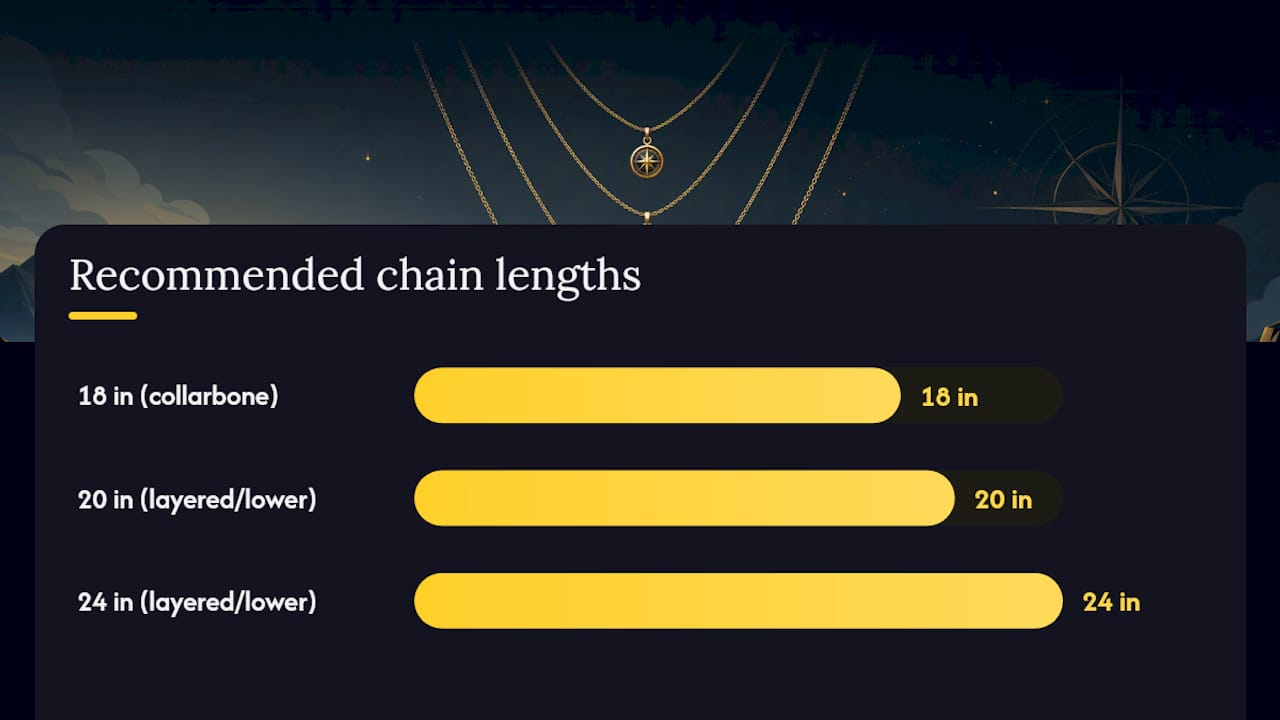
- Choose a chain length for your frame and use. An 18-inch chain sits at the collarbone for visibility, while a 20 to 24-inch chain works better layered under other necklaces or for a lower-key look.
- Decide on personalization. Engraving, a birthstone accent, or a hidden coordinate on the back turns a generic symbol into a specific one tied to your own story.
If budget and simplicity matter most, a solid stainless steel pendant on a mid-length chain covers nearly every use case. Wynwoodblvd’s necklaces collection reflects that same logic: minimalist compass and travel motifs built in stainless steel, designed to hold up under daily wear rather than sit in a drawer for special occasions.
Pro Tip: Let the design follow the meaning, not the other way around. If you’re buying to mark independence or exploration, lean toward an open compass face. If the meaning is more private, like personal resolve or recovery, a closed design with a discreet engraving usually fits better.
How Can You Make a Compass Pendant Personally Meaningful?
A compass pendant only carries the meaning you actively give it. The symbol provides the frame; you fill it in. A short, deliberate practice turns a nice piece of jewelry into something closer to a personal anchor.
- Name the intention. Decide, specifically, what “direction” means for you right now. Career, recovery, independence, a relationship. Pick one.
- Write it down. A single sentence works. Tuck it into a gift box, a journal, or a note to yourself.
- Choose a ritual moment. Some people put the pendant on the first day of a new job or after a hard decision. The moment matters more than the calendar date.
- Wear it on purpose. Not out of habit. Notice it when you put it on.
- Check in monthly. Ask whether the intention still fits, or whether it’s evolved into something new.
A simple note template: “This points toward [your goal or value]. Wear it when you need reminding.” Engraving options and add ons like birthstones make that intention permanent rather than something you have to remember. It’s a small practice, but it’s the difference between owning a compass pendant and actually using one.
How Do People Personalize Their Compass Pendant’s Meaning?
The most common thread across compass pendant stories is specificity. A generic “guidance” symbol becomes personal the moment someone attaches it to an actual event. A person who left a long career to start over often wears one as a private marker of that decision, not something they explain to coworkers, just something they know is there. Parents sometimes give compass pendants to kids leaving for college specifically because it says “find your way” without sounding like a lecture.

One pattern worth noting: people rarely pick the pendant for what it looks like first. They pick the meaning first and the design second. A closed, engraved compass tends to show up in stories about internal turning points, sobriety milestones, grief, quiet resolve. An open compass shows up more in travel stories, gap years, moves abroad. The design almost always tracks the story behind it, which is part of why compass jewelry has stayed relevant across so many different life stages instead of fading into a single demographic trend.
What the Compass Motif Means to Us
Compass motifs earn their place in a jewelry collection because they’re honest. They don’t promise transformation or claim to fix anything. They just mark a direction and let the wearer decide what that direction is. That’s a rare thing for a piece of jewelry to do without feeling gimmicky.
At Wynwoodblvd, our design language draws directly from Miami and coastal travel, so compass and navigation motifs fit naturally alongside our palm tree charms and water-resistant pieces. We build them the same way we build everything else: stainless steel first, minimal detailing, made to survive salt air and daily wear rather than sit untouched in a jewelry box.
Find a Compass Pendant Built for Everyday Meaning
If you’re ready to wear the symbol instead of just reading about it, the details matter more than the price tag. Wynwoodblvd designs compass and travel-inspired pendants in solid stainless steel, so the piece holds up to daily wear instead of tarnishing after a few months, which matters if the pendant is meant to carry meaning for years, not weeks.
Our necklaces collection includes minimalist compass and coastal motifs suited to daily wear, while the charms collection offers smaller, layerable pieces if you want to pair a compass with a personal symbol like a palm tree or a place marker. The Palm Tree Charm in silver works well for anyone building a layered look around a travel or relocation story, since it pairs a coastal identity with the compass’s forward-looking symbolism.
If you’re buying for a graduation, a move, or a milestone you want someone to carry with them, start with the necklaces collection and look for personalization options at checkout. A short engraving turns a well-made pendant into a specific, personal marker for whatever direction the recipient is heading next.
Sources
- The Compass Necklace: Navigating Life’s Journey with Style and Symbolism – Jeulia Jewelry