Small Brands: Meet Custom MOQs at 50–300 Units With WYNWOOD BLVD
MOQ stands for minimum order quantity: the smallest number of units a supplier will produce or sell in one run. For custom merchandise, that floor typically runs from a few dozen units for simple printed goods to higher numbers for finished metal products like watches. If you can’t meet a supplier’s MOQ, start with samples, consider print-on-demand, or negotiate a smaller pilot run before committing to full inventory.
TL;DR:
- Printed promotional items often require 50 to 250 units, while screen printed apparel typically needs 24 to 100 units per design and color combination.
- Custom watches frequently require 100 to 300 or more units because cases, movements, dials, and packaging can each carry separate minimums.
- A sample or prototype costs more per unit but can reveal design, fit, or finish problems before you commit to a full production run.
- Larger runs often lower unit costs but tie up more cash and may extend lead times; smaller tests can validate demand faster.
- To lower the threshold, simplify colors or finishes, ask about a paid pilot, offer a credible reorder commitment, or use print on demand.
Table of Contents
- What MOQ is and why manufacturers require it
- Typical MOQ ranges by product type and customization level
- How MOQ affects cost, pricing, and lead time
- Practical tactics to meet or lower MOQs
- How to pick an MOQ for your business: a decision checklist
- WYNWOOD BLVD’s experience with MOQs for custom watches and jewelry
- Impact of MOQ on minimum order value and budgeting
- Common supplier exceptions or flexibility on MOQs
- MOQ trends in different markets or regions
- How MOQ influences product quality and design options
- When to accept higher MOQs vs. when to use alternatives
- Custom branded watches through WYNWOOD BLVD
- FAQ
- Sources
What MOQ is and why manufacturers require it
MOQ is not the same as run size. Run size is how many units you choose to order; MOQ is the floor your supplier sets below which the math stops working for them. Factories build this floor around a few fixed realities.
Setting up a machine, loading a die, mixing a custom color, or programming an embroidery pattern costs the same whether you order 50 units or 5,000. Suppliers spread that fixed cost across your order, so smaller runs mean a higher cost per unit, and below a certain volume, the price becomes unworkable for both sides.
A few factors tend to drive MOQs up:
- Tooling and setup: custom molds, dies, or engraving plates require upfront work that only pays off at scale.
- Material minimums: raw material suppliers often sell fabric, metal, or plastic in fixed lot sizes.
- Machine efficiency: production lines run most profitably at a certain batch size.
- Quality control: inspection and testing processes add cost per batch, not per unit.
Customization multiplies these factors. A plain tote bag might need no tooling at all, while a watch with a custom dial, engraved case back, and branded packaging stacks several setup costs on top of each other, which is why personalized and branded items almost always carry higher MOQs than stock goods.
Typical MOQ ranges by product type and customization level
MOQs vary widely depending on what you’re ordering and how much customization you want. Here’s a general sense of what to expect across common merchandise categories:
- Printed promotional items (pens, tote bags, stickers): often 50 to 250 units, since printing setup is relatively cheap.
- Screen-printed apparel: typically 24 to 100 units per design and color combination.
- Embroidered apparel: usually 50 to 150 units, since digitizing a logo adds setup time.
- Custom jewelry (charms, pendants): commonly 100 to 500 units depending on metal type and plating.
- Custom watches: frequently 100 to 300+ units, since cases, movements, dials, and packaging each carry their own minimums.
Metal components push MOQs higher than almost anything else in the merchandise world. Casting a custom case shape or stamping a unique charm design requires tooling that only makes financial sense at volume, and bespoke packaging, boxes, pouches, or inserts, adds another layer of fixed cost that suppliers need to recover.
Before committing to a full run, request samples or a small prototype batch. It costs more per unit, but it lets you catch design flaws, test fit and finish, and confirm quality before locking in hundreds of units you can’t easily return.
How MOQ affects cost, pricing, and lead time
Every production run carries fixed costs (tooling, setup, sampling) and variable costs (materials, labor per unit). MOQ exists because fixed costs need to be spread across enough units to make the price per piece reasonable.
As order size grows, that fixed cost gets divided across more pieces, so the per-unit price drops, often sharply between the minimum order and a run two or three times larger. Below the MOQ, the supplier either refuses the order or charges a steep premium to cover setup costs that a tiny batch can’t absorb.
A few practical effects follow from this:
- Larger orders typically lower your per-unit cost, but they also tie up more cash in inventory.
- Lead times often stretch for bigger runs, since more raw material and production time are needed.
- Smaller test orders usually ship faster, which helps you validate demand before scaling.
Cash-flow forecasting matters here. SBA guidance on growing a business treats supplier management and cash-flow planning as central to scaling production, since a bigger order can strain working capital even when the per-unit price looks better on paper.
Practical tactics to meet or lower MOQs
When a supplier’s MOQ is higher than you need, a few tactics can close the gap:
- Simplify your specifications. Fewer colors, one finish instead of three, or a standard size range can lower the setup work and the MOQ tied to it.
- Consolidate SKUs. Ordering one design in three colorways instead of three separate designs often lets you share tooling costs across the run.
- Negotiate a smaller pilot run. Some suppliers will accept a reduced first order at a higher per-unit price in exchange for a larger second order once you’ve proven demand.
- Use print-on-demand or white-label blanks. These let you test a design with no upfront inventory commitment, though at a higher cost per piece.
- Explore split runs or group buys. Sharing a production slot with another small brand can help both of you hit a supplier’s threshold.
- Work with a sourcing agent. Agents often have relationships that unlock smaller test orders than a factory would offer a first-time buyer directly.
Manufacturing Extension Partnership resources frame MOQ conversations as a negotiation rather than a fixed rule: demonstrating a credible repeat-order forecast, or accepting a simpler finish, often moves suppliers more than price alone.
Pro Tip: Ask your supplier what specific change, fewer colors, a simpler finish, a different packaging option, would lower their MOQ, rather than just asking if they’ll make an exception.
How to pick an MOQ for your business: a decision checklist
Choosing the right order size is less about finding the “correct” MOQ and more about matching it to your cash position and sales forecast. Run through this before committing:
- Forecast realistic demand for the next 60 to 90 days, not your best-case scenario.
- Calculate your break-even units: how many pieces you need to sell to cover the order cost, including shipping and duties.
- Factor in storage cost: unsold inventory ties up cash and often physical space.
- Set a reorder trigger before you run out, so you’re not stuck negotiating a rush order under pressure.
The break-even thinking is simple in concept: divide your total order cost by your selling price per unit, and that tells you how many units you need to move before the order turns a profit. If that number is far below your MOQ, you have cushion. If it’s close to your MOQ, a slow sales month puts you at risk.
Early-stage brands often prioritize cash preservation and order smaller, even at a higher per-unit cost. Brands with proven demand and storage capacity can lean into volume to protect margin.
WYNWOOD BLVD’s experience with MOQs for custom watches and jewelry
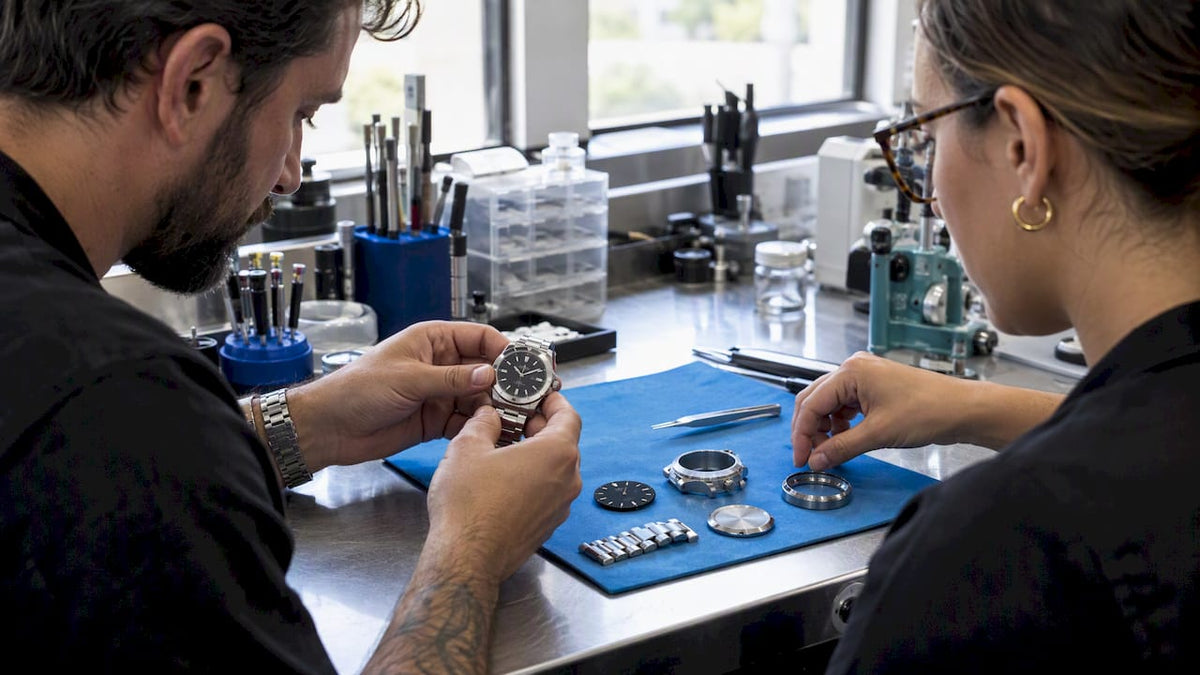
Custom watches often carry high MOQs because many components stack together: the case, the movement, the dial face, engraving, and the packaging each have their own minimums. A logo engraved on a case back is a relatively small addition; a fully custom dial color or a unique case finish adds more.
For corporate and branded projects, we recommend a sample first, a small pilot run second, and a full production order only once the design and fit are confirmed. That sequence costs a little more upfront but avoids locking into hundreds of units before anyone has held the finished piece. Our B2B custom watch page outlines how that process works for companies, hotels, and agencies exploring branded timepieces.
Impact of MOQ on minimum order value and budgeting
MOQ and minimum order value are related but not identical. MOQ sets the unit floor; minimum order value is the dollar amount that floor translates into once you multiply units by price. A supplier might require 200 units at $12 each, which sets your minimum order value at $2,400 regardless of how you’d prefer to phase the spend.
This matters for budgeting because the real commitment isn’t just “enough units,” it’s enough cash tied up at once. A small brand planning a merchandise launch needs to account for the full order value, plus shipping, duties, and any packaging add-ons, before the first unit sells.
A few budgeting habits help keep this manageable, including following recommended Amazon inventory management best practices:
- Request a full quote before deciding on customization level, since dial changes, plating, or packaging upgrades can push the order value up even if the unit count stays the same.
- Set aside a buffer for shipping and import costs, which often aren’t included in the supplier’s base quote.
- Treat the MOQ-driven order value as a cash-flow event, not just a one-time expense, since it affects what you can spend on marketing or other inventory in the same period.
Suppliers rarely negotiate minimum order value independently of MOQ, since the two move together. Reducing customization, not just asking for a discount, is usually the more effective lever if the total order value doesn’t fit your budget.
Common supplier exceptions or flexibility on MOQs
MOQs are a default, not a law. Suppliers flex on them more often than many first-time buyers expect, especially for buyers who approach the conversation with the right framing.
A few common exceptions show up repeatedly:
- New supplier relationships: some factories offer a reduced first order specifically to win a new account, expecting volume to grow over time.
- Off-season production slots: suppliers with open capacity between larger orders sometimes accept smaller runs to keep machines running.
- Standard components with custom finishing: a supplier may waive the MOQ on the base product if your customization (like a simple logo stamp) requires little extra setup.
- Sample and prototype orders: nearly every supplier will accommodate a handful of units for evaluation, even if that’s below their stated production MOQ, usually at a premium price.
The common thread across these exceptions is reduced setup burden or reduced risk for the supplier. If you can simplify your specs, commit to a reorder schedule, or accept a slightly higher per-unit price, you have real leverage to negotiate below the posted minimum.
MOQ trends in different markets or regions
Where you source from shapes what MOQ you’ll be quoted. Suppliers in different regions structure their production lines around different assumptions about order size, labor cost, and material sourcing.
Large-scale overseas manufacturing hubs often post higher MOQs because their factories are built for volume efficiency. Smaller, regional, or domestic manufacturers frequently accept lower MOQs since their operations are already scaled for shorter runs, though usually at a higher per-unit price.
This creates a real tradeoff for small brands: a domestic supplier might let you order 50 units at a premium, while an overseas factory wants 500 units at a lower per-unit cost. Neither option is universally better. The right choice depends on your cash position, your tolerance for holding inventory, and how quickly you need product in hand.

Quality standards also shift by region and by the certifications a supplier follows. Standards organizations, including ASTM’s textile standards, set material and testing expectations that some suppliers use to justify tighter batching and higher minimum runs, since consistent quality control is harder to guarantee economically at very small volumes.
How MOQ influences product quality and design options
MOQ and design freedom are more connected than most first-time buyers expect. A supplier willing to accept a small order often limits you to their existing materials, standard finishes, and simpler construction, because anything custom requires setup work that only makes sense at higher volume.
Pushing for full customization, a specific metal alloy, a unique color, a bespoke packaging insert, usually means accepting a higher MOQ, since each custom element adds its own tooling or sourcing requirement. Trying to force full customization at a low volume often means a supplier cuts corners elsewhere to keep the economics workable, which can show up as inconsistent plating, weaker stitching, or variable print quality.
Quality assurance frameworks that factories rely on, including ASQ’s quality assurance resources, tend to apply more rigorously at higher production volumes, where inspection costs can be spread across more units. At very low volumes, some suppliers reduce formal QA steps to keep the order financially viable, which is worth asking about directly before you commit.
The practical takeaway is that the tradeoff isn’t just cost versus quantity, it’s design ambition versus quantity. If a specific material, finish, or packaging detail matters to your brand, budget for the MOQ that supports it rather than trying to get full customization at the smallest possible order.

When to accept higher MOQs vs. when to use alternatives
At launch, lean toward smaller orders or alternatives like print-on-demand, even at a higher per-unit cost. Validating demand matters more than margin in the first few months. Once you have repeat sales data, accepting a higher MOQ to lower your per-unit cost starts to make sense.
Premium or branded metal goods, like custom watches or jewelry, usually justify a higher MOQ only once you’ve confirmed design, fit, and demand through a sample or pilot run. That’s the safest way to turn MOQ from a risk into a straightforward planning number.
— Mathias
Custom branded watches through WYNWOOD BLVD
If you’re weighing MOQ tradeoffs for a corporate gift, hotel amenity, or branded merchandise line, our Corporate Custom Watches service is built around exactly that decision.
A service may offer:
- logo engraving and dial customization on stainless steel cases.
- packaging customization for corporate gifting or retail presentation.
- a sample and pilot-run process before any full production commitment to confirm fit and finish first.
You can browse finished examples in our Miami Inspired Watches collection to see the materials and style we work with before reaching out. Request a B2B quote and we’ll walk you through sample options and realistic order sizes for your project.
FAQ
How much does it cost to make your own merchandise?
Cost depends heavily on product type, customization level, and order size, since MOQ directly affects your per-unit price. Simple printed items can cost a few dollars per unit at moderate volumes, while custom metal goods like watches or jewelry cost significantly more due to tooling, materials, and finishing. Requesting a quote from a few suppliers is the most reliable way to get a number specific to your product.
What is MOQ in apparel?
MOQ in apparel is the minimum number of garments a manufacturer will produce in one order, often tied to a specific design, color, and size run. Screen-printed apparel commonly starts around 24 to 100 units per design, while embroidered items often require 50 to 150 units due to digitizing setup. These figures shift based on fabric type, print method, and the supplier’s own production capacity.
How can I create my own merch?
Start by choosing a product category and customization level that matches your budget and expected demand, then request quotes from a few suppliers to compare MOQ and pricing. If supplier minimums feel too high for a first order, print-on-demand or white-label blanks let you test designs with little upfront inventory. Once you’ve validated demand, moving to a supplier with a traditional MOQ usually lowers your per-unit cost.
Can I negotiate a lower MOQ with a supplier?
Yes, many suppliers will negotiate, especially for new accounts, off-season production slots, or orders with simplified specifications. Offering a reorder commitment or accepting a slightly higher per-unit price in exchange for a smaller first run is one of the more effective ways to get below a posted MOQ.