Article: 2–4 Months to First Production: WYNWOOD BLVD Custom Watch Timeline
2–4 Months to First Production: WYNWOOD BLVD Custom Watch Timeline
Expect 2 to 4 weeks for a sample and 2 to 4 months for a first production run, depending on complexity. Sampling rounds and tooling needs are the biggest swing factors, so a vague brief can stretch either number. We work through corporate watch projects often enough to know where those weeks tend to disappear, and where you can get them back.
TL;DR:
- Reordering with the same design and tooling typically takes 4 to 8 weeks, making repeat orders significantly faster than initial production.
- Delays often stem from movement sourcing, complex finishes, additional sampling rounds, or supplier capacity limitations, which can extend timelines.
- Locking your CAD and approval stages early is crucial, as delays here impact the entire project and cannot be recovered later.
- A full custom flagship project usually requires 4 to 6 months, while simpler reorders or small batches can be completed in under three months.
- Using existing components and limiting sample revisions can reduce lead times without compromising design quality.
Table of Contents
- Typical lead time ranges for sample, first production, and reorder
- Where the time actually goes: five stages that build on each other
- What stretches or shortens your schedule
- Three timeline examples to map against your own project
- How to shorten lead time without wrecking the design
- Tooling, MOQ, and budget move on the same clock as your schedule
- WYNWOOD BLVD: how we scope and schedule custom branded watches
- When to prioritize speed over customization
- Start your custom watch project with WYNWOOD BLVD
- FAQ
- Sources
Typical lead time ranges for sample, first production, and reorder
A sample (or prototype) is the first physical version of your watch, built to confirm dial color, case finish, and logo placement before anyone commits to a full run. First production is the initial batch you actually sell or distribute. A reorder is any batch after that, using the same specs and tooling.
Here is how those three stages usually break down:
- Sample: typically 2 to 4 weeks once the brief and artwork are locked.
- First production: typically 2 to 4 months, covering tooling, component sourcing, assembly, and quality checks.
- Reorder: often just 4 to 8 weeks, since tooling and approvals already exist.
Reorders move faster because the expensive, slow parts (tooling, mold adjustments, approval cycles) are already behind you. These ranges are still estimates. A supplier can only commit to a firm date after reviewing your full brief, including movement type, case size, materials, and order quantity.
Where the time actually goes: five stages that build on each other
Total lead time is really the sum of five dependent stages, and a delay in any one of them pushes back everything after it.
- Brief and feasibility review. The supplier checks whether your design, materials, and quantity are realistic, and flags anything that needs rework before quoting a schedule.
- CAD and engineering. Your concept becomes a technical drawing, with dimensions, tolerances, and material specs locked in for approval.
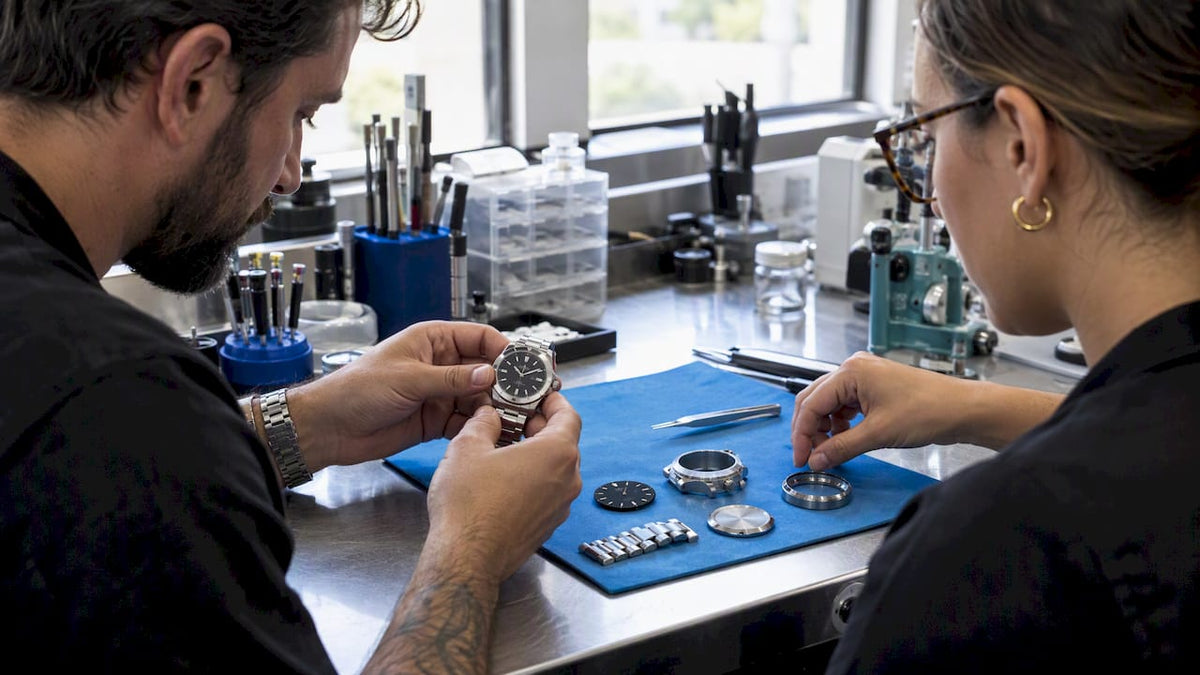
- Prototyping. A physical sample gets built and sent for your sign-off, often through more than one round.
- Component production. Cases, dials, hands, straps, and movements get manufactured or sourced, frequently from different suppliers.
- Assembly and quality control. Watches are built, tested for water resistance and movement accuracy, then packaged.
You will have direct input, and approval checkpoints, at the brief, CAD, and prototype stages. Everything after that runs largely on the supplier’s side, which is exactly why slow approvals early on cost you time you cannot get back later. Common bottlenecks include movement lead times, special case finishes that require extra plating or polishing passes, and backordered components. A detailed project management view of this process, shared by watchmakers and microbrand founders on a WatchUSeek manufacturing thread, lays out how these stages interact in real custom watch projects.
Pro Tip: Lock your CAD approval before requesting quotes on components; changing dimensions after parts are ordered usually costs more time than the original delay you were trying to avoid.
What stretches or shortens your schedule
Several variables move the calendar more than people expect, and most of them are decisions you make before production even starts.
- Movement and parts sourcing: a hard-to-find automatic movement can add weeks versus a widely stocked one.
- Finish complexity: multi-step plating, custom case shapes, or unusual dial textures add production passes.
- Number of sampling rounds: each additional round of revisions adds its own cycle time.
- Supplier capacity: a factory mid-way through other orders will quote longer than one with open capacity.
- Holidays: factory shutdowns around major holidays in the manufacturing region can add real delay if your timeline overlaps them.
- Shipping method: air freight versus ocean freight can be the difference between days and weeks once goods are finished.
Fast, clear approvals on your end often save more time than anything on the supplier’s side. A client who turns around CAD and sample feedback within a day or two keeps a project on its fastest possible track.
Three timeline examples to map against your own project
Concrete examples make these ranges easier to use. Here is how three common project types typically play out.
- Logo-only reorder: 4 to 6 weeks total, since it reuses an existing watch model and tooling, with engraving or dial branding as the only new step. Fits corporate gift programs and repeat merchandise orders.
- Small-batch first production: 10 to 14 weeks total, covering one new dial color or finish on an existing case platform, one or two sample rounds, then a modest production run. Fits a hotel or real estate brand launching a single signature piece.
- Full custom flagship: 4 to 6 months total, involving new case tooling, a custom movement configuration, multiple prototype rounds, and full QC on an entirely new design. Fits a brand wanting one distinctive, owned watch design rather than a modified existing model.
Only the full custom flagship route typically requires new tooling. The other two lean on components or molds that already exist, which is the single biggest reason their timelines run shorter.
How to shorten lead time without wrecking the design
If your deadline is tight, a few concrete choices move the needle more than general urgency ever will.
- Use an off-the-shelf movement and case instead of a custom-engineered one wherever the design allows it.
- Cap prototype rounds at one or two by approving a detailed CAD file and color reference before the first sample ships.
- Consolidate internal approvals into a single decision-maker or meeting instead of sequential reviews across departments.
- Ask about expedited shipping or fast-track production slots, which many suppliers offer at a premium.
Ask your supplier directly what can run in parallel while you review a sample, such as ordering straps or packaging while the dial gets finalized. This only works once the core design is locked, since changing it after parallel orders go out usually costs more than it saves. A brief that specifies target model, movement preference, case size, materials, logo method, order quantity, target price, and reference images from day one gives a supplier what it needs to quote a firm schedule instead of a padded guess.
Pro Tip: Send your brief as a single document, not a string of emails. Suppliers quote faster and more accurately when every spec sits in one place.

Tooling, MOQ, and budget move on the same clock as your schedule
Tooling adds real time to a first order, often the biggest single chunk of that 2 to 4 month production window, but it is what makes a 4 to 8 week reorder possible later. Smaller runs tend to cost more per unit and can take longer relatively speaking, since they get less priority than larger production slots. Our custom watch cost breakdown walks through how tooling and minimum order quantities affect pricing alongside schedule.
- Build in milestone payments tied to specific schedule points: brief approval, prototype sign-off, and production completion.
- This protects your cash flow and gives the supplier a clear incentive to hit each date.
WYNWOOD BLVD: how we scope and schedule custom branded watches
For corporate branded watches, the process starts with a short brief call, moves into a dial and case mockup, then confirms a sample before any production quantity is locked. Three questions shape most of our timelines: what is your target delivery date, do you need a fully custom case or an existing model with your branding, and what is your order quantity? Our custom logo watches for corporate branding guide and engraving cost guide cover the next layer of detail on both specs and budget.

When to prioritize speed over customization
If you are working toward a fixed event date, simplify the spec: pick an existing case and dial, accept a larger minimum order quantity, and save your creative energy for engraving or packaging. If you want a signature piece that nobody else carries, budget real time for two or three rounds of revisions rather than forcing a new design into a tight deadline. Align your commercial goal with your design ambition before you write the brief, not after the quote comes back.
— Mathias
Start your custom watch project with WYNWOOD BLVD
Send your target date, quantity, and whether you want an existing model branded or a fully custom build, and you will receive a timeline and quote matched to that scope.

- Browse our Corporate Custom Watches page to start a brief.
- Reference our Miami Inspired Watches collection, including the Sunset Orange, Atlantic Blue, and Everglades Green designs for a faster, on-catalog starting point.
- Explore our charms and palm tree charms if your project includes jewelry alongside watches.
FAQ
How long does it take to make a custom watch?
A sample typically takes 2 to 4 weeks, and a first full production run typically takes 2 to 4 months, depending on complexity and tooling needs. Reorders using the same tooling and specs are usually faster, often 4 to 8 weeks.
What is the 3 watch rule?
This term is not a standard manufacturing or production concept, and definitions vary depending on where you encounter it. It most commonly refers to a personal collecting guideline about owning a small set of watches for different occasions, not a production or lead-time standard.
How much does it cost to get a custom watch made?
Cost depends on materials, movement type, finish complexity, and order quantity, so there is no single figure that applies across projects. Our custom watch cost guide breaks down the main cost bands and what drives them.
What watch is worth $600,000?
This question points to the ultra-high-end luxury watch market, where pricing is driven by rare materials, complications, and brand heritage rather than typical production costs. That tier of pricing is unrelated to standard custom or corporate branded watch projects, which follow very different cost and lead-time structures.