Watch Engraving Cost for Corporate Bulk Orders: Budget Guide
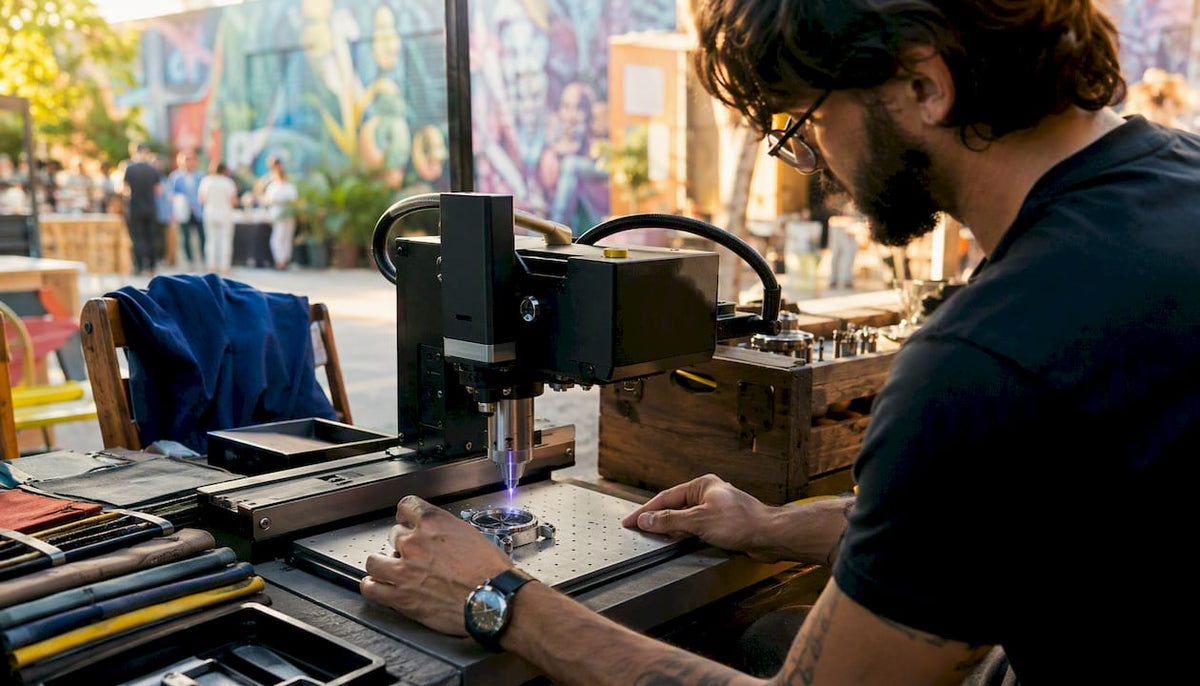
For bulk-branded stainless-steel watches ordered in the U.S., logo engraving on the case back typically adds $3–$6 per unit (roughly 3–6% of base unit cost), while dial logo printing adds 5–8% per unit. Those per-unit figures assume a mid-range base watch and an order of 100 or more pieces. At 50 units, expect the per-unit impact to run toward the top of each range; at 500+, toward the bottom.
Every quote you receive should break down into these line items:
- Setup/tooling fee: one-time charge, typically $50–$300 depending on method and complexity
- Artwork fee: vector file preparation or logo redraw, often $25–$75 if your file is not print-ready
- Sample/proof fee: factories commonly charge $50–$100 per sample; some refund this against a full order
- Per-unit engraving: the recurring cost applied to every piece in the run
- Rush fee: 15–30% surcharge for compressed timelines
- Packaging/labeling: gift-ready boxes, branded inserts, or hang tags billed separately or per unit
Quotes should include all typical line items. Budget accordingly before comparing vendors.
Key Takeaways
| Point | Details |
|---|---|
| Per-unit engraving range | Case back laser engraving adds roughly $3–$6 per unit on bulk stainless-steel orders. |
| Setup fee amortization | A $150 setup fee costs $3/unit at 50 pieces and $0.30/unit at 500 pieces — order size matters. |
| ODM vs. OEM savings | ODM customization runs 15–20% cheaper and delivers in 4–6 weeks vs. longer OEM timelines. |
| Hidden cost checklist | Always verify sample fee, packaging, freight, and rework policy before comparing total quotes. |
| Wynwoodblvd B2B | Wynwoodblvd provides itemized quotes, low MOQ options, and a sample approval workflow for corporate orders. |
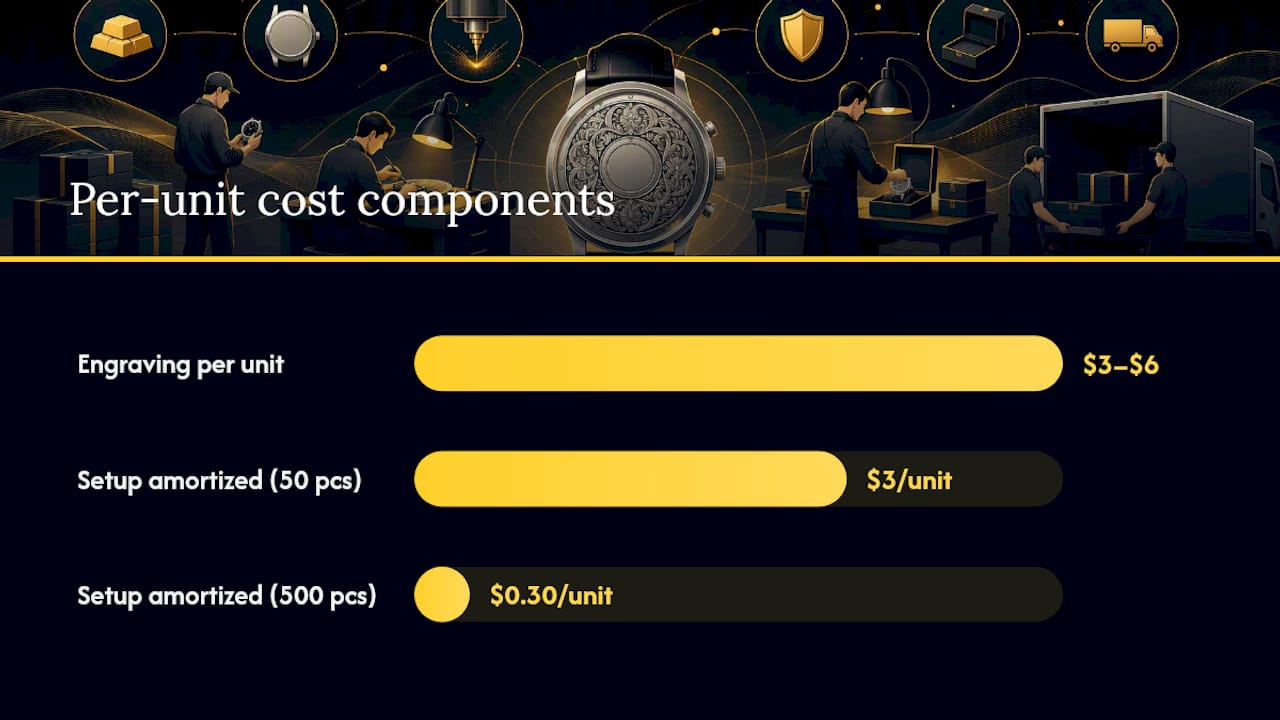
Table of Contents
- How vendors calculate watch engraving pricing
- Which engraving method fits your budget and durability needs?
- Sample cost scenarios by order size and complexity
- What a complete vendor quote must include
- How to prepare artwork so vendors give accurate quotes
- Typical lead times for bulk branded watch orders
- Questions to ask vendors and red flags to watch for
- Why a dedicated premium watch partner reduces your risk
- Wynwoodblvd makes the B2B quote process straightforward
- What experience on B2B projects actually teaches you
- Sources
How vendors calculate watch engraving pricing
Per-unit cost is not a single number. It shifts based on several factors you can control before you send an RFP.
- Setup and tooling: Laser engraving machines require a one-time file setup. That fee ($50–$200 is typical) is fixed regardless of quantity, so it amortizes sharply as order size grows. At 50 units, a $150 setup fee adds $3 per unit. At 500 units, it adds $0.30.
- Artwork complexity: A clean single-color vector logo costs less to set up than a multi-element mark with fine gradients. Filled engraving (where the recessed area is filled with enamel or paint) adds another setup step and a per-unit color charge.
- Location on the watch: Case backs are the most accessible surface for laser machines and carry the lowest per-unit cost. Clasps require repositioning and add minor labor. Bezels and crowns are curved and narrow, which increases machine time and the risk of rejects.
- Material and finish: 316L stainless steel is the standard for corporate gifts and engraves cleanly. PVD-coated or gold-plated surfaces need lower laser power to avoid burning through the finish, which slows throughput and can raise per-unit cost slightly.
- Volume breakpoints: Most suppliers tier pricing at 50, 100, 300, and 500+ units. The per-unit drop between 50 and 300 pieces is often more significant than the drop from 300 to 1,000.
- Vendor type: U.S.-based gift specialists charge more per unit but offer shorter lead times, easier communication, and lower minimum orders. Overseas OEM factories offer lower unit costs but typically require 500–1,000 units for fully custom builds and add shipping, duties, and longer timelines to the landed cost.
Pro Tip: Ask every vendor to show you the setup fee as a separate line, not bundled into the per-unit price. Bundled setup fees hide the true cost at low quantities and make apples-to-apples comparison impossible.
Which engraving method fits your budget and durability needs?
The method determines durability, visual detail, and total cost. For stainless-steel corporate watches, these are the main options:
| Method | Best for | Per-unit cost impact | Setup/tooling fee | MOQ | Typical turnaround |
|---|---|---|---|---|---|
| Deep laser engraving | Durability, daily wear | +3–6% | $50–$150 | 50+ | 2–4 weeks |
| Surface laser etching | Fine detail, low relief | +2–4% | $50–$100 | 50+ | 2–3 weeks |
| Chemical etch | Flat logos, large areas | +2–5% | $75–$200 | 100+ | 3–5 weeks |
| Metal-filled engraving | Color contrast, premium look | 5–8% | $100–$250 | 100+ | 3–5 weeks |
| Pad/screen print (dials) | Color logos on dials | +5–8% | $75–$200 | 100+ | 3–6 weeks |
| Applied metal logo (3D) | High-end visual impact | +10–20% | $200–$500+ | 300+ | 6–10 weeks |
A few practical notes:
- Deep laser engraving is the default for corporate case backs. It survives daily wear without fading and requires no consumables after setup.
- Applied metal logos and 3D dial elements cost significantly more than printed alternatives and raise tooling complexity. Reserve them for flagship gift programs where visual impact justifies the spend.
- Pad printing on dials works well for color-accurate logos but is not suitable for curved case backs.
- For display-only or limited-edition pieces, surface etching delivers a clean look at lower cost.
Sample cost scenarios by order size and complexity
These scenarios assume a base stainless-steel watch with quartz movement and mineral crystal. Sapphire crystal adds roughly $3–$5 per unit to the base cost.
Assumptions: base watch $20–$35 (entry), $25–$50 (mid), $38–$70 (premium); packaging $2–$5 per unit; freight not included. Project cost breaks into development, product, branding, testing, and delivery, so always request a fully itemized quote before committing.
Sample RFP text you can paste into a vendor request:
What a complete vendor quote must include
Use this checklist when comparing quotes side by side:
- Tooling/setup fee (one-time, stated separately)
- Artwork approval fee or file-prep charge
- Sample/proof fee and whether it is refundable against the production order
- Per-unit engraving cost at your exact quantity
- Color or finish surcharges (for filled engraving or multi-color processes)
- Per-style MOQ stated clearly
- Packaging and branded insert cost per unit
- Freight, duties, and insurance to your delivery address
- QA/inspection fee if applicable
- Warranty or rework policy for engraving defects
Some suppliers accept low MOQs of 5–50 pieces for entry-level collections; fully custom OEM projects often require 500–1,000 units. If a quote does not state MOQ explicitly, ask before proceeding.
Red flags: vague per-unit pricing with no setup line, no sample policy, MOQ that changes between emails, or a refusal to share production photos.
How to prepare artwork so vendors give accurate quotes
Clean files prevent revision rounds and surprise setup fees.
- File format: Submit vector files in AI, EPS, or PDF (vector, not flattened). Raster files (JPG, PNG) require redraw, which adds cost and delays approval.
- Line weight: Minimum 0.3mm stroke for laser engraving; finer lines may not reproduce cleanly on steel.
- Placement dimensions: Specify exact placement in millimeters. Case back engravable area is typically 20–30mm wide and 10–18mm tall depending on case diameter. Clasp engravable area is usually 10–15mm × 5–8mm.
- Curved surfaces: Note whether the case back is flat or domed. Curved backs require a rotary fixture, which some suppliers charge extra for.
- Color on dials: Color logo printing is possible on dials via pad or screen print. On case backs and clasps, engraving is the standard option; color fill is an add-on.
- Sample approval: Request a physical production sample before authorizing the full run. Wynwoodblvd provides a corporate branding guide that covers file specs, placement templates, and the sample approval workflow.
Pro Tip: Send a dimensioned placement diagram alongside your vector file. A simple sketch showing logo position, size in mm, and orientation eliminates the most common back-and-forth with factory teams.
Typical lead times for bulk branded watch orders
Plan your procurement calendar around these windows:
- Factory sample (pre-production): 2–4 weeks from artwork approval; finished sample (with engraving on the actual case) takes 3–6 weeks
- Sample approval window: Allow 1–2 weeks internally for review, revision requests, and sign-off
- Production by quantity: 50–100 units: 3–5 weeks after approval; 250–500 units: 5–8 weeks; 1,000+ units: 8–14 weeks
- Shipping: Air freight from Asia: 5–10 business days; sea freight: 25–35 days. Air adds cost but protects event deadlines.
- Rush fees: Compressed production timelines typically add 15–30% to production cost; rush air freight can double shipping cost
ODM projects (customizing an existing model) typically run faster and cost less than full OEM builds. For most corporate gift programs, ODM is the faster and more cost-effective path. Production volumes and complexity determine lead times, so give your supplier the full quantity and spec detail upfront to get a reliable timeline.
Questions to ask vendors and red flags to watch for
Ask every shortlisted vendor these questions before requesting a formal quote:
- What is your MOQ for laser-engraved case backs at my quantity?
- Do you charge a separate sample fee, and is it refundable?
- Can you share production photos or a video of engraving on the actual case material?
- What file formats do you accept, and do you charge for artwork redraw?
- What are your QA procedures, and what is your rework or replacement policy for engraving defects?
- What is your guaranteed lead time from artwork approval to shipment?
- Can you provide references or past corporate order examples?
Red flags to walk away from:
- No itemized quote; pricing given only as a total
- No sample policy or refusal to provide a pre-production sample
- MOQ that shifts between conversations
- Prices significantly below market without a clear explanation
- No production photos or references available
Why a dedicated premium watch partner reduces your risk
Generic promotional suppliers treat watches as commodity items. A dedicated partner manages the full process, from artwork review to final QA, and that difference shows up in brand consistency and reorder reliability.
Wynwoodblvd works with hotels, restaurants, real-estate brands, agencies, and influencers on custom branded watch programs built on premium stainless-steel cases. What that means for procurement:
- Low MOQ options for premium builds, so you can test a design before committing to a large run
- Itemized written quotes with setup and per-unit lines clearly separated
- A portfolio of past corporate orders and production photos available on request
- A sample approval workflow with clear timelines and a written sample policy
- Gift-ready packaging options included in the project scope, not added as a surprise line item
- A corporate branding guide covering dial customization, engraving specs, and artwork requirements
Wynwoodblvd makes the B2B quote process straightforward
Wynwoodblvd’s B2B process starts with a simple step: submit your vector logo, placement preference, and target quantity, and you receive an itemized quote with setup, per-unit engraving, sample fee, and packaging broken out separately. No bundled pricing, no vague turnaround windows.
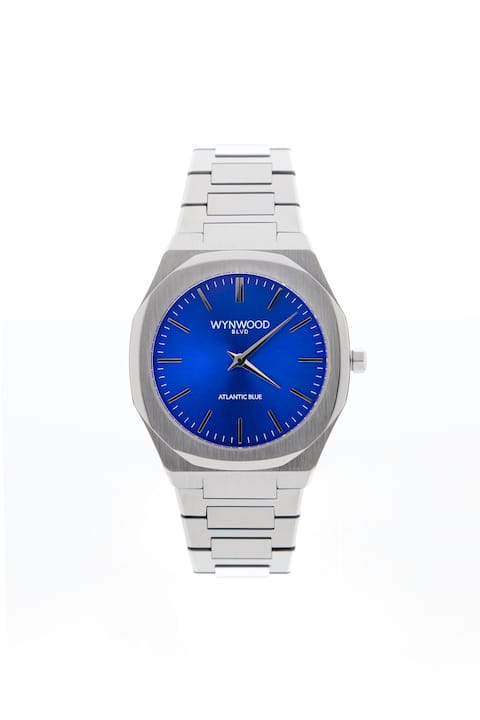
You can browse base models like the Atlantic Blue automatic watch to confirm specs before requesting a custom quote. The full watch collection shows the range of finishes and case styles available for corporate customization. When you’re ready, visit the B2B custom watches page to start your inquiry, request a sample, or download the corporate branding guide.
What experience on B2B projects actually teaches you
The single most common mistake in corporate watch programs is skipping the pre-production sample to save two weeks. That shortcut routinely costs more time than it saves: a logo placed 2mm off-center or engraved at the wrong depth on the actual case material is only visible on a physical sample, not on a digital proof. Approving a digital mockup and going straight to production is how programs end up with 300 units that need rework.
The negotiation move that consistently delivers the best value is switching from an applied metal logo to a laser-etched dial logo. For most hotel or agency gifting programs, that trade is worth making.
One tactic that cuts approval time: send your vendor a dimensioned placement template in PDF alongside the vector file. Specify logo width in mm, distance from the case back edge, and orientation. Vendors who receive this level of spec detail return accurate samples faster and with fewer revision cycles.
Sources
- How To Customize Chrono Watch As Gift Watch (Step-by-Step Guide For Bulk Orders)
- Custom Watch Pricing in OEM Projects: Full Cost Guide
- Custom watch manufacturing for brands, companies and fashion labels – B2B Intermedia Time
,%20while%20dial%20logo%20printing%20adds%205%E2%80%938%25%20pe...)