20mm Most Common: Measure Lug Width at the Spring Bar
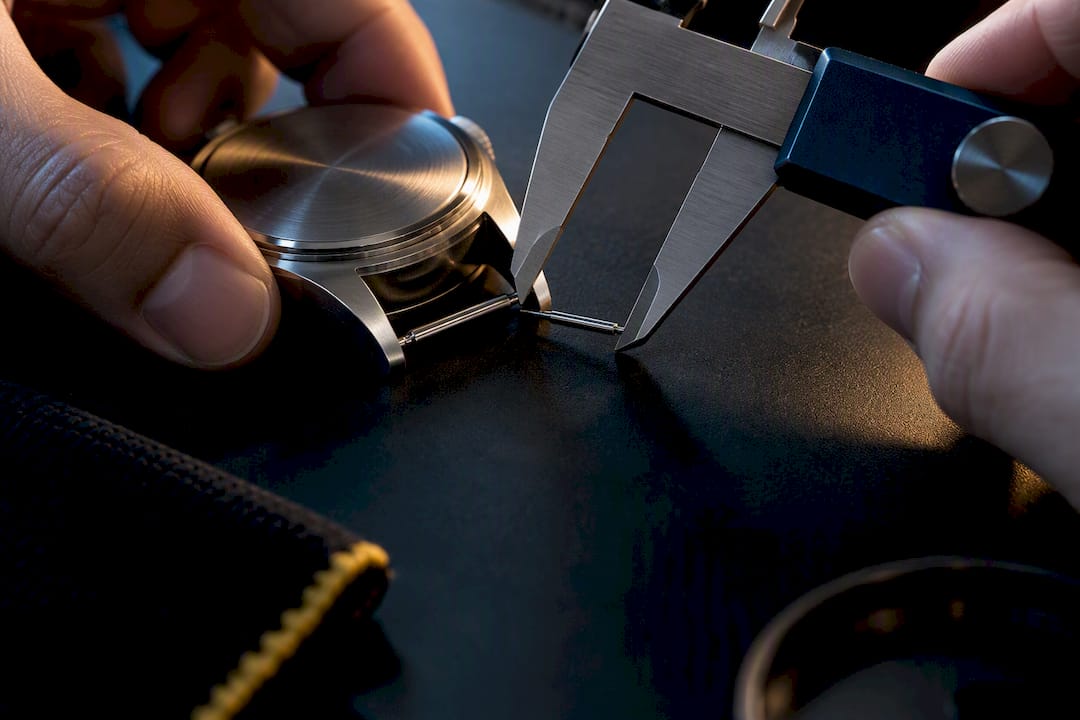
Measure the gap between the inner faces of your watch’s lugs, in millimeters, at the same height as the spring bars. That number, always an even figure between 16mm and 24mm on most watches, is what you match to a new strap. Use digital calipers if you have them; a millimeter ruler or the stamped size on your old strap works as a backup. If the number lands on an odd size, consider sizing up or sourcing a strap made specifically for that reference.
TL;DR:
- Most watches have even-numbered lug widths between 16mm and 24mm, with 20mm being the most common size across brands and styles.
- Accurate measurement with digital calipers is the most reliable method, but manufacturer specs and stamped strap widths are quick alternatives, with cross-checking recommended.
- For odd lug widths like 19mm or 21mm, sizing up by one millimeter generally offers better strap options, especially for leather and rubber materials.
- When measuring, ensure the calipers are zeroed and measure directly from above at spring-bar level to prevent errors caused by angles or misreading.
- Relying solely on old straps or visual guesses often leads to mistakes; double-check measurements with tools and published specs to ensure proper fit.
Table of Contents
- What Is Lug Width, Exactly?
- Why Getting Lug Width Right Actually Matters
- Three Ways to Find Your Watch’s Lug Width
- How to Measure Lug Width With Calipers or a Ruler
- What to Do When Your Lug Width Isn’t Standard
- Common Lug Widths and Where You’ll See Them
- Mistakes That Ruin an Otherwise Good Measurement
- A Note From Wynwoodblvd on Getting This Right
- Why Most Strap-Buying Advice Skips the Part That Matters
- Shop Straps and Watches Built Around Standard Lug Sizes
- Sources
- FAQ
What Is Lug Width, Exactly?
Lug width is the distance between the inner faces of the two metal arms (the lugs) that hold your watch case, measured right where the spring bar sits. That spring bar is the thin pin the strap loops around, and it’s the only measurement point that counts. You’ll also see this called strap width or band width in most strap listings. It’s a different number entirely from case diameter, which measures the watch face itself, not the gap that holds the strap.
Measure the watch, not the strap currently on your wrist. A worn leather strap stretches and compresses slightly over time, and a NATO strap folds around the lugs rather than sitting flush inside them. Neither gives you a trustworthy reading.
- Lug width = gap between inner lug faces at spring-bar level, in millimeters
- Also called strap width or band width
- Different from case diameter or lug-to-lug length
- Always measure the case, not a worn or stretched strap
Why Getting Lug Width Right Actually Matters
A strap that’s even 1mm too narrow leaves visible gaps on either side and tends to shift side to side as you move your wrist. Go too wide, and the strap simply won’t fit between the lugs, or you’ll have to force the spring bar, which risks scratching the case finish or bending the bar itself.
Material makes the margin for error even smaller. Leather and rubber straps sit flush against the lugs, so a mismatch of even half a millimeter shows immediately. NATO and Zulu straps, because they wrap around the outside of the lugs rather than sitting between them, tolerate small mismatches far better.
Most modern watches use even-numbered lug widths between 16mm and 24mm, which narrows your search but doesn’t excuse guessing.
- Too narrow: visible side gaps, strap sliding, uneven wear on the spring bar
- Too wide: strap won’t seat, forced fitting can scratch or dent the case
- NATO and Zulu straps forgive small mismatches; leather and rubber do not
- Getting it right the first time avoids a second order and a second wait
Pro Tip: If you’re between two strap listings and unsure which fits, buy the one matching the smaller measurement. A slightly loose leather strap is a minor annoyance; a strap that won’t fit at all is a wasted order.
Three Ways to Find Your Watch’s Lug Width
You’ve got three realistic paths to the right number, and each has a place depending on how much time and precision you need.
- Look up the manufacturer’s spec. If you know your watch’s model reference, check the brand’s website or product listing. This is the fastest route and works well as a starting point, but treat it as a first pass rather than gospel. Third-party sellers occasionally publish specs that don’t match the actual production run.
- Measure directly with digital calipers. This is the most accurate method available to a home user and takes about ten seconds once you know the technique. Calipers remove the guesswork that comes with a ruler and eye judgment.
- Check the underside of your existing strap or use a ruler. Most factory straps have the width stamped near the buckle end. No stamp? A millimeter ruler works, though it’s more prone to reading error than calipers.
Here’s how the three stack up in practice:
- Manufacturer spec: fastest, zero tools needed, but occasionally wrong for third-party or vintage models
- Digital calipers: most precise, costs $10 to $20, best for anyone replacing straps more than once
- Ruler or strap stamp: free and quick, but vulnerable to angle and parallax errors
These three approaches, confirmed as the standard methods by strap makers, cover almost every situation you’ll run into. The only time you need more than one is when the numbers disagree, and then you cross-check.
How to Measure Lug Width With Calipers or a Ruler
Getting an accurate reading takes less than a minute once you’ve set up correctly.
- Prep the watch. Remove the strap if you can (most spring bars pop out with a spring-bar tool), and set the case face down on a flat, well-lit surface. If you can’t remove the strap, angle the watch so you can see straight into the lug gap.
- Zero your calipers. Close the jaws fully and confirm the display reads 0.00mm before you start. A caliper that isn’t zeroed will throw off every reading that follows.
- Set to millimeters. Most digital calipers toggle between mm and inches with a single button. Double check you’re on mm before reading anything.
- Expand the inner jaws into the lug gap. Gently open the smaller, inside-facing jaws of the caliper until they touch both inner lug faces at the height of the spring-bar holes. Don’t force it. You’re looking for light contact, not pressure.
- Read the display. Lug width is defined as this exact inner-face distance, so whatever number appears is your answer.
- No calipers? Use a ruler. Line up the zero mark exactly at one inner lug face, then look straight down from directly above the ruler to read the opposite face. Reading from an angle is the single biggest source of ruler error.
- Verify. Measure a second time from the other side of the case if possible, and compare your number against the stamped width on your old strap or the brand’s published spec.
Pro Tip: Take the measurement twice, on two different days if you’re not confident. A rushed first measurement is the most common reason people end up with a strap that’s off by a millimeter.
What to Do When Your Lug Width Isn’t Standard
Odd lug widths like 19mm, 21mm, and 23mm exist, and they catch a lot of first-time strap buyers off guard. The safest move for leather or rubber straps is to size up to the next standard width. A 21mm lug generally does better with a slightly compressible 22mm leather strap than a strap cut exactly to spec, since most strap inventories concentrate at 20mm and 22mm, which means better selection and faster shipping at those sizes.
NATO and Zulu straps handle odd sizes with less fuss, since they wrap around the lugs rather than sitting flush between them.
Integrated bracelets are a different problem entirely. Even if the visible gap measures a standard width, the case is often shaped to accept only a specific factory-made bracelet or end-link, so a generic strap won’t seat properly no matter what the tape measure says.
- Odd widths (19mm, 21mm, 23mm): size up one increment for leather or rubber
- NATO and Zulu straps: more forgiving of small size mismatches
- Integrated bracelets: often need a model-specific strap regardless of measured gap
- Curved-end straps: can hug certain case profiles more closely than flat-ended straps, which sometimes show a visible gap on rounded lugs
Common Lug Widths and Where You’ll See Them
Most watches sold today fall into a narrow band of standard sizes, which makes shopping easier once you know your number.
- 18mm: common on smaller dress watches and vintage-style pieces with slimmer cases
- 20mm: the single most common lug width across modern sport, dress, and everyday watches
- 22mm: typical on larger dive watches, pilot watches, and field watches with wider cases
- 24mm: less common, usually reserved for oversized dive or military-style cases
If your watch lands on 20mm or 22mm, you’ll have no trouble finding straps in any material or color. Rarer sizes, particularly 19mm, 21mm, and anything outside the 16mm to 24mm range, are better sourced from specialist leather makers or ordered directly from the watch brand as an OEM replacement. Trying to force a mainstream strap onto an unusual lug width usually ends in a return.
Mistakes That Ruin an Otherwise Good Measurement
Most bad strap orders trace back to one of a handful of avoidable errors.
Reading a ruler from an angle instead of straight down is the most frequent mistake people make, and it can throw a reading off by a full millimeter in either direction. Measuring the tapered tail end of an old strap instead of the wider buckle end is another common trap. The buckle end holds the true lug width; the tail is often narrower for style.
Don’t round an odd reading up or down just because it seems cleaner. A watch that measures 21mm is a 21mm watch, not a 20mm or 22mm one, even if 21mm straps are harder to find. And if your case has a shrouded or recessed lug design, measure at the actual spring-bar seat, not the visible outer lip, since the two can differ by a millimeter or more.
- Always read a ruler from directly above, never at an angle
- Measure the buckle end of an old strap, never the tapered tail
- Don’t round an odd measurement to a “nicer” number
- On shrouded cases, measure at the spring-bar seat, not the outer lip
Pro Tip: When in doubt, cross-check your caliper reading against the brand’s published spec sheet. Two independent numbers that agree are far more trustworthy than one confident guess.
A Note From Wynwoodblvd on Getting This Right
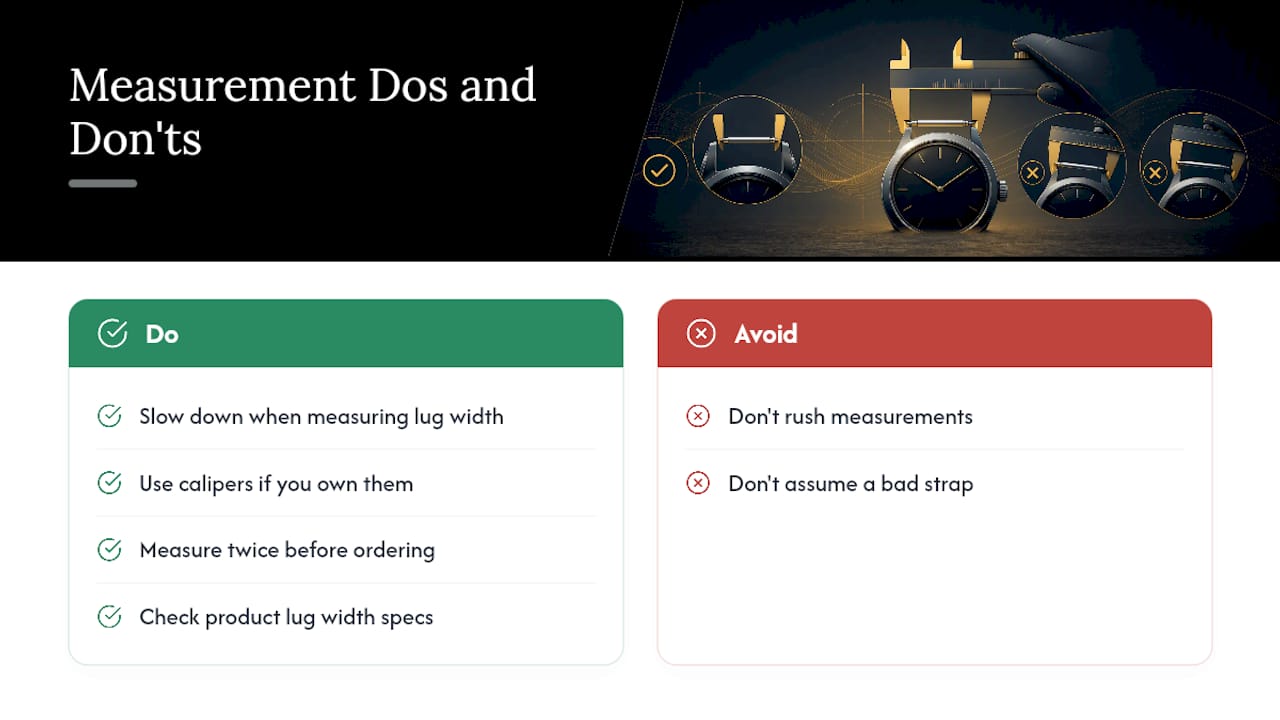
Mathias has spent enough time swapping straps and adjusting clasps on personal and customer watches to know where people go wrong: it’s almost always a rushed measurement, not a bad strap. The fix isn’t complicated. Slow down, use calipers if you own a pair, and check your number twice before you order anything.
Lug width specs are often listed on product pages to help customers shop for replacement straps with confidence. If you’re working through fit questions beyond lug width, the watch size guide covers case diameter and lug-to-lug length, and the clasp adjustment guide is useful once your new strap is on and you’re dialing in the fit on your wrist.
Why Most Strap-Buying Advice Skips the Part That Matters
Most guides treat lug width like a trivia fact: look up a number, done. The truth is that the number only helps you if you trust how you got it, and that’s where most people cut corners. A ruler read at an angle or a stretched strap measured as if it were new will hand you a confident-looking figure that’s wrong.
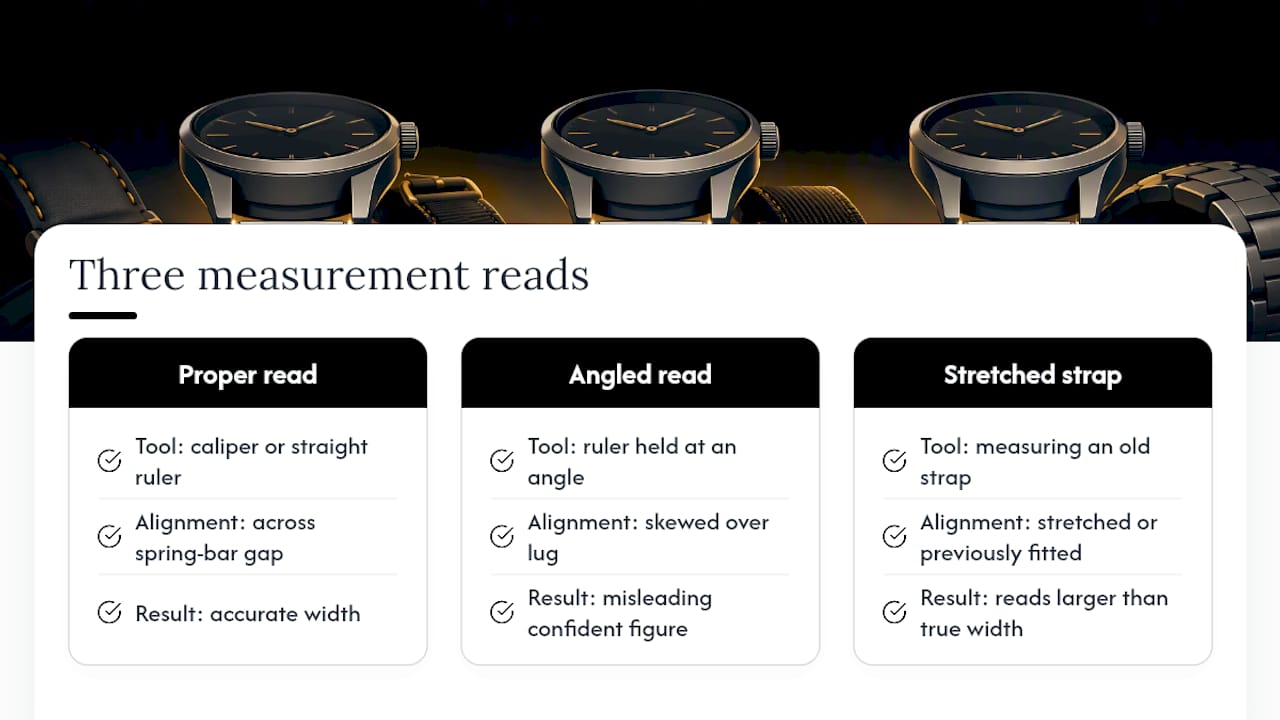
The conventional advice to “just check your old strap” also falls short more often than people expect, especially on watches that have been re-strapped once already, since a previous owner or seller may have installed a strap that was never quite right for the case. The habit worth building isn’t memorizing standard sizes. It’s cross-checking two independent sources, a caliper reading against a manufacturer spec, or a ruler reading against a stamped strap width, before you commit to an order.
Prioritize the tool over the shortcut. A $15 caliper pays for itself the first time it saves you from a returned strap and a second shipping wait.
— Mathias
Shop Straps and Watches Built Around Standard Lug Sizes
Some watch designs use standard, easy-to-source lug widths, so once you know the measurement, finding a compatible strap is more straightforward.

Every product page lists the lug width alongside case diameter and strap material, so you can confirm fit before you buy rather than after. The Atlantic Blue automatic and the Keys Blue automatic both use widths common enough to match a broad range of leather, rubber, and NATO straps without any sizing gymnastics. Browse the full Miami Inspired Watches collection to compare specs side by side, and reach out to support directly if your case falls on an uncommon size. If you’re outfitting a team, hotel, or event with matching pieces, Wynwoodblvd’s Corporate Custom Watches program handles bulk orders with consistent, documented specs across every unit.
Sources
This guide draws on measurement methods and sizing data from Helvetus, StrapVault, Nothing But Bands, Delugs, and the Wikipedia entry on watch straps for general terminology.
- How to Measure Your Watch Lug Width: The Complete Guide | Helvetus®
- How to Measure Watch Lug Width for Strap Replacement | StrapVault
- How to Measure Watch Lug Width Without a Gauge – NBB
- How to Find Your Watch’s Lug Width | Delugs
FAQ
How Do You Determine Lug Width?
Measure the distance between the inner faces of the lugs at spring-bar height, using digital calipers for the most accurate reading. A millimeter ruler or the stamped size on your existing strap works as a fallback if you don’t have calipers.
What Does 22mm Lug Width Mean?
A 22mm lug width means the gap between the inner faces of the lugs, measured at the spring bar, is 22 millimeters wide. You need a strap or bracelet manufactured at that same 22mm width for a proper fit, common on larger dive and pilot watches.
What Is the Most Common Lug Width for Watches?
Twenty millimeters is the single most common lug width across modern watches, with 22mm and 18mm following behind it. Most watches fall into an even-number range between 16mm and 24mm.
Is 47mm Lug-to-Lug Big?
The lug-to-lug measurement (the distance from the tip of one lug to the tip of the opposite lug, not the same as lug width) affects how a watch fits and tends to suit medium-to-large wrists. If you’re between sizes, checking your wrist circumference against the case’s lug-to-lug figure, covered in more depth in Wynwoodblvd’s watch size guide, gives a clearer read than lug-to-lug alone.