Under 200 Units, Choose Corporate Gift Packaging That Looks Premium
Start with a custom printed mailer box, a soft-touch matte finish, and a personalized insert card. That combination covers most corporate gifting budgets and timelines. For executive or VIP recipients, upgrade to a magnetic rigid box for the added weight and reveal. For sustainability-focused programs, choose a reusable tote or pouch instead. The sections below walk through format, finish, cost, and lead time so you can pick the right one.
TL;DR:
- Digital print mailer boxes are suitable for orders under 200 units, while rigid boxes become cost-effective at 250 units or more, and overseas production is viable past 500 units.
- finishes like soft-touch laminate, spot UV, and foil stamping significantly boost perceived quality at lower print volumes, especially when applied to lids and interior layers.
- Personalization tactics such as variable-data cards, branded ribbons, and QR codes enhance gift impact without adding substantial costs, especially for small-scale campaigns.
- Lead times range from one to two weeks for domestic digital proofs, extending to 8 to 12 weeks for overseas production, requiring early planning for deadlines.
- Recyclability is maximized when packaging uses mono-material construction and water-based coatings, with clear reuse suggestions printed directly on the packaging.
Table of Contents
- Which Corporate Gift Packaging Format Should You Choose?
- What Design Details Actually Raise Perceived Value?
- What Volume and Lead Time Should You Plan For?
- How Do You Make Gift Packaging More Sustainable?
- How Do You Build a Repeatable Packaging Program?
- How Wynwoodblvd Matches Packaging to Its Watch and Jewelry Line
- Why Packaging Is Part of the Relationship, Not an Afterthought
- Get Custom-Branded Watches and Charms for Your Next Corporate Gifting Program
- Sources
- FAQ
Which Corporate Gift Packaging Format Should You Choose?
Format choice depends on volume, budget, and how the gift ships. Here’s how the main options stack up:
- Printed mailer boxes work best for small to mid-size runs. They print quickly on digital equipment, ship flat before assembly, and leave enough interior space for a real unboxing moment.
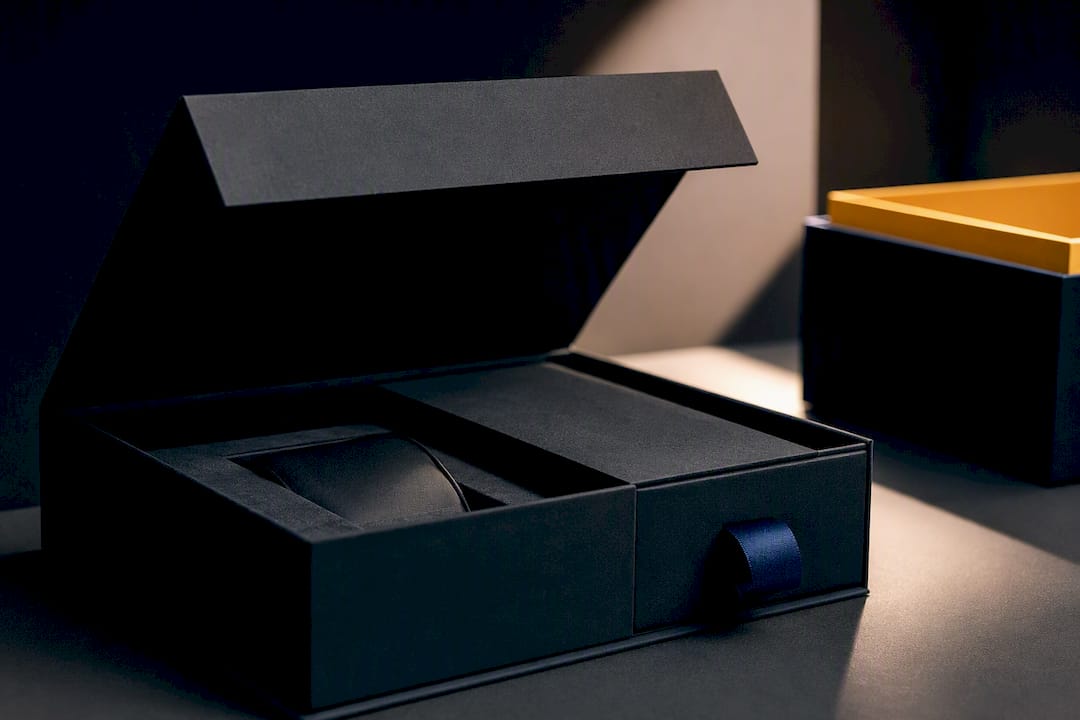
- Rigid or magnetic-lid boxes deliver the strongest premium feel, but the tooling and setup costs only make sense once you’re ordering 250 units or more. Lead times run longer, too.
- Sleeves and branded bags are a cost-effective way to refresh a seasonal campaign. Swap the sleeve, keep the same core box, and you’ve got a fresh look for seasonal updates without reprinting anything structural.
- Hampers and trays suit food, beverage, or multi-item assortments. These need more insert engineering, since loose bottles or jars shift in transit if you don’t build in dividers or molded trays.
- Reusable wraps and pouches give the packaging a second life. A drawstring pouch that becomes a travel bag, or a fabric wrap that gets reused for storage, extends your brand’s presence well past the unboxing moment.
Most marketers land on a mailer box or a rigid box. The deciding factor is almost always volume, not taste. If your list is under 200 names, the mailer box wins on cost every time.
What Design Details Actually Raise Perceived Value?
Finish moves perceived quality more than format does, especially at lower volumes — understanding how to use visual storytelling tips can greatly boost your brand’s impact through packaging. A soft-touch matte laminate on a simple mailer box often reads as more premium than a glossy rigid box with no tactile finish at all. If you’re ranking finishes by impact per dollar, soft-touch laminate comes first, spot UV or spot gloss accents come second, and foil stamping or embossing comes third for most programs.
Personalization is where corporate gifting has changed the most. A few tactics scale well without blowing the budget:
- Variable-data insert cards that print each recipient’s name and a short note.
- Branded sleeves or ribbons with a name or department printed in the same run.
- Small QR or NFC cards that link to a personalized thank-you video or digital gift portal.
- A printed message under the lid, visible only when the box opens.
Interior details matter as much as the exterior. Colored tissue that contrasts with the box interior, a simple foam or cardboard insert to stop movement, and a printed thank-you under the lid all cost very little relative to the effect they create. Layered “story box” designs with a lift-off lid build anticipation before the recipient even sees the gift.
Pro Tip: Save your biggest finish budget for the parts recipients actually touch first, the lid and the first interior layer, rather than spreading it evenly across the whole box.
What Volume and Lead Time Should You Plan For?
Packaging decisions come down to three numbers: units, weeks, and dollars per box. Get these wrong and you either overpay for a format you don’t need or run out of time before the event date.
- Volume thresholds: Domestic digital print becomes viable starting around 50 units, making it the right choice for pilot programs. Rigid boxes need roughly 250+ units to justify the tooling cost. Overseas production only makes financial sense past 500 units, once you factor in freight and minimums.
- Lead times: Domestic digital proofs typically take 1 to 2 weeks. Add specialty finishes like foil or spot UV and expect another 1 to 2 weeks on top. Overseas production runs 8 to 12 weeks end to end, so book that timeline well before your gifting deadline.
- Budget allocation: If your box-only budget is limited, focus spending on interior inserts and finishing rather than expensive rigid formats that cannot be well executed. A well-finished mailer box usually outperforms a minimally finished rigid box at the same price.
Always order a physical proof before committing to a full run. Colors, textures, and fold lines look different on screen than in hand, and a proof catches problems while they’re still cheap to fix.
How Do You Make Gift Packaging More Sustainable?
Reusable packaging works best when the recipient will actually use the item again, a tote, a pouch, a travel case. Recyclable mono-material boxes work better when you’re shipping at scale and can’t guarantee reuse behavior. Match the choice to how the gift travels and who’s receiving it.
A few practical rules keep sustainability claims honest instead of decorative:
- Choose mono-material construction (all paperboard, no plastic window or foil layer) so the box can actually go through standard recycling.
- Use water-based varnish instead of solvent-based coatings, which block recyclability even on otherwise paper-based boxes.
- Skip multi-material laminates that look premium but can’t be separated at a recycling facility.
- Print a short second-life suggestion right on the insert card, like “reuse this pouch for travel,” so the sustainability message doesn’t rely on the recipient guessing.
How Do You Build a Repeatable Packaging Program?
A one-off gift box is easy. A packaging program that works every quarter needs structure. The Good, Better, Best tier model handles most corporate gifting needs without forcing your team to reinvent the box for every campaign:
- Good: printed mailer box, one hero finish, standard insert card. Fits high-volume mailings and new-client welcome kits.
- Better: soft-touch mailer or light rigid box, personalized insert, branded tissue. Fits client renewals and mid-tier partners.
- Best: magnetic rigid box, foil detail, custom message card, premium interior. Reserved for executives, top clients, and milestone gifts.
Before scaling any tier, run a pilot of 100 to 200 mixed kits to test how assembly and shipping actually hold up. Bundle each finished kit as a single SKU so your pick-and-pack process treats it as one item, not five loose parts. For seasonal refreshes, swap sleeves, stickers, or insert cards instead of reprinting the entire box.
Pro Tip: Keep a return-ready label zone printed on the box itself. It saves a scramble if a recipient needs to exchange or return an item inside a program that includes physical goods.
How Wynwoodblvd Matches Packaging to Its Watch and Jewelry Line
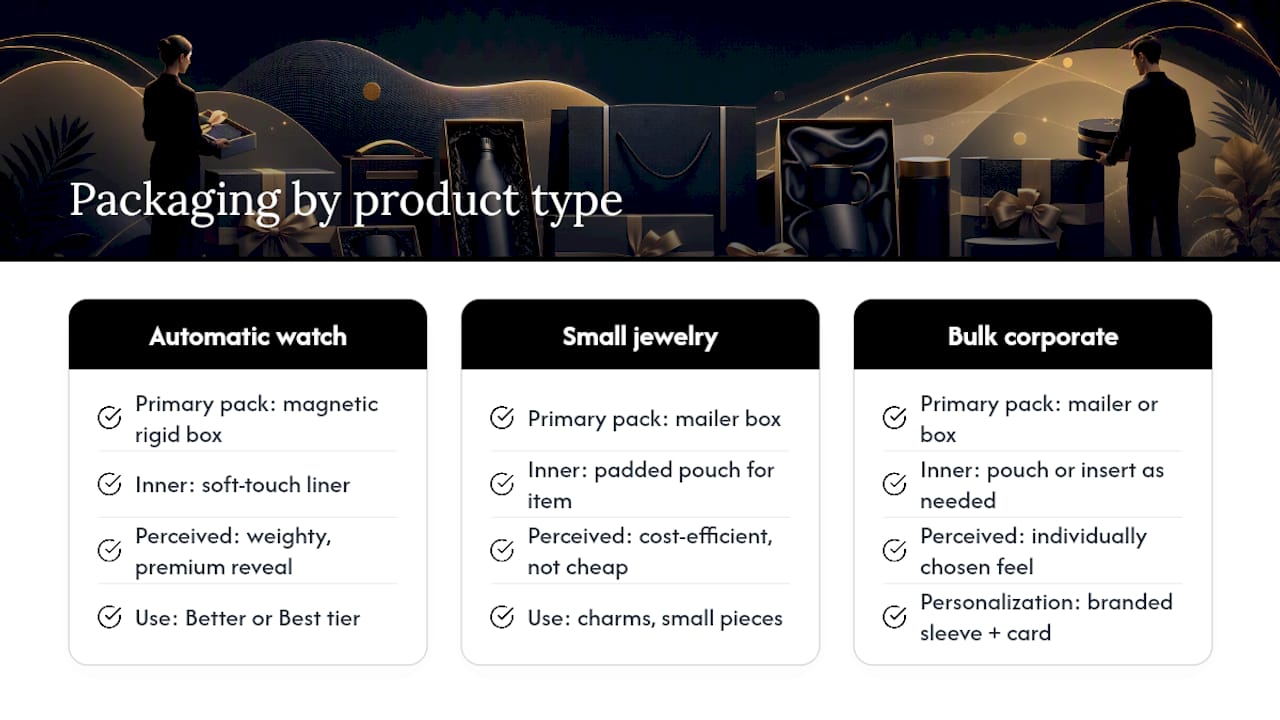
Miami-inspired watches suit the Better or Best tier: a magnetic rigid box with a soft-touch liner gives an automatic watch the weight and reveal it deserves. Smaller items like the palm tree charm collection work well in a padded pouch inside a mailer box, keeping cost down without looking cheap. A branded sleeve with the recipient’s name, paired with a message card, turns a bulk corporate order into something that feels individually chosen. See our custom jewelry packaging guide for insert sizing specifics.
Why Packaging Is Part of the Relationship, Not an Afterthought
Most gifting budgets go to the item itself, and packaging gets whatever’s left. That’s backwards. The box is the first physical thing a client touches, and it sets the tone before they even see what’s inside. A well-chosen mailer box with a thoughtful insert often lands better than an expensive item stuffed into a plain shipping carton. Treat the unboxing as a small piece of the ongoing relationship, not a one-time production task.
— Mathias
Get Custom-Branded Watches and Charms for Your Next Corporate Gifting Program
The gift and the packaging can be built together, so you’re not coordinating a watch supplier and a box supplier separately. A corporate custom watches program can handle logo engraving, dial customization, and packaging finishes (sleeves, boxes, message cards) as one order, which is the difference between assembling five vendors and working with one.
Pair an Atlantic Blue automatic watch or a Sunset Orange dial watch with a magnetic rigid box for your Best tier, or send the Palm Tree Charm in gold in a soft-touch pouch for a lighter-touch client gift. Both can scale to bulk corporate orders with consistent branding across every unit. Request a quote through our Corporate Custom Watches page to get pricing and lead times for your next gifting cycle.
Sources
- Corporate Gift Boxes: How to Choose the Right Format and Finish - PackagingStudio
- Corporate Gift Packaging Ideas for Clients, Employees, and Events - Interpak
- Custom Packaging Ideas for 2026 Corporate Gifts | Righteous
- Branded Client Gifts & Corporate Gifting Guide - POZI Packaging
- Corporate gift box packaging: trends and design tips from experts - Swag42
FAQ
What Are Good Ideas for a Corporate Gift Box?
A custom mailer box with a soft-touch finish, a personalized insert card, and branded tissue covers most budgets and volumes. For higher-tier clients, a magnetic rigid box with foil detail and a printed message under the lid adds the premium feel executives expect.
What Are Good Corporate Gift Items to Package?
Watches and jewelry travel well in structured packaging because they’re compact and benefit from a padded interior. Wynwoodblvd’s Miami-inspired watches and charm collection both fit naturally into a rigid box or padded pouch setup for corporate orders.
What Should Go in a Corporate Gift Bag?
A branded bag works best for lighter, informal gifting like event swag or conference giveaways. Fill it with one hero item, a small printed card explaining the gift’s story, and tissue paper in a color that matches your brand palette.
What Are the Latest Trends in Corporate Gifting?
Personalization and sustainability lead the current trends, with variable-data insert cards and QR codes linking to thank-you videos becoming standard for mid-size programs. Reusable pouches and mono-material recyclable boxes are also gaining ground as companies look to reduce packaging waste without sacrificing the unboxing experience.
How Much Does Custom Corporate Watch Packaging Cost?
Pricing depends on the watch style, order volume, and packaging finish selected, so current pricing is available directly through Wynwoodblvd’s B2B page. Domestic digital print runs are typically the most cost-effective starting point for orders under 200 units.