Men's Bracelet Sizes: Measure Your Wrist, Not the Tag
Most men choose a bracelet length based on their wrist measurement and preferred fit. Fit changes with style, so your first step is simple: measure your wrist where the bracelet will sit. Below, we show how to measure, read a size chart in inches and centimeters, and adjust for each style.
TL;DR:
- Measure twice at day’s end, use the larger reading if the results differ, and remember that bangles require measuring across your knuckles, not around your wrist.
- Add 1/4 to 1/2 inch for a normal fit, up to 1/4 inch for beaded or elastic styles, and extra room for thick designs.
- If you fall between sizes, choose the larger size for chain or link bracelets; links can be removed, but fixed clasps cannot be lengthened.
- Adjustable clasps, extenders, and leather holes suit gifts or changing wrist sizes; check return terms for fixed pieces and ask about plated metal before resizing.
Table of Contents
- How do you measure your wrist for a bracelet?
- What are the standard men’s bracelet sizes?
- How does bracelet style change the fit?
- How do you convert wrist size to bracelet length?
- How much should you add for comfort?
- Which clasp types help with sizing?
- How can you measure without tools or check a bracelet you own?
- What should you know about sizing custom or corporate branded bracelets?
- How does bracelet width affect comfort and fit?
- How do seasons and swelling change your size?
- Can you adjust or resize a bracelet after you buy it?
- How do you choose the right fit for your style and clasp?
- Why we think fit matters more than the size on the tag
- Where can you find bracelets and charms that fit well?
- FAQ
- Sources
How do you measure your wrist for a bracelet?
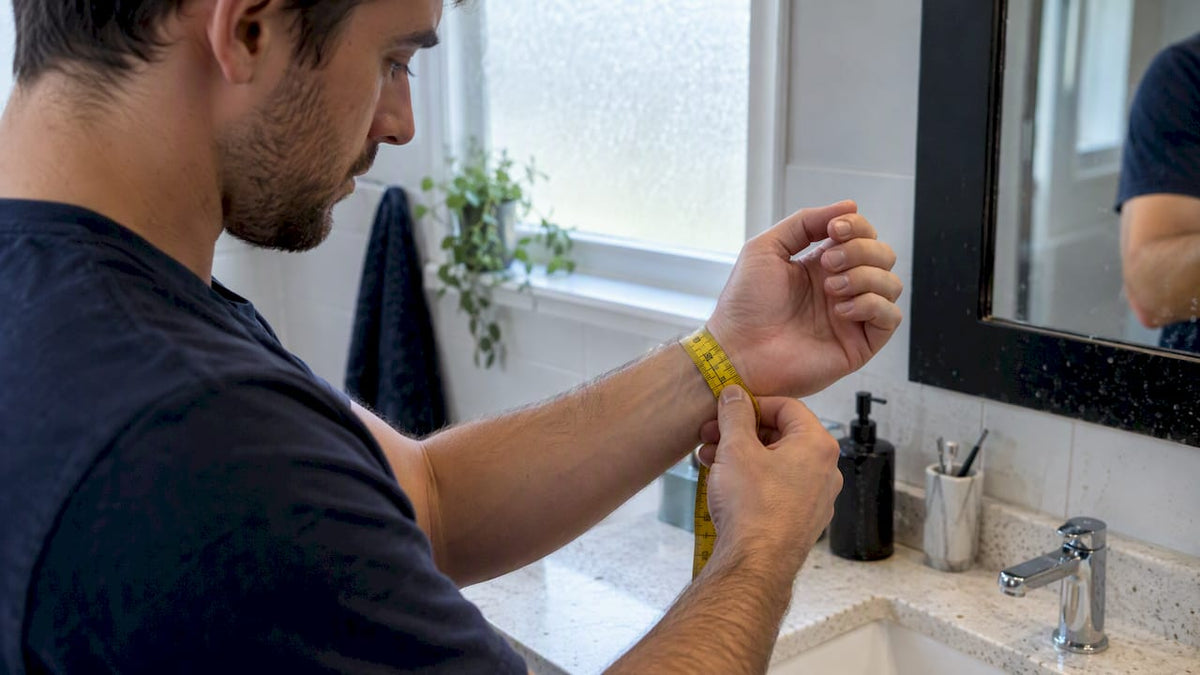
You can get an accurate measurement with a few simple steps. Use a soft tape measure if you have one, and a string or a strip of paper if you don’t. Measure the wrist you will wear the bracelet on, usually your non-dominant one.
- Relax your hand and place the tape just below the wrist bone, where a bracelet or watch normally rests.
- Wrap it snugly, flat against the skin, with no twists. It should touch your skin without squeezing.
- Read the number where the tape meets the end. That is your wrist circumference.
- Repeat the measurement twice. If the numbers differ, use the larger one.
- Measure the other wrist if you are unsure. Many people have a slightly larger dominant wrist.
For a string or paper strip, wrap it the same way, mark the overlap with a pen, then lay it flat against a ruler. A paper strip works well because it does not stretch.
Slip-on bangles are a different case. Your wrist circumference does not decide the fit. What matters is whether the bangle can pass over the widest part of your hand. We cover that in the section on measuring without tools.
Pro Tip: Measure at the end of the day, when your wrist is at its natural size, and keep the tape flat against the skin the whole way around.
What are the standard men’s bracelet sizes?
Men’s bracelet lengths vary by wrist size and style. Choose a length based on your wrist measurement and how snug or loose you want the bracelet to fit. Chunkier styles may need extra length.
Bracelet length is not the same as wrist circumference. Your wrist number is the body measurement. The bracelet length is that number plus a small allowance, so the piece can move and sit comfortably.
Use your wrist measurement as a starting point, then choose a tighter, normal, or looser fit based on your preference and bracelet style.
If you land between two sizes, pick the larger one for chain and link styles. You can shorten a link bracelet, but you cannot lengthen a fixed one. For larger wrists or thick and beaded styles, check that the maker offers extra length.
How does bracelet style change the fit?
The same wrist needs a different length depending on the design. Rigid pieces and bulky pieces take more room, soft and stretchy pieces take less.
- Beaded or elastic: These are usually worn closer to the wrist. Allow about 0 to 1/4 inch over your wrist size, since the cord stretches.
- Chain or link: Use the standard allowance. Thicker links sit higher off the skin and need a little extra length.
- Cuffs and rigid bangles: These do not stretch. Use the bangle-over-hand method and leave clearance for your knuckles and the base of your thumb.
- Leather straps and cuffs: Most have several holes, so you get built-in adjustment. Thick leather needs a bit more length because it does not bend tightly.
- Charm bracelets: Charms add bulk and weight. Add a small allowance so they can swing without pinching.
On our own pieces, we design charms with their fit in mind. You can browse our Miami Inspired Charms to see how they pair with a bracelet.
Pro Tip: If you plan to wear a watch and a bracelet on the same wrist, size the bracelet one step looser so the two do not crowd each other.
How do you convert wrist size to bracelet length?
The rule is simple: bracelet length equals wrist circumference plus an allowance. For most men, the allowance is between 1/4 inch and 3/4 inch, depending on how snug or loose you like the fit. Fit categories are explained in the next section.
To switch between units, remember that 1 inch equals 2.54 centimeters. Multiply inches by 2.54 for centimeters, or divide centimeters by 2.54 for inches. Always check the unit on a product page before you order, because some makers list centimeters only.
Check the product page for the bracelet’s length and unit of measurement.
Say your wrist measures 7.5 inches and you want a normal fit. Add 1/2 inch, and you are looking for an 8 inch bracelet, which is about 20.3 cm. That is an illustrative example, not a rule for every wrist, so use your own number.

How much should you add for comfort?
Allowance is what turns a measurement into a comfortable bracelet. We group it into three fit categories.
- Tight: About 0 to 1/4 inch over your wrist size. The bracelet stays in place and barely moves. Good for beaded and elastic styles.
- Normal: About 1/4 to 1/2 inch over. The bracelet sits comfortably and slides a little. This is the best default for most men.
- Loose: About 1/2 to 3/4 inch over, or more. The bracelet moves freely and can slide down toward your hand. It works for heavy links and for layering.
Think about real use. If you work out, a tight or normal fit keeps the bracelet from swinging. In hot weather, a looser fit gives your wrist room to expand. If you stack several bracelets, each one adds bulk, so go up a size for the top layer.
Before you cut or alter anything, test the fit. Hold the bracelet in place and check that you can slide one finger under it. Raise your hand, shake it lightly, and make sure it stays where you want it.
Which clasp types help with sizing?
The clasp decides how forgiving a bracelet is. Some let you adjust by small steps, others lock you into a fixed length.
- Lobster claw: Usually paired with an extender chain, so you get a few steps of adjustment.
- Buckle or tang: Offers several holes, so it is easy to fine tune.
- Slide or sliding knot: Adjusts smoothly across a range, with no fixed steps.
- Box or fold-over clasp: Fixed length. You need to get the size right the first time.
- Magnetic clasp: Fixed length, easy to close, with no micro-adjustment.
If a clasp has no adjustment, size up rather than down, since a bracelet that is slightly long still works, while one that is too short does not. For more detail on each type, read our guide to bracelet clasp types. Extenders and professional resizing are options when a favorite piece is a little off.
How can you measure without tools or check a bracelet you own?
You do not need special equipment. Household items work well.
- Cut a strip of paper or a piece of string long enough to wrap around your wrist.
- Wrap it around your wrist at the wearing point and mark where the ends meet.
- Lay the strip flat and measure it against a ruler.
- To check a bracelet you already own, lay it flat, closed or fastened, and measure from end to end including the clasp.
- For slip-on bangles, measure the widest part of your hand across the knuckles, with your thumb tucked in, and compare it to the bangle’s inner width.
Match the number you get to a size chart and you have your size.
What should you know about sizing custom or corporate branded bracelets?
When a business orders branded bracelets for a team, an event or a client gift, the goal is a size that fits most people without a custom measurement for each one. Adjustable styles solve this best. A leather strap, a sliding knot or a clasp with an extender covers a wide range of wrists in a single product.
For fixed-length pieces, order a range of sizes instead of just one length, and consider adding more options if your group has varied wrist sizes. It helps to ask recipients for a wrist size ahead of time, or to include a simple measuring strip in the invitation.
Branding also affects fit. A logo plate, an engraved tag or a thick edge adds length and stiffness, so check that the final dimensions still work for the wrist. If the piece is a watch, the same logic applies to the strap.
We make corporate custom watches for companies, hotels, restaurants and agencies, and we can talk through sizing for your group before you place a bulk order.
How does bracelet width affect comfort and fit?
Width changes how a bracelet feels, even when the length is correct. A thin bracelet moves easily and tolerates small sizing errors. A wide bracelet covers more of the wrist and has less give.
To measure width, lay the bracelet flat and measure across the band at its widest point, using a ruler. Compare that with the space between your wrist bone and the base of your hand, where the bracelet will sit.
Here is how width plays out:
- Narrow bands (under about 1/4 inch): Flexible, easy to wear all day, forgiving of small size differences.
- Medium bands: The most common range for men’s bracelets. Standard allowances apply.
- Wide bands and cuffs: They do not bend with the wrist, so a tight fit feels restrictive. Choose a normal or slightly loose fit.
Wide pieces also tend to shift toward your hand. If you choose a wide style, test it with your wrist bent and flexed to make sure the edges do not dig in.
How do seasons and swelling change your size?
Your wrist is not a fixed size. Heat, humidity, salt, exercise and long flights can all make it swell slightly, and cold weather often brings it back down. A bracelet that fits perfectly in winter can feel snug in summer.
This is why we suggest a normal fit for most men, with a loose fit for people who live in warm climates or travel often. A bracelet that moves slightly gives your wrist room to change through the day.
Some practical habits help:
- Measure at the end of the day and in the season when you will wear the bracelet most.
- If a bracelet feels tight after a workout or a hot afternoon, take it off and let your wrist rest.
- Choose adjustable styles, such as leather straps or extender chains, if your size changes often.
- Do not wear a tight bracelet to sleep, since your wrist can swell overnight.
If you live somewhere warm, the same logic applies to metal watches and bracelets. They absorb heat, and a close fit gets uncomfortable faster. A little extra room makes daily wear easier.
Can you adjust or resize a bracelet after you buy it?
Often, yes. How easy it is depends on the style.
- Chain and link bracelets: A jeweler can remove or add links. Some metal link bracelets include small pins or screws that you can adjust at home with the right tool.
- Leather: Extra holes can be punched, or you can choose a different hole if the strap has several.
- Beaded and elastic: Elastic can be restrung to a new length by a jeweler or a careful DIY hobbyist.
- Rigid cuffs and bangles: These are hard to change. Some cuffs can be gently bent a small amount, but too much force can warp the shape or damage the finish.
Always keep any removed links, since you may want to add them back if your size changes. If your bracelet has a plated finish, ask a jeweler about the risks of resizing before cutting, because altering plated metal can expose the base material.
Before buying, check the maker’s return and exchange terms. If you are between sizes, ordering the larger one and having it shortened is usually the safer route. Our Palm Tree Charms can add personality to a bracelet.
How do you choose the right fit for your style and clasp?
Pull everything together with three questions: what style are you buying, how does it close, and how do you like it to feel?
For a chain or link bracelet with a fixed clasp, pick a normal fit and round up if you are between sizes. For a bracelet with an extender or buckle, you have more freedom, so choose the size closest to your wrist plus 1/2 inch and fine tune with the adjustment. For rigid cuffs and bangles, prioritize clearance over hand and wrist, and pick the next size up if you are unsure.
If you are buying a gift, ask for a wrist size or pick an adjustable style. A leather strap or an extender chain forgives a wide range of wrists.
A trusted partner source suggests adding about 1/2 inch to your wrist measurement for a comfortable fit with gold bracelets, which matches our normal fit range. Watch sizing follows a similar logic, and our guides on watch sizing and unisex watch fit explain how wrist measurements translate to a case and strap.
When you are done, you should have a wrist number, a fit category and a clear idea of how the clasp will work. That is enough to buy with confidence.

Why we think fit matters more than the size on the tag
A bracelet that fits well gets worn every day. One that fits badly ends up in a drawer, however good it looks. That is the real reason we care about sizing: comfort decides whether a piece becomes part of your routine.
Many shoppers treat size as a number to match. We think it works better as a balance between wrist, style and habits. A man might wear a chain with a little extra room, a snug beaded strand, and a loose cuff, and all three can be right. The number on the tag is only a starting point.
That is how we approach our own designs. If you want help with a custom size, an unusual wrist or a bulk order for your business, contact our support team and we will work through it with you.
— Mathias
Where can you find bracelets and charms that fit well?
When you are ready to shop, our collections are a good place to start. We design premium stainless steel watches and jewelry inspired by Miami, with comfortable daily wear in mind.
- Browse our Miami Inspired Watches, including the Keys Blue, Atlantic Blue and Everglades Green automatic models.
- Add personality with Miami Inspired Charms and Palm Tree Charms.
- Order branded pieces for your team through Corporate Custom Watches, with logo engraving, dial customization and packaging options.

Measure your wrist, pick your fit, then view the watch and charms collections, or contact us about bulk orders.
FAQ
What size bracelet should I wear?
Most men choose a bracelet length based on their wrist measurement and preferred fit. Measure your wrist, then add about 1/4 to 1/2 inch for a normal fit. Adjust up for thick or heavy styles.
How do you measure for bangles?
Bangles do not stretch, so measure the widest part of your hand across the knuckles with your thumb tucked in. The bangle’s inside diameter needs to be slightly larger than that number so it can pass over your hand. Wrist circumference alone is not enough.
What is the wrist circumference of a size 7 bracelet in centimeters?
A bracelet’s length should allow for your wrist measurement and the fit you prefer. Check the sizing chart and product details when choosing a size. Multiply inches by 2.54 to convert any size.
Are men’s bracelets supposed to be loose?
A good bracelet should move slightly, but not slide off your hand. A normal fit leaves room for about one finger under the band. Beaded and elastic styles can sit closer, while heavy links and cuffs usually feel better a little looser.
Sources
- Federal Register jewelry guidance (Federal Register, August 16, 2018)
- Summary of Basis and Purpose for the Revised Jewelry Guides
- FTC commentary on metallic watch band and jewelry guides