Palm Tree Necklace Meaning: Psalm 92, Resilience, and 316L Steel
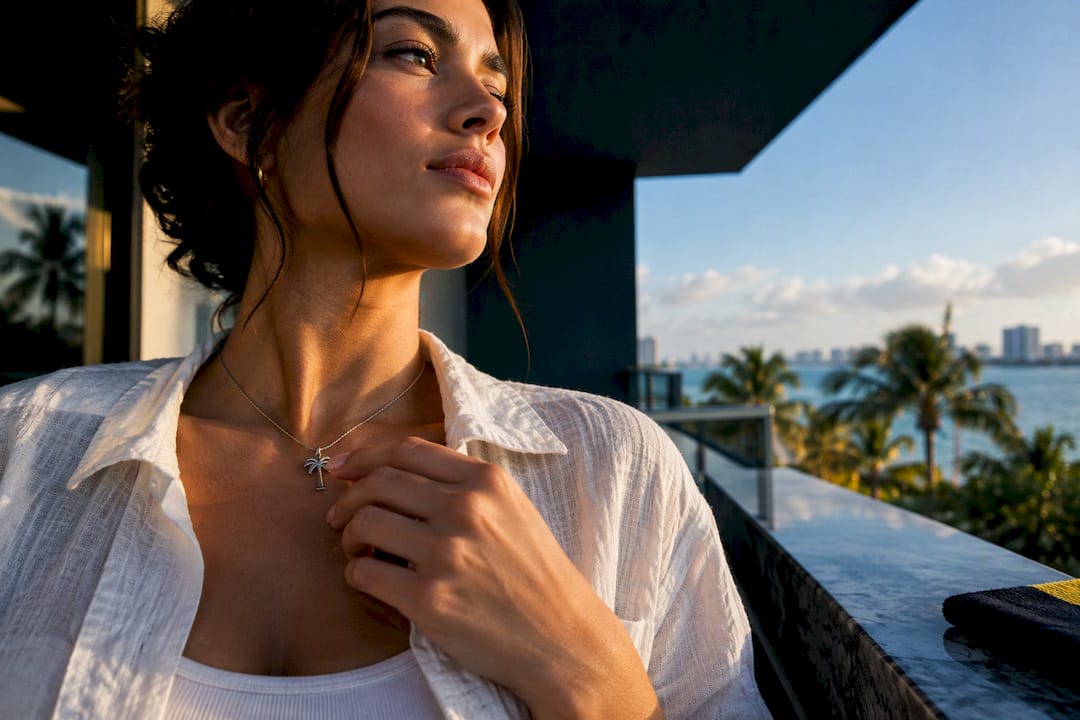
A palm tree necklace typically stands for resilience, victory, renewal, and a relaxed, paradise-tinged escape. The meaning traces back to ancient rites and religious texts, but modern coastal and travel culture reshaped it into something lighter and more personal. Brands like WYNWOOD BLVD lean into this dual history, designing palm charms that read as both a nod to old symbolism and a simple, wearable reminder of good times.
TL;DR:
- Palm necklaces symbolize resilience, victory, renewal, and leisure, with meanings that can shift based on design, motifs, and the wearer’s context.
- Historically, palms have represented eternity, triumph, and spiritual victory, rooted in ancient Egypt, Greek, Jewish, and Christian traditions.
- Modern coastal and travel culture uses palms as visual shorthand for vacation, often paired with waves, sunsets, or travel coordinates to evoke specific memories.
- Durable materials like stainless steel and PVD gold finishes suit daily wear near saltwater, while detailed pendants or motifs influence whether the piece feels personal or celebratory.
- The resilience of palms in storms physically supports their symbolic association with endurance, making them a lasting choice across trends and personal stories.
Table of Contents
- Core symbolic themes behind the palm tree motif
- A short history: Egypt, the Mediterranean, and sacred rites
- What scripture and religious tradition say about the palm
- How coastal and travel culture reads the palm today
- Silhouette, metal, and finish change the message
- Choosing or gifting a palm necklace with the right meaning
- How WYNWOOD BLVD designs meaning into its palm charms
- The psychological pull of wearing a palm pendant
- When people reach for a palm necklace
- How the palm compares to other nature-inspired jewelry
- Why the palm motif keeps outlasting trends
- Wear the meaning: WYNWOOD BLVD’s palm charm collection
- Where these meanings come from
- Sources
- FAQ
Core symbolic themes behind the palm tree motif
Four meanings show up again and again when people talk about palm tree jewelry.
- Resilience: the palm bends in storms but rarely breaks, so wearers often choose it after a hard season.
- Victory: ancient cultures carried palm branches to mark triumph, a meaning that still surfaces in graduation or achievement gifts.
- Renewal: the tree’s evergreen habit makes it a natural stand-in for fresh starts and new chapters.
- Leisure and paradise: modern use ties the palm to vacation, beach life, and an easy, unhurried mindset.
Design choices tilt the reading. A single slim palm silhouette leans quiet and personal, closer to resilience or renewal. Two palms side by side, or a palm paired with a sun or wave, shift the tone toward celebration or travel memory. A minimal, small charm often reads as a private symbol, while a larger detailed pendant reads as a statement piece meant to be noticed. For a friend starting over, the meaning leans renewal. For a graduate, it leans victory. For a beach lover, it is simply paradise on a chain.
A short history: Egypt, the Mediterranean, and sacred rites
The palm’s symbolic weight did not start with jewelry. It built up over thousands of years across several cultures.
- In ancient Egypt, the palm rib appeared in hieroglyphs as a sign for “time” and “eternal years,” linking the tree to longevity in funerary contexts.
- In the classical Mediterranean, victors carried palm branches as a victory symbol, a practice that later softened into a broader sign of peace and triumph.
- In Jewish tradition, the lulav, a palm frond bound with other branches, is waved during Sukkot as part of a harvest ritual.
- In Christianity, palm fronds mark Palm Sunday and carry associations with martyrdom and spiritual victory.
That timeline shows a steady thread: from a literal marker of time in Egypt to a public symbol of triumph in Rome and Greece, then into structured religious ritual. Every later use, including jewelry, borrows from one branch of that history.
What scripture and religious tradition say about the palm
Religious readers often want to know if there is real textual grounding, and there is. Psalm 92 draws a direct comparison between a righteous life and a flourishing palm tree.
That passage, from Psalm 92:12–15, gives the “flourishing with age” reading its scriptural footing. Palm Sunday extends the association into a specific commemorative moment, which makes a palm pendant a natural, low-key devotional piece for someone who wants a daily reminder rather than a display item. One caution: the lulav is a specific ritual object tied to Sukkot, so a pendant that closely copies that form is best gifted with context and respect rather than treated as generic decor.
How coastal and travel culture reads the palm today
Outside religious and historical contexts, the palm now works as visual shorthand for vacation. A palm emoji or a palm print on a tote bag signals the same thing instantly: warm weather, slower pace, time off. That shorthand carries directly into jewelry.
- Paired with waves, the palm reads as beach life or surf culture.
- Paired with a sunset motif, it leans romantic or nostalgic.
- Paired with coordinates or a city name, it becomes a specific travel memory rather than a general mood.
Palms often survive hurricane-force winds better than many broad-leaved trees because their growth habit lets them shed fronds while protecting the terminal bud, according to horticultural research on wind resistance. That biological detail gives the “resilience” reading an actual physical basis, not just a poetic one.
Silhouette, metal, and finish change the message
The physical design of a palm necklace shapes how the symbolism lands.
- A minimal, single-line silhouette reads as understated and personal, often chosen for the resilience or renewal meaning.
- A detailed pendant with visible fronds and trunk texture reads as a statement piece, closer to the leisure or victory meaning.
- 316L stainless steel resists tarnish and holds up well against salt air and pool chemicals, making it a practical pick for daily coastal wear.
- Sterling silver offers a softer shine but needs more upkeep near saltwater.
- PVD gold finishes hold color longer than standard plating, which matters for anyone wearing the piece daily.
- Added motifs such as a sun, wave, or small gemstone can shift a plain palm from a resilience symbol toward a travel or celebration one.
Pro Tip: Layer a minimal silver palm charm with a slightly longer gold chain instead of matching metals exactly; the contrast reads as intentional rather than mismatched.
Choosing or gifting a palm necklace with the right meaning
Picking the right piece takes a few quick decisions rather than guesswork.
- Identify the recipient type: someone celebrating a win, starting fresh, or simply loves the beach.
- Match the message to the silhouette: minimal for personal meaning, detailed or paired motifs for celebration.
- Consider durability needs: daily wearers near water should prioritize stainless steel over plated pieces.
For styling, a small palm charm on a short chain works well for casual or beach outfits, especially when paired with thoughtful presentation like the elegant Baroque Jewelry Organizer that highlights the gift’s sentimental value. For travel-focused wearers, stack it with a coordinate or compass pendant for a personal collection that tells a story. For a devotional or commemorative gift, keep the design minimal and skip added motifs that might clutter the meaning. A short gift note can help: “for the fresh start” fits renewal, “for the fighter” fits resilience, and “for the trip we won’t forget” fits a vacation memory. As noted earlier, avoid gifting a piece that closely mimics the lulav’s ritual form unless the context calls for it.
How WYNWOOD BLVD designs meaning into its palm charms
Some jewelry brands build their pieces around real places, so each palm charm carries a specific sense of place rather than a generic tropical look. Some brands favor minimalist silhouettes in stainless steel, a material choice suited to salt air and daily wear, and pair that with bold color finishes that nod to coastal visual identities.
- The Silver Classic charm uses a clean stainless steel silhouette for a quiet, everyday resilience read.
- The Gold Classic charm brings warmer tones for a more celebratory feel.
- The Gold Signature Painted charm adds color detailing for wearers who want a bolder statement.
Anyone who wants to browse the full range can view the Palm Tree Charms collection directly.
The psychological pull of wearing a palm pendant
A small, worn symbol can do quiet work on how someone feels day to day. For a person moving through a hard stretch, a palm pendant can act as a physical checkpoint, something to touch or glance at that reinforces the idea of getting through rather than giving up. That is not unusual: people commonly choose jewelry that mirrors an internal state they want to reinforce, whether that is calm, strength, or hope.
For someone marking a fresh start, a palm necklace can function less as decoration and more as a small daily cue, a reminder chosen on purpose rather than picked at random. The tree’s evergreen quality supports that use well, since it never visibly withers the way other plant symbols might.
There is also a lighter emotional register at play. For many wearers, the palm carries no weighty message at all. It simply calls up a specific memory, a trip, a beach afternoon, a season of feeling unhurried. Both uses sit comfortably side by side, and a single necklace can shift between them depending on the day and the wearer’s mood. That flexibility is part of why the motif has stayed popular across such different contexts, from religious verses to vacation photos.
When people reach for a palm necklace
Certain moments call for a palm pendant more than others. Graduations and promotions often prompt a gift built around the victory meaning, since the symbol has carried that association since antiquity. A friend’s recovery from illness or a difficult year frequently inspires a resilience-themed gift, sometimes paired with a short note referencing strength.
Trips and travel milestones are the most common everyday trigger. A palm necklace bought on a beach vacation or gifted before a big trip works as a portable souvenir, something that outlasts photos on a phone. Some wearers also choose a palm pendant around Palm Sunday or another personally significant religious date, treating it as a quiet devotional object rather than a fashion choice.

Anniversaries of a move to a coastal city, a divorce finalized, or a sobriety milestone also show up as common occasions, since each involves some version of the “renewal” meaning. None of these rituals are formal or fixed the way Sukkot’s lulav practice is. Most palm necklace traditions are personal ones that wearers build for themselves, borrowing loosely from the older symbolism without following any strict rule.
How the palm compares to other nature-inspired jewelry
Nature motifs in jewelry tend to cluster around a few recognizable meanings, and the palm sits in useful contrast to its neighbors. A lotus pendant usually signals spiritual growth or purity, drawing on its use in Buddhist and Hindu traditions, and tends to skew more overtly spiritual than the palm. A tree of life necklace represents interconnectedness and family roots, often chosen for its broad, inclusive symbolism rather than any single cultural reference. An oak leaf or acorn leans toward strength and steady growth, similar to resilience, but without the leisure association the palm carries.

The palm’s advantage is range. Few nature symbols move as easily between a serious meaning, victory or endurance, and a purely casual one, vacation and good weather, without feeling contradictory. A lotus rarely reads as “beach day,” and an oak leaf rarely reads as “trip to Miami.” That flexibility makes the palm one of the more adaptable choices for someone who wants a piece that can shift meaning depending on the outfit, the occasion, or simply the story they want to tell that day.
Why the palm motif keeps outlasting trends
Palms hold onto two ideas at once: they stay rooted through storms, yet everything about their shape suggests movement, wind, travel, light. That tension between staying grounded and staying in motion is probably why people keep reaching for the symbol, whether they are marking a hard year or a good vacation. A small pendant lets someone carry both meanings without picking just one. Readers drawn to that idea can look through WYNWOOD BLVD’s palm designs for a version that fits their own story.
— Mathias
Wear the meaning: WYNWOOD BLVD’s palm charm collection
If the resilience or victory meaning speaks to you, some palm charms are designed for daily wear rather than as one-time souvenirs. These often use stainless steel construction meant to hold up against salt air, pools, and everyday routines, so the symbol stays on rather than fading with the finish.

- Browse the Silver Classic charm for a minimal, everyday piece.
- View the full Palm Tree Charms collection to compare finishes side by side.
- Check out Miami Inspired Watches if you want a matching piece for the same coastal story.
Companies, hotels, or agencies looking for branded merchandise can explore Corporate Custom Watches for bulk and logo options.
Where these meanings come from
- Psalm 92 (NRSVUE) supports the “flourish like the palm” religious reading.
- Wind and Trees: Lessons Learned from Hurricanes supports the botanical basis for the resilience symbol.
- Palm branch history supports the victory and ritual background.
- Palm tree symbolism analysis supports the modern leisure and travel reading.
Sources
- Psalm 92 NRSVUE - Bible Gateway
- FOR118/FR173: Wind and Trees: Lessons Learned from Hurricanes (IFAS)
- Palm branch — Wikipedia
- Palm tree symbolism — Symbolora
FAQ
Is it okay to wear a Tree of Life necklace?
Yes, a Tree of Life necklace is a widely worn symbol of family, growth, and interconnectedness, and it carries no restricted religious status. It fits casual and formal settings alike and works well as a personal or gifted piece.
What does a palm tree symbolize?
A palm tree typically symbolizes resilience, victory, renewal, and, in modern use, vacation or leisure. The meaning shifts depending on context: ancient cultures leaned on victory and longevity, while contemporary readings lean toward travel and relaxation.
What does God say about palm trees?
The Bible compares the righteous to a palm tree in Psalm 92:12–15, describing flourishing, bearing fruit in old age, and staying green. Palm branches also appear in Palm Sunday accounts, tied to triumph and spiritual victory.
What do two palm trees symbolize?
Two palm trees together usually shift the meaning from personal endurance toward partnership, balance, or shared celebration, such as a couple, friendship, or a specific shared trip. The exact reading depends heavily on the design and context, since there is no single fixed rule.