Best Japanese Luxury Watch Brands: 2026 Buyer's Guide
The best Japanese luxury watch brands to know right now are:
- Grand Seiko — pinnacle of in-house finishing and Spring Drive technology
- Credor — Japan’s answer to haute horlogerie, within the Seiko Group
- Seiko Presage / King Seiko — accessible entry into high-end Japanese craft
- Citizen / The Citizen — precision quartz and mechanical excellence
- Orient Star — value-driven mechanical finishing
- Hajime Asaoka — self-taught independent master, limited to a handful of pieces per year
- Kikuchi Nakagawa — two-person atelier with 8–10 year wait times for specific pieces
- Kurono Tokyo — Asaoka-designed, more accessible price point
- Minase — architectural cases, Sallaz polishing, Swiss-sourced movements
- Masahiro Kikuno — single-digit annual production, traditional Japanese time-telling
Japanese luxury watches span from $500 Presage automatics to $50,000+ hand-finished Grand Seiko and Credor pieces, with independents driving high-end attention alongside the corporate luxury divisions.
Table of Contents
- What are the best Japanese luxury watch brands right now?
- What makes Japanese luxury watches different from Swiss?
- Brand profiles: what to expect from each maker
- How do you choose the right Japanese luxury watch?
- What should collectors know about rarity and wait times?
- Service, warranty, and resale for U.S. buyers
- Wynwoodblvd: Miami-inspired watches, in stock, with B2B options
- Key Takeaways
- Why Japanese luxury watches deserve more credit than they get
- Useful sources for further reading
What are the best Japanese luxury watch brands right now?
| Brand | Best For | Signature Tech | Price Band | U.S. Availability | Rarity |
|---|---|---|---|---|---|
| Grand Seiko | Finishing, collectors | Spring Drive | $3,000–$20,000+ | Authorized dealers, boutiques | Limited editions |
| Credor | Haute horlogerie | Hand-finishing, enamel dials | $50,000+ | Very limited U.S. boutiques | Extremely limited |
| Seiko Presage | Entry luxury, value | In-house automatics | $500–$5,000 | Wide AD network | Readily available |
| Citizen / The Citizen | Precision, daily wear | High-precision quartz | $200–$5,000+ | Wide AD network | Available |
| Orient Star | Value mechanical | In-house automatics | $200–$800 | Online and AD | Available |
| Hajime Asaoka | Collectors, independents | Hand-built movements | $30,000+ | Direct / specialist dealers | Extremely rare |
| Kikuchi Nakagawa | Serious collectors | Hand-finished, classic-inspired | $20,000+ | Waitlist only | 8–10 year wait |
| Kurono Tokyo | Design-focused buyers | Sourced movements, artisan design | $500–$1,500 | Online drops | Sells out fast |
| Minase | Architecture enthusiasts | Sallaz polishing, Swiss movements | $3,000–$8,000 | Specialist importers | Limited |
| Masahiro Kikuno | Ultra-rare collectors | Traditional Japanese techniques | $50,000+ | Direct only | Single digits/year |
What makes Japanese luxury watches different from Swiss?
Three things set premium Japanese timepieces apart: proprietary movement technology, a distinct finishing philosophy, and a production ethos rooted in Monozukuri.
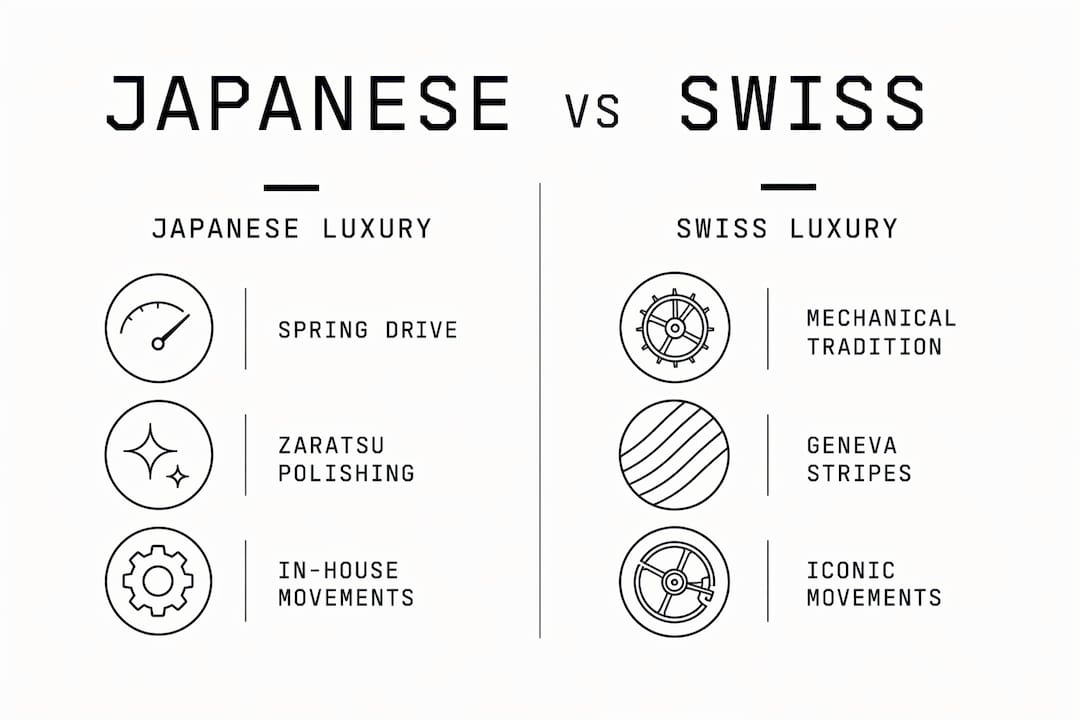
Spring Drive is the clearest technical differentiator. Developed by Seiko, it combines a mechanical mainspring with a quartz-regulated glide wheel, achieving accuracy within one second per day without a traditional escapement. No Swiss house offers an equivalent. High-beat calibers, running at 36,000 vibrations per hour, are another Japanese specialty, delivering smoother sweep and higher positional accuracy.
Zaratsu polishing (also called Sallaz polishing) produces mirror-flat case surfaces with no distortion at the edges. Industry experts note that properly executed Zaratsu is one of the most reliable indicators of high-level finishing on any Japanese watch. Swiss brands polish cases too, but the Japanese discipline for flat-surface geometry is widely considered more exacting at comparable price points.
Monozukuri is the underlying philosophy: a commitment to manual skill, iterative refinement, and perfection in craft. Collectors value it as much as technical specs because it shapes everything from dial texture to case geometry. The result is watches that reward close inspection.
- Spring Drive: mechanical energy, quartz precision, no battery
- High-beat calibers: 36,000 vph for smoother motion and accuracy
- Zaratsu polishing: flat, distortion-free mirror surfaces
- Monozukuri: craft philosophy driving finishing standards
- Dial arts: maki-e lacquer, enamel, and seasonal motifs unique to Japan
Pro Tip: To verify genuine Zaratsu polishing, hold the case under a single light source and look for perfectly flat reflections with sharp transitions between polished and brushed surfaces. Any waviness or distortion at the lug edges suggests a lower finishing standard.
Brand profiles: what to expect from each maker
Grand Seiko and Credor
Grand Seiko and Credor sit at the top of the Seiko Group’s luxury hierarchy. Grand Seiko is best known for Spring Drive movements, Zaratsu-finished cases, and dials inspired by Japanese seasons and landscapes. Prices run from roughly $3,000 for entry quartz models to well over $20,000 for limited Spring Drive editions. U.S. buyers can find Grand Seiko through an authorized dealer network and dedicated boutiques in major cities.
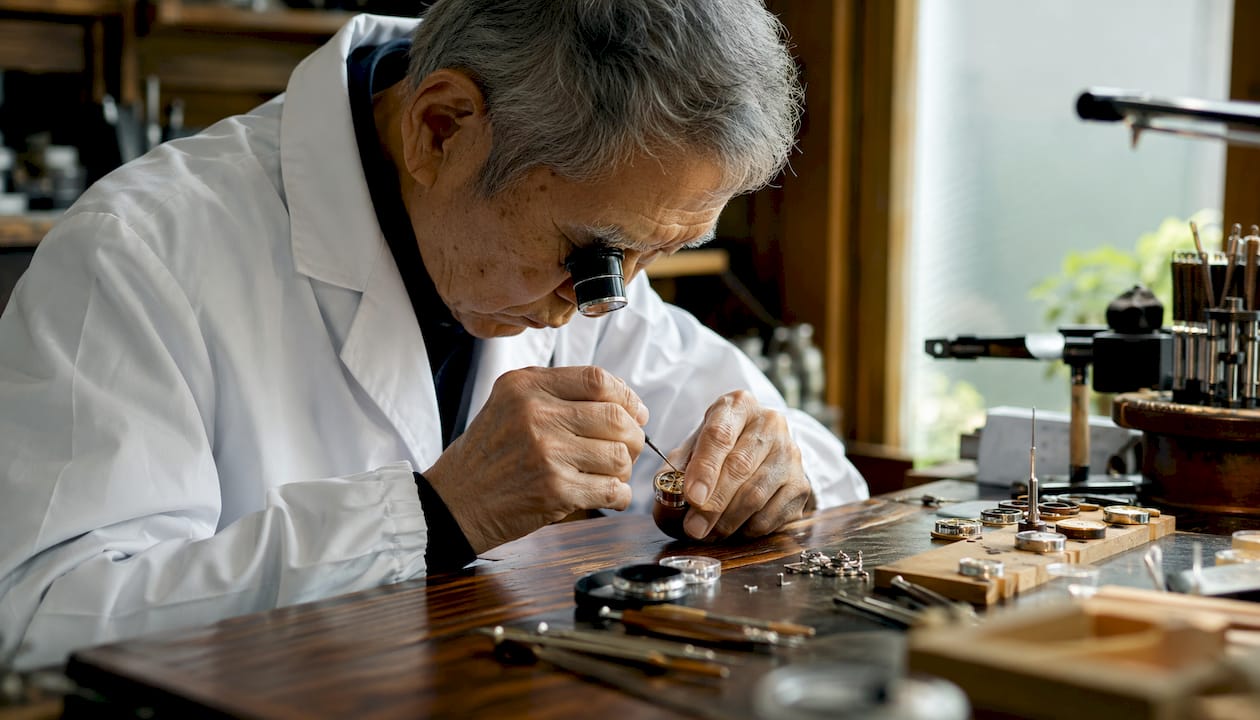
Credor goes further into haute territory. Enamel dials, hand-engraved cases, and movements assembled by a single craftsperson define the line. U.S. availability is very limited; most pieces require contact with a boutique or specialist importer.
Seiko premium lines
Seiko’s own portfolio includes Presage, King Seiko, and Astron. Presage automatics start around $500 and offer genuine in-house movements with lacquer and enamel dial options. King Seiko revives 1960s designs with modern finishing. Both are widely available through authorized dealers across the U.S.
Citizen and The Citizen
Citizen’s high-precision lines, including The Citizen collection, use proprietary eco-drive and high-accuracy quartz movements. The Citizen models target buyers who want extreme timekeeping precision in a refined dress watch. Prices range from a few hundred dollars to over $5,000 for high-end mechanical pieces developed with La Joux-Perret.
Orient and Orient Star
Orient Star uses fully in-house automatic movements at prices between $200 and $800. For buyers comparing stainless steel automatic watches at accessible price points, Orient Star delivers genuine mechanical finishing without the premium markup.
Hajime Asaoka
Self-taught from George Daniels’ Watchmaking textbook, Asaoka builds movements entirely by hand. Production is measured in a few pieces per year, and prices start above $30,000. U.S. buyers typically access his work through specialist dealers or direct contact.
Kikuchi Nakagawa
Founded by Yusuki Kikuchi and Tomonari Nakagawa, this two-person atelier produces watches inspired by Patek Philippe and Vacheron Constantin proportions but with distinctly Japanese finishing. Wait times of 8–10 years are documented for specific references. Prices start around $20,000.
Kurono Tokyo, Minase, and Masahiro Kikuno
Kurono Tokyo uses sourced movements paired with Asaoka’s design standards, keeping prices between $500 and $1,500. Drops sell out within minutes. Minase focuses on architectural case geometry and Sallaz polishing, typically using Swiss base movements, with prices from $3,000 to $8,000. Masahiro Kikuno produces a very limited number of pieces annually, incorporating Edo kiriko glass cutting and traditional Japanese seasonal time systems into mechanical showpieces priced at the higher end of the market.
How do you choose the right Japanese luxury watch?
Work through this checklist before you commit:
- Movement priority — Do you want Spring Drive, high-beat mechanical, or precision quartz? Each has different service needs.
- Finishing standard — Ask specifically whether Zaratsu polishing was applied to the case.
- Authorized dealer vs. gray market — Gray market purchases typically void the manufacturer warranty.
- Warranty coverage — Confirm the warranty is valid in the U.S. and ask for the international warranty card.
- Availability and wait time — Independent makers may require years; corporate luxury divisions ship from stock.
- Service interval — Mechanical and Spring Drive movements generally need service every 3–5 years.
- Resale potential — Limited editions and independent pieces with full paperwork hold value better.
- Dial condition and provenance — Original dials, unpolished cases, and box-and-papers sets command premiums.
Questions to ask your authorized dealer or seller:
- Is this movement fully in-house, or does it use a base caliber?
- What finishing method was applied to the case and dial?
- Is this watch covered by an international warranty valid in the United States?
- Has the case been polished since purchase?
- Is the original box and all paperwork included?
- What is the expected service interval and estimated cost?
For ultra-thin dress watches or minimalist designs, also ask whether the movement height affects water resistance ratings.
Pro Tip: B2B buyers ordering custom-branded or bulk watches should request a written lead-time commitment and minimum order quantity before signing any agreement. Japanese corporate luxury divisions and independent ateliers rarely accommodate rush orders.
What should collectors know about rarity and wait times?
The independent segment operates on a completely different timeline than corporate luxury divisions. Independent makers like Kikuchi Nakagawa and Masahiro Kikuno produce so few pieces per year that demand structurally outpaces supply regardless of price.
- Kikuchi Nakagawa: documented wait times of 8–10 years for specific references
- Masahiro Kikuno: single-digit annual production; pieces are effectively allocated before completion
- Kurono Tokyo: limited online drops that sell out within minutes after specialist media coverage
- Hajime Asaoka: no public waitlist; access typically requires established relationships with specialist dealers
A single mention in a specialist publication or a celebrity sighting can trigger sudden demand spikes and immediate sellouts for smaller ateliers. Aftermarket premiums follow quickly.
Limited-edition Grand Seiko pieces also appreciate, particularly seasonal dial references tied to specific Japanese landscapes. Full provenance, original packaging, and an unpolished case are the three factors that most consistently protect resale value across all tiers.
Service, warranty, and resale for U.S. buyers
Buy from an authorized dealer whenever possible. It is the single most important step for warranty coverage, authentic paperwork, and long-term resale value. Gray market purchases may save money upfront but typically come without a valid manufacturer warranty in the U.S.
Service intervals and options:
- Mechanical movements (Grand Seiko, Orient Star, Hajime Asaoka): service every 3–5 years
- Spring Drive: similar interval; requires a Grand Seiko authorized service center
- High-precision quartz (The Citizen): battery and regulation service as needed, less frequent mechanical service
Grand Seiko maintains authorized service centers in the U.S. For independent makers, contact the atelier directly; some accept international service requests, others do not.
Preserving resale value:
- Keep all original packaging, warranty cards, and purchase receipts
- Avoid polishing the case; original surfaces command premiums
- Use only authorized service centers and retain service records
- Store with a proper watch care routine to protect dials and movements
Pro Tip: Corporate buyers ordering serialized custom watches should document each serial number against the recipient’s name and order date. This creates a clean chain of custody for insurance, gifting records, and eventual resale or trade-in programs. Review luxury watch packaging standards before finalizing B2B orders to match presentation quality to your brand.
Wynwoodblvd: Miami-inspired watches, in stock, with B2B options
If you want a premium automatic watch now, without a multi-year waitlist, Wynwoodblvd offers a direct alternative. The brand designs stainless steel automatic watches and jewelry inspired by Miami’s coastal neighborhoods, from the Atlantic Blue automatic to the Everglades Green dial, each with a distinct story and colorway.
For corporate buyers, Wynwoodblvd’s B2B custom watch program covers logo engraving, dial customization, branded packaging, and bulk ordering for hotels, restaurants, real estate brands, agencies, and lifestyle businesses. Lead times are a fraction of what independent Japanese ateliers require. You get a design-led, Miami-identity product with the flexibility to scale for gifting or merchandise programs. Visit the B2B page to request a quote and discuss minimums for your next campaign.
Key Takeaways
Grand Seiko, Credor, and Japan’s independent ateliers set the global standard for finishing and technical innovation, but U.S. buyers must weigh availability, wait times, and warranty coverage before committing.
| Point | Details |
|---|---|
| Top brands to know | Grand Seiko, Credor, Kikuchi Nakagawa, Hajime Asaoka, and Kurono Tokyo lead the field across price tiers. |
| Independent wait times | Kikuchi Nakagawa wait times reach 8–10 years; plan well ahead for atelier pieces. |
| Buy from authorized dealers | Gray market purchases void U.S. warranty coverage; always verify dealer status before buying. |
| Finishing is the differentiator | Zaratsu polishing and Spring Drive technology are the clearest markers of genuine Japanese luxury craft. |
| Wynwoodblvd for in-stock needs | Wynwoodblvd offers Miami-inspired automatic watches and B2B custom orders with faster lead times than any Japanese independent. |
Why Japanese luxury watches deserve more credit than they get
The persistent assumption that Japanese watches are primarily mass-market quartz products is simply outdated. High-end Japanese houses now compete directly with Swiss makers on finishing quality and technical originality, and in some areas, they lead.
What strikes me most about this segment is the value discipline. A Grand Seiko at $5,000 delivers a level of case finishing that Swiss brands rarely match below $15,000. That gap exists because Japanese luxury houses treat finishing as a craft obligation, not a marketing differentiator. The Monozukuri philosophy is not a brand story. It shows up in the actual geometry of the case.
The independent scene adds another dimension entirely. Kikuchi Nakagawa and Masahiro Kikuno are not making watches for the watch market. They are making objects that happen to tell time. The 8–10 year wait for a Kikuchi Nakagawa piece is not a supply chain problem. It is the natural result of two people doing everything by hand at the highest possible standard.
For buyers who want that level of craft but need something available today, the gap between Japanese independents and accessible premium watches is real. That is exactly where brands like Wynwoodblvd fit: design-led, in-stock, and built for buyers who value identity and quality without the decade-long queue. You can also compare luxury German watch alternatives if you want a broader view of non-Swiss options.
Useful sources for further reading
- Monochrome Watches — Kikuchi Nakagawa Genmon specs, price, and availability: detailed specs and wait-time documentation for Kikuchi Nakagawa
- WatchTime — Japanese watchmaking analysis and independent spotlight: Spring Drive technical coverage, Zaratsu finishing, and independent maker profiles
- RotateWatches — 18 best Japanese watch brands: broad market overview from entry to haute horlogerie
- Teddy Baldassarre — best Japanese watch brands complete guide: accessible buyer-focused guide covering the Big Three and independents
- Montredo — top 10 Japanese watch brands: Minase and Masahiro Kikuno profiles with finishing notes
- ItalianWatchSpotter — rise of Japanese independent watchmakers: demand dynamics, media-driven sellouts, and aftermarket behavior
- Chrono24 Magazine — the wonderful world of Japanese watch brands: brand-by-brand overview including Kurono Tokyo and Hajime Asaoka